

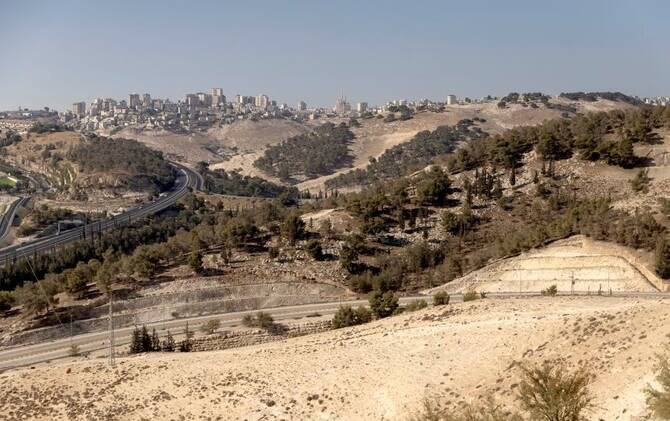
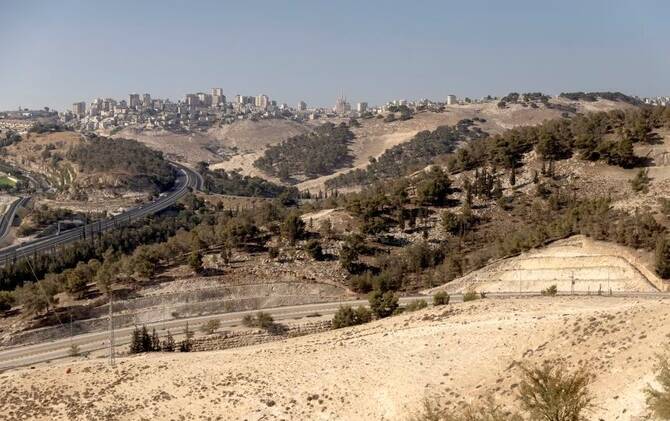
CAIRO: Arab League Secretary-General Nabil Fahmy on Thursday condemned Israel’s move to advance the E1 settlement project in the occupied West Bank, warning that it would divide Palestinian territory and further isolate East Jerusalem from its Palestinian surroundings.
Fahmy also condemned recent Israeli strikes on Syria and Lebanon, accusing Israel of repeatedly violating international law and the sovereignty of states in the region.
He cited UN Security Council Resolution 2334 of 2016, which declared Israeli settlements in territory occupied since 1967, including East Jerusalem, to have “no legal validity.”
The resolution condemned measures aimed at altering the demographic composition, character and status of the occupied Palestinian territories, including settlement construction and expansion, the transfer of Israeli settlers, land confiscations, home demolitions and the displacement of Palestinian civilians.
Fahmy called on the UN Security Council to take clear action against continued Israeli settlement activity.
He accused Israel of acting as a “rogue state,” disregarding international law and repeatedly violating the sovereignty and territorial integrity of other countries in the absence of effective international deterrence or sanctions.
The Arab League chief warned that continued international silence and the absence of punitive measures were encouraging Israel to press ahead with settlement expansion.
Fahmy had also condemned an Israeli strike on the Abu Al-Duhur military airbase in Syria’s Idlib governorate in the early hours of Aug. 18, describing it as a “flagrant violation” of Syrian sovereignty and international law.
He said the attack represented another act of aggression in a series of repeated Israeli strikes against Syria and elsewhere in the region.
Egypt’s Ministry of Foreign Affairs also condemned the E1 project on Thursday, saying it would undermine the contiguity of Palestinian territories and threaten the prospects of establishing an independent and viable Palestinian state.
In an official statement, the ministry described the project as a blatant violation of international law and relevant international resolutions.
Egypt called on the international community to assume its responsibilities and take serious steps to halt such violations.
It also highlighted Cairo’s support for the establishment of an independent Palestinian state along the June 4, 1967 borders, with East Jerusalem as its capital.
Former Egyptian Foreign Minister Mohamed El-Orabi told Arab News that Israel’s settlement policy violated international humanitarian law and contradicted UN Security Council resolutions.
He said the E1 project was intended to divide the occupied West Bank and accused Israel of disregarding objections from numerous countries to continued settlement expansion.
El-Orabi called for international action during the UN General Assembly in September, saying the gathering offered an opportunity for countries to consider sanctions against Israel over its actions.
Former Egyptian Assistant Foreign Minister Salah Halima also called for a stronger international response.
Halima told Arab News that Israeli settlement activity amounted to “international terrorism” and accused Israel of disregarding international law and Security Council resolutions.
He said Israel’s actions reflected a continuing policy of settlement expansion in the region.
“There must be a strong international stance against these ongoing violations,” Halima said, arguing that Israel was undermining prospects for a political solution and obstructing the road map for peace.


