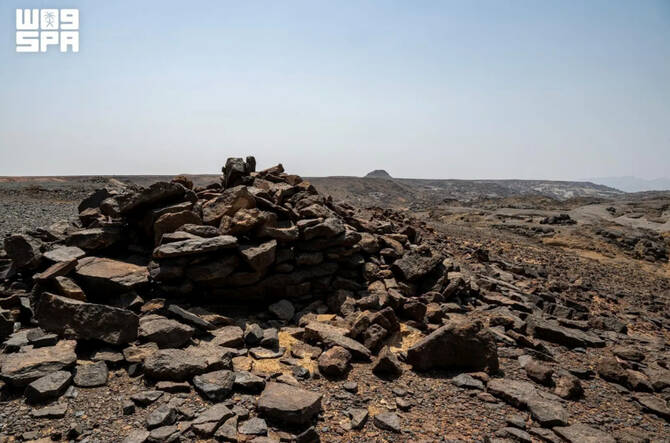


NAJRAN: The Saudi Heritage Commission has highlighted Shoaib Dahdah archaeological site in Najran region as vital evidence of early human settlement and migration in southern Arabia, featuring Lower Paleolithic stone tools dating back between 1.2 and 1.8 million years.
Discovered during a 1980 survey on elevated gravel terraces overlooking the valley, the site yielded a systematic sample of 34 Oldowan stone tools made from hard, malleable quartzite.
The artifacts include pebble cutters, polyhedrals, scrapers, blades and hammers used for cutting meat, breaking bones and skinning hides.
Ajab Alotaibi, director general of the antiquities sector at the commission, said that the site provided critical scientific insights into the chronology of early human presence in the Arabian Peninsula, underscoring efforts to document, protect and study prehistoric sites.
Connected to the Wadi Najran on the eastern slopes of the Sarawat Mountains, the site offered water, toolmaking materials, and abundant flora and fauna during the wet, river-fed Pleistocene era.