
MANILA: Malou Elsa Bacay used to leave Manila every week to visit her mother in the province, but since the Iran war dealt a blow to the Philippine economy, such trips can take place only once a month.
The Philippines is highly dependent on imported fuel, so disruption to supplies from Gulf countries and shipping through the Strait of Hormuz quickly affected domestic prices. In March, days after the beginning of US-Israeli attacks on Iran and Tehran’s retaliatory strikes on US bases in the region, the Philippine government declared a national energy emergency.
With fuel prices directly linked to the cost of transportation, agriculture, manufacturing, and distribution, consumer goods have also grown more expensive.
“You start comparing prices — for example, at the mall versus a shopping center or a traditional market ... I’m looking for cheaper options,” Bacay, a 46-year-old professional working at a publishing company, told Arab News.
“Even when buying clothes. Before, I preferred buying clothes at the mall, but now I find it cheaper to buy them online. I’ve also switched to different brands, usually the more affordable ones.”
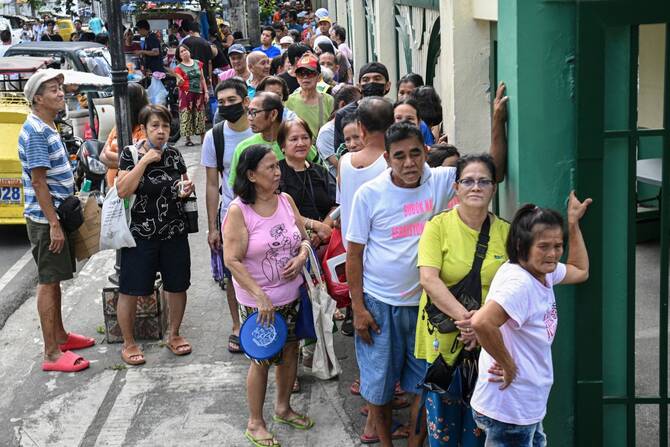
A recent survey shows that most Filipinos are tightening their belts to handle the impact of higher prices linked to the Iran war, with the share of households classified as “struggling” nearly tripling since the conflict broke out.
The Shopperscope 2026, released at the weekend by market research company Worldpanel by Numerator, examines how Filipinos are coping with global uncertainty. The report compares two periods — before the conflict and after it began — as households face rising pressures and make increasingly difficult choices about their spending.
During the period before the conflict, between February and March, 49 percent of the 1,100 respondents contacted said their household’s financial outlook for the next 12 months “will stay the same.” By May-June, four months into the war, that figure had fallen to 34 percent.
Before the conflict, those who said their situation “will somewhat worsen” accounted for around 4 percent. Currently, those who say it “will somewhat worsen” and “will greatly worsen” account for 31 percent.
The share of those fearing that the whole country’s economic outlook will be worse has increased from less than 10 percent to 40 percent.
From grocery prices to geopolitical fears, many families say that their worries have intensified.
Before the conflict, about 9 percent of Filipino families were classified by researchers as “struggling,” meaning they were regularly short on money. With the onset of the war, that share has risen to 25 percent.
At the same time, the share of families classified as “comfortable” and enjoying a financial buffer has fallen from 16 percent to 8 percent.
With higher prices and increasing inflation due to the war, the purchasing power of households, businesses, and industries has dropped, forcing them to cut down on consumption and spending, including on hiring people.
“The poorest of the poor have greater adverse effects and are more vulnerable due to limited financial resources, thereby making them worse off financially, (and) also more vulnerable to cost-cutting measures and job losses,” Michael Ricafort, chief economist at the Rizal Commercial Banking Corporation, told Arab News.
“The Philippines is more prone to geopolitical risks in the Middle East and the resulting increase in world oil prices and overall inflation, as it imports almost all of its fuel requirements.”
He also raised concerns about job losses among overseas Filipino workers, more than a million of whom live and work in Gulf countries, and the expected arrival of El Nino this year, which will result in an increased risk of droughts, which can severely hurt local crops.
“That could lead to higher food prices and overall inflation,” he said.
“All of this erodes the purchasing power and reduces consumption, spending, which accounts for about 70 percent of the economy. That, in turn, slows down GDP growth.”