

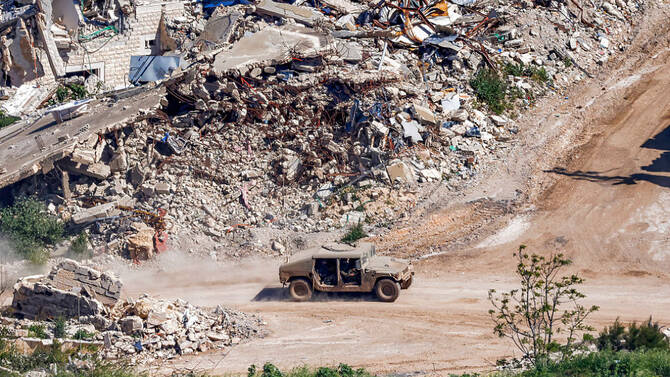

BEIRUT: Lebanon has received no Israeli response to proposals submitted during the latest round of direct negotiations in Rome, a Lebanese official source said, as Israel expands military roads and defensive positions in areas of southern Lebanon under its control.
The source, who is close to the Lebanese negotiating delegation, ruled out an imminent eighth round of talks, saying Israel appeared to be “playing for time” ahead of its elections.
“Lebanon has not received any Israeli response to the demands and proposals it submitted during the seventh round of the Rome negotiations held last week under US sponsorship,” the source said.
“Israel does not appear to be interested in doing so in the near term.”
The source also said US Central Command chief Adm. Brad Cooper had postponed a planned visit to Lebanon this week and would travel instead to Saudi Arabia.
“Lebanon does not appear to be a priority on the US agenda at the moment,” the source added.
Israeli public broadcaster Kan said mediators were trying to narrow differences and arrange another round of talks next month.
It attributed the delay to tensions between the two sides, claiming Lebanon was reluctant to resume negotiations because Israel had not expanded the areas from which it was withdrawing.
Israel, meanwhile, has complained to Washington about the Lebanese Army’s activities and accused it of coordinating with Hezbollah.
Lebanese officials reject that accusation.
The stalled diplomatic track comes as Israeli military activity continues to impede implementation of arrangements in southern Lebanon.
The Lebanese Army has been unable to complete its deployment in Zawtar Al-Gharbiyah in the Nabatieh district, the first pilot area under the initial phase of a framework agreement being implemented through a mechanism agreed in Rome.
Deployment began there on July 21.
However, Israeli forces continue to carry out explosions in neighboring Zawtar Al-Sharqiyah and have opened fire toward Lebanese Army units when they move deeper into areas close to the Israeli-held town.
Zawtar Al-Gharbiyah, which covers about 4 sq. km, is one of three towns selected for the first pilot zone under the US-backed framework.
Retired Lebanese Army Brig. Gen. Khalil Gemayel, a former commander of the South Litani Sector, told Arab News that Lebanon used the latest Rome talks to propose larger Israeli withdrawals from Bint Jbeil and Khiam.
The aim, he said, was to accelerate both the withdrawal of Israeli forces and the deployment of the Lebanese Army.
“If withdrawals are carried out only in small increments, clearing southern Lebanon of the Israeli military will take months, perhaps years,” Gemayel said.
He said military information indicated that Israel had established a major command center in Khiam and was constructing military roads, while remaining reluctant to withdraw from Bint Jbeil because of its symbolic importance to Hezbollah.
Gemayel said the Lebanese Army was capable of assuming control south of the Litani River and rejected Israeli claims that it coordinated with Hezbollah.
“The Lebanese Army does not coordinate with Hezbollah,” he said.
He added that the army had previously dismantled about 200 Hezbollah military facilities and sealed tunnels it had discovered, while working within legal restrictions governing searches of private property.
“The problem is not the army’s ability to deploy, despite its need for support,” Gemayel said. “The problem lies in the mechanism for monitoring implementation of the pilot zones and giving this experiment a genuine chance to succeed.”
He said Lebanese troops had been instructed to arrest anyone openly carrying weapons and could conduct raids, although searches of private property generally required judicial authorization.
In the pilot areas, he said, Lebanese troops were facilitating the return of unarmed residents, but continuing Israeli explosions and gunfire were making it difficult for families to remain.
“How can families be expected to settle amid this constant fear and intimidation?” Gemayel said.
The mayor of Zawtar Al-Gharbiyah, Abdul Ezzeddine, said recently that an Israeli drone entered the municipal building and instructed those inside to open its doors for inspection before moving to the town square to monitor rubble-clearing work.
Gemayel said some Hezbollah facilities discovered by the Lebanese Army were embedded within civilian properties and connected between residential buildings.
He said searches could be conducted when an offense was witnessed, under judicial authorization or during a state of emergency declared under Lebanon’s Defense Law.
The latter would require a government decision issued by decree.
The developments have fueled concern in Beirut that negotiations intended to halt military operations, secure Israeli withdrawals and allow displaced residents to return are instead continuing alongside Israeli activity on the ground without restraining it.
As delegations negotiate maps and withdrawal arrangements, Israeli forces continue bulldozing, demolishing structures and establishing positions in the south.
A Lebanese official source said Beirut nevertheless remained committed to negotiations.
“Pulling out of the talks could be more dangerous because it would leave the outcome to be decided on the battlefield,” the source said.
The source accused Israel of placing increasing pressure on a Lebanese state that had chosen diplomacy as its alternative to renewed war.
“Hezbollah rejects negotiations entirely and offers no alternative,” the source said.
The official also cited statements by Israeli politicians and incidents involving extremist Israeli activists crossing into Lebanese territory as factors that had increased concerns in Lebanon about Israel’s long-term intentions.
Those fears intensified after the Israeli Foreign Ministry published a regional map accompanying data on child malnutrition that appeared to incorporate areas of Lebanese territory either occupied by Israeli forces or under Israeli fire control.
The map triggered condemnation in Lebanon and diplomatic contacts with Washington.
Israel later removed it from its official English-language account, although it remained visible on the Arabic-language account.
The Lebanese source described the episode as an attempt to “provoke Lebanon and distract it from the fundamental issue — the fate of the occupied areas.”
Strategic hills under pressure
Israeli military operations are also concentrated around the Ali Al-Taher hills in the Nabatieh district, which rise to about 600 meters and overlook Nabatieh, surrounding villages and areas toward Jezzine.
Gemayel said the ceasefire announced in June prevented Israeli forces from completing an advance onto the hills, which Lebanese military assessments suspect may contain significant Hezbollah infrastructure.
The hills were among the last positions Israeli forces withdrew from when they left southern Lebanon in 2000.
Gemayel said fighting around nearby Kfar Tebnit had exposed what appeared to be an extensive tunnel network and demonstrated the potential cost of attempting to seize the elevations.
“The Israeli Army controls the rear slopes of the hills through robots and loitering drones that it has moved onto the central hill, known as Al-Dabsha,” he said.
“It is building roads and fortifications but has not yet reached the tunnels.”
He said Israeli forces were also burning woodland across the hills.
Gemayel said unverified information had circulated suggesting robots had been sent into tunnels, but stressed that details remained unclear.
He also pointed to Israeli military construction elsewhere in the occupied area as evidence of possible longer-term entrenchment.
According to Gemayel, Israeli forces are extending roads and building defensive positions, including along a route running from the Taybeh border area toward Yohmor in the Western Bekaa and in the direction of Beaufort Castle, potentially providing access toward areas north of the Litani.
He said more than 20 excavators and bulldozers had been observed operating across difficult rocky terrain.
“Anyone undertaking construction of this scale is signaling that they intend to remain in the area and do not want to withdraw,” Gemayel said.
He also pointed to Mansouri, a coastal town in the western sector about 12 km from the border and 7 km from Tyre.
Gemayel said the ceasefire prevented an Israeli occupation of the town, but Israel subsequently placed it within what it describes as a “yellow zone” and exercises fire control over the area.
The Lebanese Army had previously facilitated the return of about 50 families because the town itself was not occupied, he said, but they were later forced to leave again following Israeli evacuation warnings.
For Lebanon, the increasingly visible gap between diplomatic negotiations and developments on the ground is becoming the central concern.
Beirut entered the Rome process seeking a mechanism that would halt attacks, facilitate Israeli withdrawals and enable the return of residents and reconstruction.
With another round now uncertain, Lebanese officials fear that time is working against that objective — allowing military realities on the ground to harden while negotiations remain suspended.


