


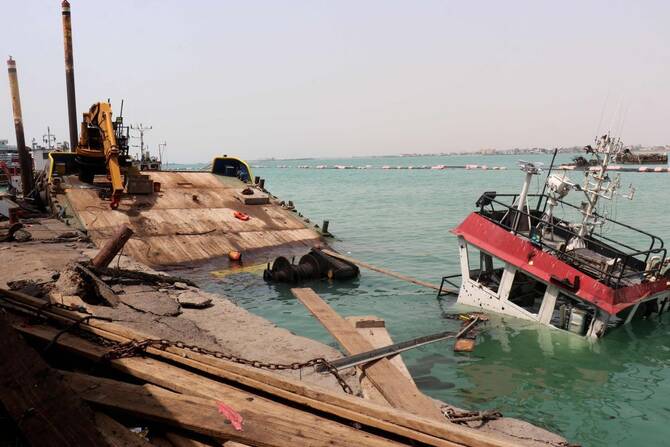

AL-MUKALLA: At least two Yemeni government soldiers were killed in southern Yemen as the Houthis launched a new wave of drone attacks on government-controlled areas in Aden, Mocha and Shabwa.
The escalation came as the Yemeni army vowed on Monday to respond to Houthi drone and missile strikes on the Red Sea port city of Mocha that killed seven people and wounded 30 others.
A Houthi drone struck a position belonging to the Shabwa Defense Forces in Najd Margad, near the border with Marib, killing two soldiers and wounding several others, according to local media and social media posts by friends of the victims.
Gunfire was also heard across the southern port city of Aden, the seat of Yemen’s internationally recognized government, as air defenses opened fire on drones hovering over what local security forces described as “vital facilities.”
Opinion
This section contains relevant reference points, placed in (Opinion field)
In Mocha, local government forces on Sunday night urged residents to remain indoors as air defenses confronted another wave of Houthi drones targeting the city.
Seven Yemenis — four soldiers and three civilians — were killed when Houthi drones and missiles struck several locations in Mocha, including the city’s seaport.
The renewed attacks followed strikes by Yemeni government forces on Houthi positions in Marib and Shabwa earlier on Monday, shortly after the army pledged retaliation for the deadly assault on Mocha.
“Army forces launched a strong artillery attack targeting enemy command and control centers, drone launch sites and missile platforms in Shabwa and Marib,” a military official in Marib told Arab News by telephone.
Yemeni army spokesman Col. Majed Al-Nuzaili said the Houthi strikes on Mocha hit accommodation used by seaport workers and their families, as well as power stations, civilian sites and military facilities.
He vowed that government forces would continue military operations against the Houthis.
“The armed forces will continue to perform their duties with high efficiency on all fronts, and will continue the national battle until its goals are achieved — ending the threat posed by the terrorist Houthi militia and its Iranian project, and restoring the security and stability of Yemen and its institutions,” Al-Nuzaili was quoted as saying by the official SABA news agency.
Meanwhile, Abdul Malik Al-Shara’bi, director of Mocha seaport, told Arab News that repair work had begun on damaged facilities in an effort to restore operations.
“We are carrying out maintenance on some of the damaged facilities using the resources available,” he said.
Political analysts said that despite the exchange of attacks and increasingly confrontational rhetoric, neither the Iran-backed Houthis nor the internationally recognized government appeared eager to enter a large-scale ground war.
Maged Al-Madhaj, chairperson of the Sana’a Center for Strategic Studies, linked the Houthis’ latest escalation partly to what he described as “Tehran’s needs” in its wider confrontation with regional adversaries.
He said the attacks were also intended to deter the Yemeni government from launching a major ground offensive against Houthi-held areas.
“The Houthis prefer to escalate through missiles and drones. A full-scale war worries them,” Al-Madhaj told Arab News.
He said repeated attacks on government forces were designed to spread fear among troops, weaken their willingness to fight and demonstrate the Houthis’ military capabilities.
“These attacks are pre-emptive. They are intended to create panic among government forces, break their will to fight and, at the same time, serve as a large and public show of force,” he said.
Al-Madhaj said government forces had also increasingly incorporated drones into their combat strategy, narrowing an advantage previously held by the Houthis.
“Government forces have incorporated drones into their combat strategy, thus eliminating the Houthis’ most significant advantage, leaving them with only missiles,” he said.
For now, he said, the Yemeni government appeared to be pursuing a strategy of containment rather than escalation, responding to Houthi attacks while avoiding a wider ground offensive unless regional conditions change.
“Government forces are inclined toward a defensive and containment approach until the regional environment changes to allow for a large-scale ground offensive, or if the Houthis decide to launch a ground campaign,” Al-Madhaj said.


