

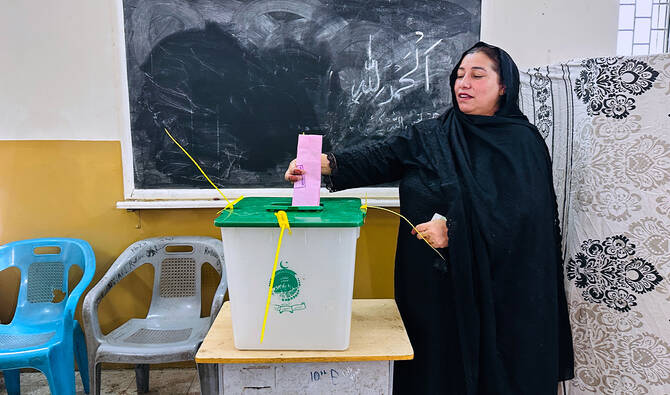

ISLAMABAD: Pakistan’s ruling party expects to form the next government in Azad Kashmir with around a two-thirds majority, a senior adviser to Prime Minister Shehbaz Sharif said on Monday, as voting continued in four constituencies after authorities postponed polls in seven others over security concerns.
Pakistan and India each administer part of the disputed Himalayan region but claim it in full. Elections are being held for the 53-member Azad Jammu and Kashmir Legislative Assembly after a campaign overshadowed by weeks of deadly unrest, a boycott campaign by the banned Joint Awami Action Committee (JAAC) and allegations of electoral manipulation by opposition parties.
Sharif’s Pakistan Muslim League-Nawaz (PML-N) has already won 24 of the 34 constituencies decided in the first two phases, putting it on course to return to power in the region after a decade. Monday had been scheduled to conclude the three-stage election, but voting in seven of the 11 remaining constituencies was postponed after election authorities cited the law-and-order situation.
“Pakistan Muslim League Noon will form a government with a majority, in fact, with a roundabout two-thirds majority in Azad Kashmir,” Rana Sanaullah, the prime minister’s adviser on political affairs and a senior PML-N leader, told reporters.
Sanaullah said the government and security agencies had ensured a fair election and rejected accusations of rigging by the Pakistan Peoples Party (PPP), which supports the PML-N-led federal government but is one of its principal rivals in the Kashmir vote.
“I believe that the government of Azad Kashmir, with the support of the federal government and the law enforcing agencies, has established a transparent and fair election,” Sanaullah said.
“The people of Azad Kashmir have expressed their mandate. Accordingly, the assembly will be held there. After that, the governance will be implemented.”
The PPP renewed its allegations of electoral manipulation on Monday, saying it had documented irregularities before, during and after polling and submitted complaints to election authorities over delayed voting, blocked access to polling stations and alleged interference with ballot materials.
“We want to be on record, that we have pre-polled, election day rigging, and post-poll rigging. We have registered hundreds of complaints, about all the rigging,” PPP leader Palwasha Khan told reporters.
Fellow PPP leader Shehla Raza said the party had submitted dozens of complaints during Monday’s voting, citing alleged irregularities at polling stations in Bagh and Haveli. The allegations could not immediately be independently verified.
Sanaullah said the PPP had failed to provide evidence for its claims and argued that unusually high turnout at some polling stations reflected the strong family and community networks in the mountainous territory rather than electoral manipulation.
The dispute is politically significant because the PPP is a key ally of Sharif’s government at the federal level, even as the two parties compete against each other in Azad Kashmir.
The election has unfolded against a broader crisis in the region.
Weeks of protests led by the banned civil rights group JAAC have resulted in deadly clashes with security forces, road closures and Internet disruptions. The movement opposes, among other issues, the constitutional allocation of 12 of the assembly’s 45 directly elected seats to constituencies representing people designated as refugees from Indian-administered Kashmir, many of whom live elsewhere in Pakistan.
JAAC says the arrangement gives Islamabad excessive influence over regional politics and has demanded that the refugee constituencies be abolished. The regional government says the seats are constitutionally protected and cannot be removed without a constitutional amendment.
The Jammu Kashmir Human Rights Observatory, a rights monitoring group, said last week it had verified 89 civilian deaths linked to unrest between June 5 and Aug. 5. Authorities in Azad Kashmir have disputed allegations that security forces were responsible for protesters’ deaths and have accused JAAC supporters of attacking law enforcement personnel and attempting to disrupt the electoral process.
The regional government banned JAAC in June. The movement has called for a boycott of the election and says it is campaigning for broader political and economic reforms.
Voting was underway on Monday in three constituencies in Bagh district and one in Haveli under heightened security. Election officials have not announced when polling in the seven postponed constituencies will take place, meaning the electoral process will continue beyond Monday.


