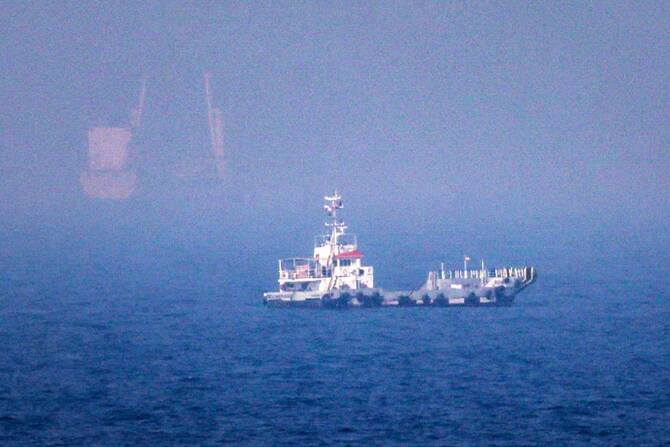

DUBAI: The UAE on Saturday said Iran had targeted an Abu Dhabi National Oil Company tanker with a missile while it was transiting the Strait of Hormuz.
The foreign ministry “strongly condemned and denounced the hostile Iranian attack,” which it said did not cause any injuries.
“This attack constitutes a flagrant violation of Security Council Resolution 2817, which ensures freedom of navigation and rejects targeting commercial vessels or disrupting international maritime route,” the ministry said.
“Targeting commercial shipping and using the Strait of Hormuz as a tool of economic coercion or blackmail represents acts of piracy by Iran’s Revolutionary Guard Corps, and constitutes a direct threat to the stability of the region, its peoples, and global energy security,” the statement added.
Tehran has reduced shipping through one of the world’s major energy transit routes to a trickle since the US and Israel launched attacks against Iran on Feb. 28.
Dozens of ships trying to pass through the strait have been attacked by Iranian forces, killing and injuring crew members.
The US has also enforced a blockade of Iranian ports and targeted ships it accused of trying to breach the embargo.
On Friday, ADNOC said 15 of its vessels had been attacked in the Strait of Hormuz since the war started, “including three vessels this week alone.”
The United Kingdom Maritime Trade Operations (UKMTO) said on Saturday that a ship was hit by a projectile off Oman in the Strait of Hormuz, causing a fire that was extinguished but no casualties.
It was unclear whether or not they were referring to the same ADNOC ship, AFP reported.
The attack comes as the US and Iran move closer to a deal to reopen the strait, although uncertainty remains over the terms of the agreement.
In its statement, the UAE foreign ministry called for the “complete and unconditional reopening of the Strait of Hormuz” to safeguard regional security, and maintain the stability of the global economy and trade.
Saudi Arabia also condemned the targeting of the ADNOC tanker.
“These rejected attacks are an assault on the security and safety of maritime navigation, and on the security of global energy supplies,” the Kingdom’s foreign ministry said.