

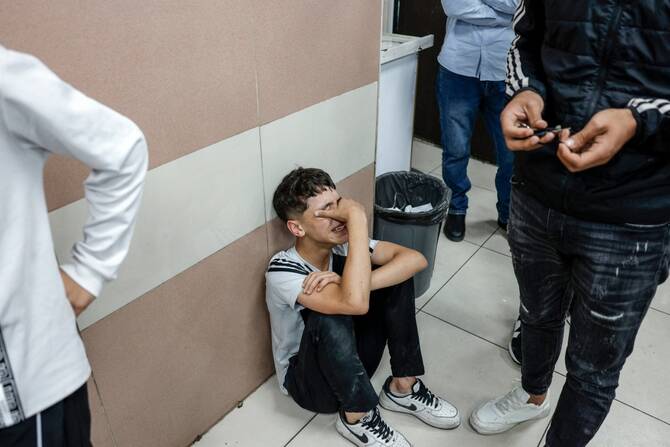

LONDON: Sujood, 29, a mother of two young children, suffered cardiac arrest in late July as an ambulance rushed her to a hospital in Ramallah. On the outskirts of her hometown of Sinjil, the ambulance encountered a closed Israeli army gate guarded by soldiers.
Her husband pleaded for help and the troops were informed of the emergency situation, but the gate remained closed for about 30 minutes, according to local reports. Faroun was dead by the time she reached the hospital.
Weeks earlier, a 4-month-old boy, Ahmad, reportedly died in Deir Ammar, west of Ramallah, after Israeli forces blocked an ambulance from reaching him.
Humanitarian and rights groups say deaths such as these reflect a broader deterioration in healthcare across the occupied West Bank, where checkpoints, road closures, settler violence and the financial crisis affecting the Palestinian Authority are limiting access to treatment and placing strain on hospitals and clinics.

Since the start of the Gaza war in October 2023, violence has escalated in the West Bank, which Israel has occupied since 1967. (AFP)
Diana Mardi, a field researcher for the Israeli group Bimkom — Planning and Human Rights, described the situation as “truly catastrophic.” Gates installed at the entrances to Palestinian villages have caused repeated delays for patients, she said, and closures are often imposed without a clear security justification, sometimes after requests from settlers.
“In the case of Sinjil, the army closed the main gate to the village, the gate through which ambulances enter,” Mardi told Arab News.
Between January and June, the World Health Organization documented 50 cases of delayed medical care in the West Bank.
The UN Office for the Coordination of Humanitarian Affairs said expanded checkpoint and road closures in Nablus governorate, following a deadly clash between Israelis and Palestinians on July 24 in the village of Tell, have significantly impeded access to healthcare, including delays to ambulances.
Medical personnel and their vehicles also face attacks by settlers, Mardi said. A video that circulated on social media in early June appeared to show Israeli settlers blocking a Palestinian ambulance on the Nablus-Ramallah road as it reportedly transported a critically ill patient. Such incidents are particularly common in villages close to or bordering settlements, Mardi added.

Israeli security forces patrol along a busy street in the Qalandia refugee camp, south of Ramallah, on August 5, 2026. (AFP)
The access restrictions coincide with growing financial pressure on the Palestinian health sector. Physicians for Human Rights Israel said on Thursday that the continuing withholding by Israel of tax revenues collected on behalf the Palestinian Authority was pushing hospitals and clinics toward collapse.
The organization said 447 of the Palestinian Health Ministry’s 590 facilities had sharply reduced their operations, with many opening only once or twice a week.
Dr. Zaher Sahloul, president and CEO of medical aid group MedGlobal, warned on Thursday that the healthcare system in the West Bank was being pushed toward a Gaza-like collapse, not as a result of airstrikes but through financial pressures and restrictions on movement.
Patients in the West Bank with complex medical needs also now struggle to obtain referrals for treatment in Israel, Mardi said. Before the war in Gaza began in October 2023, the Palestinian Authority referred patients who required specialized care, including cancer treatment and complex surgeries, to Israeli hospitals. Such referrals have largely halted because the authority can no longer cover the costs, Mardi explained. Some patients are also unable to obtain permits to travel for treatment amid the deteriorating security situation.

Salah Haj Yahya, director of PHRI's mobile clinics, says no NGO can replace a functioning public healthcare system. (Supplied)
As public facilities in the West Bank increasingly run short of medicines and staff, more patients are seeking care from mobile clinics run by Physicians for Human Rights Israel, the organization said.
“Every week we visit a different community, and every week we hear the same story,” said Salah Haj Yahya, its director of mobile clinics: local Health Ministry clinics are still open in many communities but the doctors might be available for only a few hours each week, if at all.
Essential medicines are running out, people with chronic illnesses are missing regular treatments, and families that once paid for private care can no longer afford it, Haj Yahya told Arab News.
“Over the past few months, we’ve seen a sharp rise in the number of patients coming to our mobile clinics,” he said. “The demand keeps growing, and at every medical day people travel from villages across the region despite checkpoints, closures and long delays on the roads.”
The organization’s mobile clinics continue to operate twice a week “because the need has never been greater,” Haj Yahya said. However, although the clinics play an important role they “cannot replace a functioning public healthcare system,” he added. “No humanitarian organization has the capacity to fill that gap.”

Palestinians wait at PHRI's mobile clinic in Iktaba, on the outskirts of Tulkarem in the Israeli-occupied West Bank, on August 4, 2026. (AFP)
Checkpoints and closures also delay the mobile medical teams for hours as they attempt to reach communities that need their help, he said. Settler violence compounds the problem, and its effects extend beyond individual attacks.
“Fear, displacement, restrictions on movement and the loss of livelihoods all make it even harder for people to access healthcare,” Haj Yahya said.
Mardi said Palestinian Authority hospitals have long faced serious shortcomings, even before the current war and financial crisis. Major public health facilities, including Ramallah Hospital and Rafidia Hospital in Nablus, are located in urban centers that can be difficult for patients in outlying areas to reach when roads are closed.
The situation has also deteriorated at hospitals affiliated with the UN Relief and Works Agency for Palestine Refugees. It historically provided healthcare for many registered refugees but Israeli measures targeting the agency’s operations have further disrupted care, rights groups say.
“Unless the underlying causes of this crisis are addressed, humanitarian organizations will continue treating the symptoms while the healthcare system itself continues to unravel,” Haj Yahya warned.


