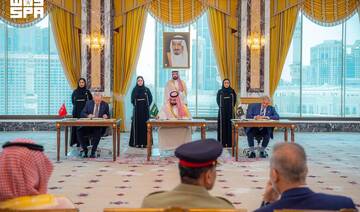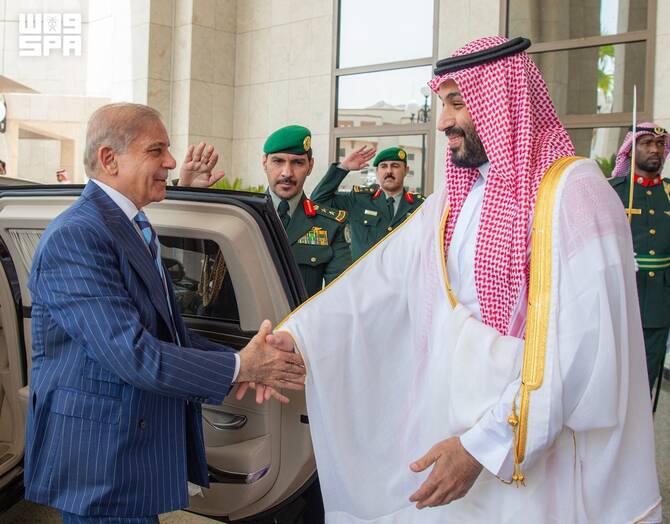
ISLAMABAD: As Prime Minister Shehbaz Sharif arrived in Jeddah on Thursday, leading a high-powered delegation comprising federal ministers and Chief of Defense Forces Field Marshal Syed Asim Munir, foreign affairs and defense experts said that the visit is expected to enhance defense and security cooperation between the two nations.
Sharif arrived in the Kingdom on Thursday, where he is scheduled to meet Saudi Crown Prince Mohammed bin Salman during his three-day visit to Saudi Arabia.
The visit takes place amid regional tensions, with US President Donald Trump calling off planned strikes against Iran on Sunday.

As per international media reports, the region remains on edge, with Iran warning Gulf nations explicitly that Tehran will hit their oil, power and water plants unless they convince Trump to end US strikes on Iran and seek a negotiated end to the war.
Pakistan enjoys cordial relations with Saudi Arabia, Iran, the US and other Gulf countries. It is due to this role that it has been accepted as one of the most prominent mediators between the US and Iran.
Pakistan hosted the first round of talks between both sides in April this year and was the official mediator that helped sign the Islamabad Memorandum of Understanding in June.
Pakistan’s foreign office spokesperson Tahir Andrabi said on Thursday that the visit marks the country’s longstanding partnership with Saudi Arabia anchored in decades of mutual trust, cooperation and brotherhood.
He said though the visit takes place amid the backdrop of heightened tensions in the Gulf, it will carry “immense significance” beyond the crisis and short-term considerations.
“It will further strengthen bilateral relations, deepen strategic cooperation, enhance coordination on regional and international issues of mutual interest and also reinforce multilateral cooperation,” he added.
Amjad Sher Ali, a former Pakistani ambassador to the UAE, told Arab News that several Middle Eastern nations have realized that the US cannot guarantee “complete regional security” for them.
He said the visit takes place against a dual backdrop; Pakistan seeks Saudi investment for its fragile economy while the Kingdom seeks security cooperation.

The Ministry of Defense announced the commencement of the “Spears of Victory 2026” military exercise at the Air Warfare Center in Eastern Region. (FILE/SPA)
“Saudi Arabia seeks security cooperation and an expanded deployment of Pakistani troops to supplement those already stationed there,” Ali noted.
“Security concerns are further heightened along the Red Sea and the Bab Al-Mandab Strait due to threats from Houthi forces in Yemen.”
Pakistan is among 14 countries that last week backed the establishment of a Saudi-led multinational maritime defense alliance aimed at protecting shipping routes through the Bab Al-Mandab Strait, the Red Sea and the Gulf of Aden.
The Bab Al-Mandab Strait is a roughly 32-km-wide, 113-km-long water body between the Horn of Africa and the southern tip of the Arabian Peninsula. It links the Red Sea to the Gulf of Aden and is one of the world’s busiest maritime chokepoints, carrying about 12 percent of global trade.
The alliance was announced amid escalating threats to commercial shipping in the Red Sea, after the Iran-backed Houthi rebels declared what they described as a maritime blockade on Saudi Arabia last month. The Houthis claimed attacks on Saudi-linked vessels.

The Ministry of Defense announced the commencement of the “Spears of Victory 2026” military exercise at the Air Warfare Center in Eastern Region. (FILE/AFP)
Pakistan has bolstered defense cooperation with Saudi Arabia in recent months. In September 2025, Islamabad and Riyadh signed a landmark defense pact. The Strategic Mutual Defense Agreement stipulates that any act of aggression against one country will be considered an attack against both.
Asif Durrani, a diplomatic expert who has served as Pakistan’s former special representative for Afghanistan, said Pakistan and Saudi Arabia’s defense partnership has strengthened their cooperation and made it easier for the two countries to work together to promote peace and stability in the Middle East.
“In any case, Pakistan is emerging as a net security provider,” Durrani noted. “And you may have seen this happening with Kuwait also, which ratified a mutual defense agreement with Pakistan. It was signed in 2023, but Kuwait has ratified it now.”
The bilateral defense cooperation agreement was signed in June 2023 but ratified by Kuwait last month. It provides a comprehensive institutional framework for expanding defense cooperation through military training and education, joint exercises, exchanges of expertise, and other mutually agreed areas of collaboration.

Army soldiers leave the Mosamiat Chowrangi area after security forces completed a clearance operation after a militant attack on Pakistan's Security Rangers compound in Karachi (FILE/AFP)
Durrani said there were also talks of a new “regional security architecture” amid ongoing tensions in the Middle East, wherein regional countries are responsible for their own security.
“And I think Pakistan would be the one playing a leading role in establishing such a security architecture,” he said.
‘Stabilizing force’
Speaking about Pakistan’s role as a mediator in the recent US-Iran war, Brig. Said Nazir (retired), a defense analyst, said Pakistan had consulted Saudi Arabia, China, Turkiye, Egypt, Qatar and other countries as it mediated between the US and Iran.
“Pakistan was playing a mediator role, and that role was because Pakistan is a stabilizing force in the region,” Nazir said.
He said Islamabad was also advising Gulf nations not to retaliate against Iran as the “ownership of the war would come to Gulf countries” while the US and Israel would potentially walk away from it.

Pakistan prepares to host the US and Iran for the second phase of peace talks in Islamabad. (FILE/REUTERS)
Nazir said if the Gulf nations retaliate against Iran, the resulting destruction, displacement and energy crisis, as well as civilian infrastructure in the Gulf region, would then be “negatively affected” due to the war.
“And thanks to Saudi Arabia, as well as the (Gulf) countries that they showed a strategic restraint in this aspect,” he said.
About Pakistan’s defense cooperation with Saudi Arabia, Nazir said Islamabad is reassuring Riyadh that its interests and those of the other Gulf states will be safeguarded.
He noted that Pakistan had always been consistent in its policy that it would protect the “Two Holy Mosques” in Saudi Arabia at any cost.
Pakistan deployed a jet squadron and thousands of troops to Saudi Arabia earlier this year amid escalating tensions in the region.
Nazir said Pakistani troops will get involved if Saudi security is challenged.
“Pakistan troops there in Saudi Arabia will be coming into play if the security and sovereignty of Saudi Arabia is challenged,” he said.