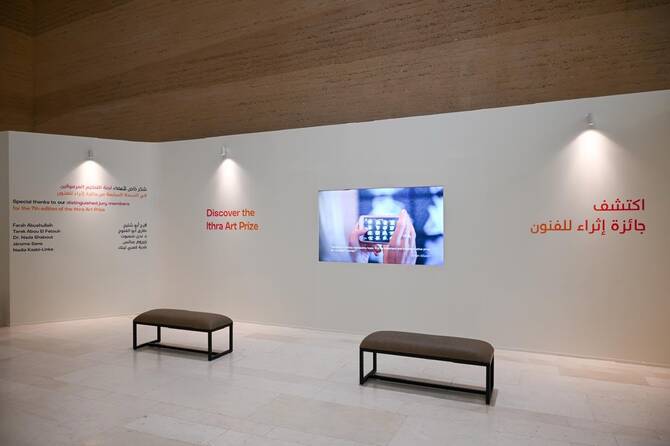
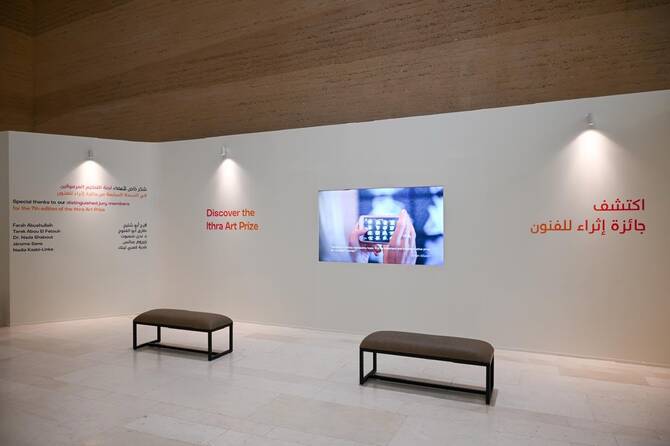
DUBAI: The King Abdulaziz Center for World Culture (Ithra) has opened an exhibition of the five shortlisted works for the seventh edition of the Ithra Art Prize, bringing all the finalists together under one roof.
The exhibition, which opened on Aug. 6 in Dhahran, featured new works by Aseel Al-Yaqoub, Bady Dalloul, Heba Y. Amin El-Mahamly, Ala Younis and Jawad Al-Malhi, spanning installation, painting, textile and conceptual practice.
Launched by Ithra, an initiative of Saudi Aramco, in 2017 and held every two years, the prize is one of the Middle East’s largest art awards. It supports contemporary artists from or based in the Arab world’s 22 countries, offering the winner a grant of $100,000 and a place in Ithra’s permanent collection.
Farah Abushullaih, head of museum at Ithra, said the show reflected “the Ithra Art Prize’s continued evolution as a platform for artistic production and dialogue.
“By presenting all shortlisted works together, we aim to offer audiences a deeper engagement with the ideas, processes and perspectives shaping contemporary art across the region,” she said.
Kuwaiti artist Al-Yaqoub presented “Flora Incognita,” a herbarium of hybrid desert plants examining how systems of botanical classification have shaped knowledge in the Gulf.

The winning artist will be announced in October. (Supplied)
Syrian artist Dalloul showed “Drawing in Matchboxes,” a series of miniature matchbox works on images, lived history and collective memory.
Egyptian artist Amin El-Mahamly’s “The Last Carrier: Iteration I” reinterpreted an 18th-century engraving of the Egyptian mahmal procession in textile, while Jordanian artist Younis’ installation “Lifted Arches” drew on Minoru Yamasaki’s architecture in Dhahran and Riyadh to explore Islamic architectural traditions and modernism.
Palestinian artist Al-Malhi’s mixed-media series “Ashes of Absence” depicted ghost-like figures to explore disappearance and loss.
The finalists were chosen by an international jury including Abushullaih; independent curator Tarek Abou El-Fetouh; art historian Nada Shabout of the University of North Texas; Jerome Sans, co-founder of Palais de Tokyo; and artist Nadia Kaabi-Linke, winner of the fourth Ithra Art Prize.
The winning artist will be announced in October.