

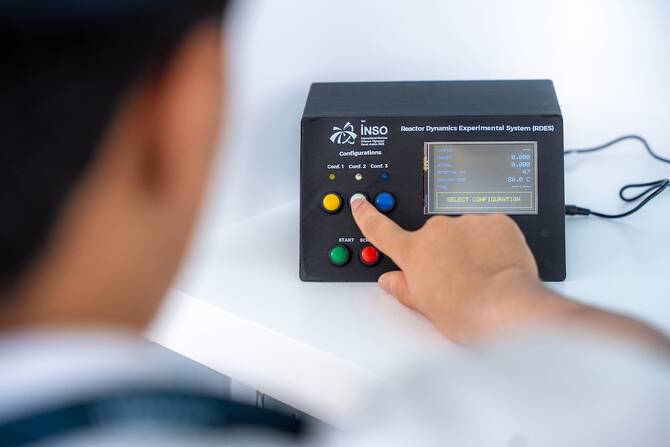


JEDDAH: A Saudi Arabia-developed educational device designed to give students a realistic understanding of reactor operations has debuted at the International Nuclear Science Olympiad 2026, highlighting the Kingdom’s growing capabilities in advanced scientific research and innovation.
The Reactor Dynamics Educational System device, developed by the Nuclear Engineering Department at King Abdulaziz University with support from Mawhiba, was introduced during the practical examinations of the INSO 2026, which is currently taking place at King Abdulaziz University.
Speaking to Arab News about the RDES, Dr. Anas Mohammed Alwafi, chair of the INSO scientific committee, said: “The idea came to address a significant challenge in nuclear science education and testing.”
He added that “some concepts related to nuclear reactor behavior are difficult to present practically due to safety requirements and the high cost of equipment.”
The RDES was “developed to provide students with a near-realistic experience within a safe learning environment.”

Dr. Anas Alwafi, Chair of INSO26 Scientific Committee. (Supplied)
It would enable them to “conduct measurements, analyze results, and understand system responses, just as a nuclear researcher or engineer would, without handling any radioactive materials or facing radiation hazards.”
The device was entirely designed, manufactured and programmed by a Saudi team from King Abdulaziz University’s Nuclear Engineering Department.
The multidisciplinary team included specialists in nuclear engineering and reactor physics alongside engineers, programmers and technicians, demonstrating the Kingdom’s growing expertise in developing advanced scientific technologies.
According to Alwafi, the unveiling during INSO 2026 reflects Saudi Arabia’s ambition to position itself as a contributor to global scientific innovation, by showcasing homegrown technologies that support education and research.
“The introduction of the RDES also underscores the Kingdom’s investment in developing the next generation of scientists and engineers, in line with broader national efforts to strengthen research, innovation and advanced technology sectors.
“By providing students with a realistic and interactive learning platform, the system is expected to enhance nuclear science education and could find wider applications in universities and research institutions in Saudi Arabia and beyond.”
The Olympiad consists of a theoretical exam and practical exam over two days.
The RDES instrument was used in the practical exam to take readings, analyze system responses, understand the relationship between actions and results, and make scientific decisions based on data.
The theoretical exam focuses on measuring scientific understanding, fundamental knowledge, and the ability to perform calculations and analyze problems. By combining the two exams, the Olympiad provides a more comprehensive assessment of the student’s abilities.
Alwafi said practical testing had been one of the biggest challenges in previous editions of the Olympiad. Conducting such experiments can be costly, require complex equipment, or be difficult to implement due to safety considerations.
Furthermore, there were a limited number of ideas that could be implemented fairly and independently by all students. “The RDES system has opened new horizons for practical testing.
“It has demonstrated the feasibility of delivering an advanced, safe, and feasible nuclear experiment within an international competition, while providing each student with an independent device and maintaining the quality and fairness of the evaluation,” he said.


