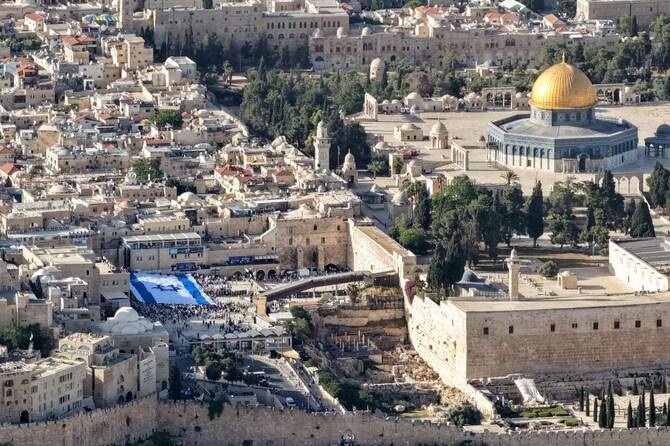

AMMAN: The importance of Al-Aqsa for Muslims, Christians and Jews means that Israel’s current forceful measures to maintain control of the sacred site has caused considerable strife.
Ministers from Arab and Muslim nations, who held an emergency meeting in Amman recently, warned that Tel Aviv’s actions at Al-Aqsa Mosque risks dismantling its historical and legal status quo, potentially igniting a wider religious confrontation and threatening regional security.
The warning was issued amid growing concern over restrictions on worship, incursions by extremist settlers and what many have described as attempts to weaken the authority of Jordan.
Jordan currently holds the title of custodian of the Islamic and Christian holy sites in Jerusalem, a role that gives Amman administrative responsibility through the Jerusalem Awqaf Department.
Israel has been seeking to establish temporal and spatial division of Al-Aqsa Mosque, under which different groups would be allocated separate times or areas for access and worship.

This is a development that would fundamentally alter the longstanding arrangements governing the compound and transform the Israeli-Palestinian conflict from a political and territorial dispute into an explicitly religious one.
Jordan’s Foreign Minister Ayman Safadi said: “An occupying power has no sovereignty over occupied territory.” He accused Israel of violating the sanctity of the sites and restricting freedom of worship.
Mohamed El-Orabi, the former Egyptian foreign minister, told Arab News Israel was a serious threat to the existing status quo. He warned that continued violations could lead to a “more catastrophic situation,” particularly if the international community fails to respond.
Al-Aqsa Mosque is the world’s third-holiest site for Muslims. Jews refer to the area as the Temple Mount, claiming it was the site of two Jewish temples in antiquity.
Israel occupied East Jerusalem, where Al-Aqsa Mosque is located, during the 1967 Arab-Israeli War. It annexed the entire city in 1980 in a move not recognized by the international community.

Israel's far-right National Security Minister Itamar Ben-Gvir speaks during the funeral of Israeli hostage Ran Gvili, an off-duty police officer who was killed fighting militants that had infiltrated Israel during the deadly October 7, 2023, attack by Hamas. (FILE/ REUTERS)
Some of Al-Aqsa’s gravest crises have involved direct attacks on the site, including arson in 1969, and shooting at the Dome of the Rock in 1982. Both incidents deepened fears that extremists sought to damage the compound or alter its religious character.
Incidents at the compound have repeatedly fueled unrest in the West Bank and Gaza, triggered cross-border violence and mobilized anger across the Arab and Muslim worlds.
“Israel is violating international law and does not respect human rights,” El-Orabi said.
Arab League Secretary-General Nabil Fahmy warned that undermining the Jordanian awqaf would deprive the mosque of one of the principal safeguards protecting its Islamic identity and historical and legal status.
He said extremist Israeli settlers were seeking to transform the conflict with the Palestinians from a political dispute that could be resolved through negotiation into a religious confrontation.
“Their first target is Jerusalem because of its spiritual value and symbolism for everyone,” Fahmy said.
He added that the region was facing an “inhumane and illegitimate situation.” And stressed the central role of the Arab ministerial committee in mobilizing international action against illegal Israeli policies in occupied Jerusalem.

Muslims perform a special morning prayer marking the start of Eid al-Adha, the Feast of Sacrifice, at the Al-Aqsa Mosque compound in Jerusalem on May 27, 2026. (FILE/ AFP)
For Jordan, any change to the arrangements at Al-Aqsa would not only undermine its custodial role but also provoke widespread anger across the Arab and Muslim worlds.
The Amman meeting therefore sought to place the issue on the international agenda before the situation deteriorates further, while establishing a common Arab and Islamic position ahead of the UN General Assembly meeting in September.
The participants at the gathering called for a joint ministerial meeting of the Organization of Islamic Cooperation and the Arab League during the UN General Assembly.
The proposed meeting would focus on the escalation in Jerusalem, the future of its holy sites and measures that could be taken to protect the existing arrangements.
Ezzat Saad, the former Egyptian assistant foreign minister, said the escalation in Jerusalem could have consequences far beyond the city itself.

Muslims perform a special morning prayer marking the start of Eid al-Adha, the Feast of Sacrifice, at the Al-Aqsa Mosque compound in Jerusalem on May 27, 2026. (FILE/ AFP)
“Israel’s continued violations will have an impact on regional security,” he told Arab News.
Saad said the risk was particularly serious because Al-Aqsa carries religious and political significance for Palestinians, Jordanians and Muslims across the world.
Any perceived change to its status quo could trigger protests, intensify violence in the Occupied Territories and increase pressure on governments throughout the region.
He called for clear international intervention and said the EU should consider imposing economic sanctions on Israel, including measures targeting goods produced in settlements deemed illegal under international law.
Saad said such sanctions should be comparable to those imposed on Russia following its invasion of Ukraine.