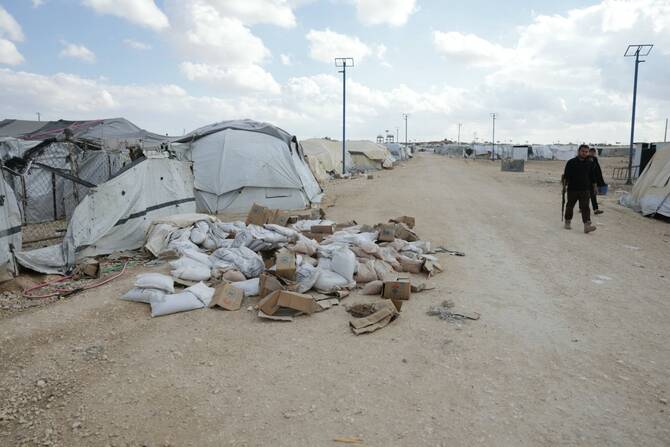

NEW YORK CITY: The closure of Syria’s Al-Hol camp in February has resulted in heightened security and humanitarian concerns, senior UN officials told the Security Council on Wednesday.
The whereabouts of thousands of Daesh-linked individuals and members of their families who were held in the camp remain unclear, they said, warning that the militant group remains a serious risk to international peace and security.
Briefing council members on a recent report by Secretary-General Antonio Guterres on the threat posed by Daesh, Oguljeren Niyazberdiyeva, chief of the Office of the Under-Secretary-General at the UN Office of Counter-Terrorism, reiterated a call by Guterres for the safe, voluntary and dignified repatriation of those affected by the closing of the camp, conducted in accordance with the principles of international law.
She said the closure had taken place amid a broader, evolving political and security landscape in Syria that continues to reshape the threat environment.
Meanwhile, continuing counterterrorism pressure has significantly constrained the capabilities of Daesh in Iraq, she added, though consolidation of these gains would require strong, accountable national institutions, effective administration of justice, and robust rehabilitation and reintegration efforts.
The threat from Daesh remains particularly acute in Africa’s Sahel and Lake Chad Basin regions, Niyazberdiyeva said, where affiliates have been strengthening capabilities and expanding their operational reach.
The Islamic State West Africa Province is the most active Daesh affiliate globally, she added, and has displayed a growing capacity to acquire and use commercial drone technology.
In South Asia, she described Daesh-Khorasan as one of the group’s most capable affiliates, displaying both the intent and capacity to support or inspire attacks beyond Afghanistan.
Niyazberdiyeva called for deeper cross-border cooperation on information-sharing and financial investigations; stronger governance over Daesh’s use of artificial intelligence, encrypted communications, virtual assets and drones; and efforts to ensure counterterrorism efforts remain grounded in international human rights, humanitarian and refugee law.
Carmen G. Cantor, deputy executive director of the Counter-Terrorism Committee, said the closure of Al-Hol underscored, with renewed urgency, the complexities involved in efforts to address the situation of former Daesh members and their relatives.
The development of measures for prosecution, rehabilitation and reintegration that are age-appropriate and gender-sensitive remains far from resolved, she said, and will require sustained international engagement, adequate resources and compliance with international human rights law.
Tammy Bruce, the US deputy ambassador to the UN, commended the leadership shown by Iraq in repatriating its detained and displaced citizens from northeastern Syria. Meanwhile, she added, Iran and its proxies, including the Houthis, Hezbollah, Hamas and Tehran-aligned militias in Iraq continue to destabilize the Middle East.
Jess Jambert-Gray, the UK’s deputy political coordinator at the UN, welcomed Syria’s decision to join the Global Coalition against Daesh as its 90th member, describing it as part of a new political chapter that offers greater stability.
She said the UK continues to support Iraqi authorities as they address the cases of about 6,000 Daesh detainees who must face justice.
She also welcomed the renewal of the UN’s Global Counter-Terrorism Strategy, now in its 20th year, and said the past two decades have shown that counterterrorism efforts succeed when they are rooted in human rights, the rule of law and international cooperation.