

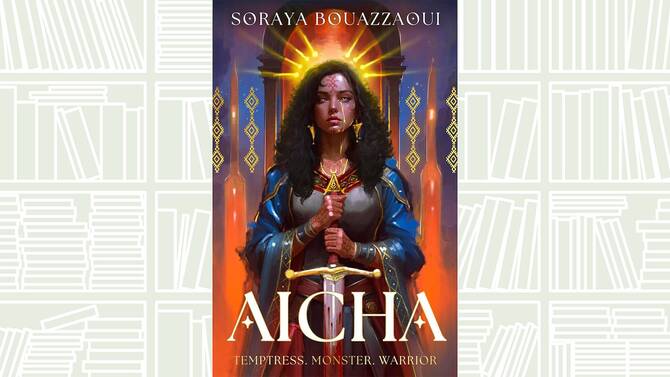

JEDDAH: In “Aicha,” Soraya Bouazzaoui, a British writer of Moroccan heritage, turns to one of Morocco’s most enduring monster myths to craft a historical fantasy epic exploring the immense love and consuming rage that coexist under colonial occupation.
Set in 18th-century Morocco during the Portuguese occupation of a coastal citadel, “Aicha” follows its titular heroine, the daughter of blacksmith and freedom fighter Fouad who teaches her to forge weapons and fight.
Published by Orbit Books, a science fiction and fantasy imprint of Hachette Book Group, the novel takes place over the eight days leading up to the sultan’s long-awaited siege to drive out the occupiers from the city.
Rachid, her childhood friend and protective secret lover who wishes to marry her, is the rebellion leader whose underground network is working toward the battle that could finally liberate the coast.
Raised under a brutal occupation by her father, Aicha has had to survive starvation, surveillance, and the everyday cruelties inflicted by Portuguese soldiers and their commander, the novel’s antagonist, Duarte.
At the age of 20, she is a sharp-tongued young girl who is already fluent in the dance of resistance: how to move unseen, deliver an insult yet remain unscathed, and conceal fear beneath a mask of bravery.
Her fierce sister Samira, Fouad and his friends, and the wider community form a small but vivid ecosystem where everyone is absorbed into the rebellion’s fabric in some capacity, because under occupation, neutrality is not a position anyone gets to hold.
Rather than merely allude to the myth of Aicha Kandicha — traditionally described as a seductive, camel-legged woman who haunts the streets to lure and slaughter men — the author reimagines her as a dormant second consciousness, a jinn that stirs beneath the skin and hungers for the blood of the men who have hurt Aicha’s people.
It represents the anger of a young girl growing up under occupation, accumulating, the way sediment accumulates, until it has a weight and a will of its own.
Even so, in one of her more mature choices as a debut writer, Bouazzaoui refuses to romanticize resistance, instead seeming to ask what sustained exposure to cruelty might do to the soul. If violence is inflicted upon a person every day, what becomes of the one who finally chooses to answer it?
Aicha’s unlikely friendships and her romance with Rachid bring a refreshing tenderness to the story, depicting that softness, hope and intimacy can survive, however briefly, under the shadow of war, grief and loss.
What distinguishes “Aicha” as a historical fiction novel is the layered Muslim representation within a genre that so often tackles Western mythology for a non-Muslim audience.
Bouazzaoui reinforces it through creative choices: Islamic references and Darija vocabulary remain untranslated, prayer and religious rituals are woven naturally into the story, and encounters with the supernatural are understood through the lens of faith and never divorced from moral scrutiny.
The novel bears the friction of a debut when its pacing surges and stalls, its secondary characters blur at the edges, and its fantasy elements arrive far later than its marketing promises.
And yet, these imperfections do not gnaw at the reading experience. The fantasy-themed novel succeeds as a work of resistance literature because it insists that, above all, those living under occupation remain fully human: daughters, friends, lovers, believers and dreamers.


