
LONDON: More than five months into the war between the US and Iran, children across the region continue to pay the highest price, with many killed, injured, displaced or cut off from healthcare, education and protection, aid organization Save the Children warned on Monday.
Disruption caused by the conflict to shipping in the Strait of Hormuz, a critical global trade route, and Bab Al-Mandab Strait, which connects the Red Sea to the Gulf of Aden, is compounding the crisis by slowing the delivery of humanitarian assistance, the London-based charity said.
“Children are directly impacted by blocked routes and restricted maritime traffic,” said Ahmad Alhendawi, Save the Children’s regional director for the Middle East, North Africa and Eastern Europe.
“Disruption is delaying humanitarian supplies and driving up the cost of food, fuel and medicine. These waterways must remain open and safe for civilian and humanitarian traffic.”
Both waterways have become flash points in the wider conflict. Iran has kept the Strait of Hormuz closed to traffic for months and said it will not reopen until the US lifts its blockade of Iranian ports.
Attempts to reroute shipping through the Red Sea faced a second threat when the Houthis in Yemen declared a blockade on Saudi-linked shipping on July 20 and began firing on tankers. This has reduced traffic through Bab Al-Mandab by about 30 percent, Reuters reported.

Disruptions in the Strait of Hormuz have reportedly delayed deliveries of humanitarian aid. (AFP file photo)
Alhendawi called for an immediate halt to the fighting, saying: “Children are paying the price daily for this dangerous escalation which must end now.
“The international community must pressure all parties to immediately deescalate, act responsibly towards children, cease all military operations, and pursue peaceful resolutions to their disputes.”
Dr. Jeeda Alhakim, a specialist counseling psychologist at City St. George’s, University of London, said: “Scholars and clinicians working in conflict and occupation contexts have long noted that the damage to children is not simply emotional, it reshapes how they understand the world and their place within it.”
Such damage, she added, is broader than any single diagnosis.
“This goes beyond what a diagnosis like (post-traumatic stress disorder) can capture,” she told Arab News. “PTSD focuses on specific traumatic events, but for children in conflict zones there is rarely a single incident. Instead, there is a continuous accumulation of exposures to threat, loss, displacement and powerlessness that affects every aspect of daily life.
“One of the things that happens when a child grows up under ongoing threat is that their nervous system adapts. They become hypervigilant, constantly scanning for danger, struggling to feel safe even when there is no immediate risk. When that state becomes permanent, it takes a serious toll on a child’s ability to concentrate, sleep, form relationships and develop normally.”

A Palestinian child plays amongst the rubble in the Jabalia camp, northern Gaza Strip, on August 2, 2026. (AFP photo)
The effects might also be passed on to future generations.
“There is growing evidence that trauma affects us biologically, influencing how stress-response systems develop and, potentially, how certain genes are expressed,” Alhakim said.
“Children may arrive in the world already carrying something of what their parents and grandparents endured.”
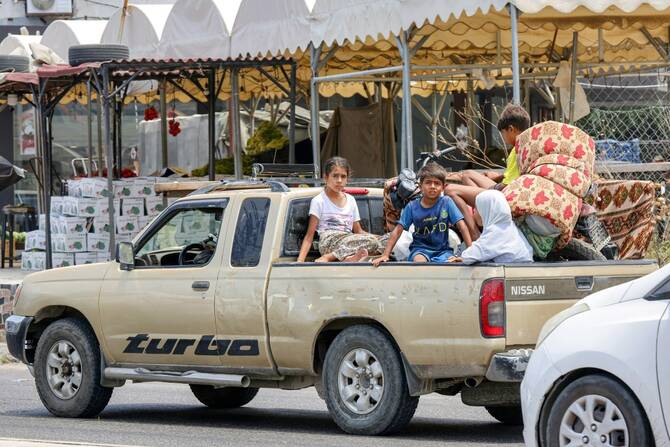
Dr. Rim Ajjour, a child psychologist in Lebanon, said repeated displacement leaves many children feeling that they are never truly safe.
“This accumulation of traumatic events and the repetitive displacement leaves children in a (constant) state of fear, where they feel that their safety is not guaranteed,” she added.
In her clinical work, Ajjour told Arab News, this fear manifests as constant worry, difficulty concentrating and a sense of being “always on edge,” driven by the lack of control children have over their own safety.
In Lebanon, where Israeli shelling and house demolitions continue in the south of the country, children account for an estimated 35 percent of the more than 375,000 people still internally displaced.
In Gaza, more than 800,000 Palestinian children have been displaced, more than 7,000 of whom are unaccompanied or separated from their families, according to the Site Management Cluster, which coordinates humanitarian aid, tracks population movements, and monitors conditions across more than 1,600 active displacement sites supporting about 1.7 million displaced people in the territory.
In both Lebanon and Gaza, schools have been repurposed as shelters, which additionally leaves many displaced children with no access to education.

Displaced children play at a corridor in a school transformed into a shelter in Dekwaneh, east of Beirut on April 15, 2026. (AFP file photo)
Losing a familiar home compounds the fear, Ajjour said, because children are forced to move into places they must share with strangers. “Their home is not their home anymore,” she said, leaving them with a “sense of instability.” Additionally being cut off from school “can have a massive effect on their well-being.”
She added: “Children who have achieved specific milestones in terms of walking, speaking, toilet training are even showing regression in those achievements.”
Despite a fragile ceasefire that has been in force in Gaza since Oct. 10, 2025, rights groups have warned that children continue to be killed and essential civilian infrastructure remains under attack.
Israeli strikes on Sunday killed four children, according to media reports. One was the unborn child of a pregnant woman whose body was found under the rubble.
In the occupied West Bank, meanwhile, Israeli military operations and settler attacks have intensified. On Friday, settlers reportedly shot a 10-year-old child in the back during an attack on a village near Ramallah.
“Growing up under these conditions does not only produce fear and symptoms,” Alhakim said. “It produces a particular way of understanding the world, a clear-eyed awareness of power, history and injustice that develops earlier than it would under other circumstances.
“This is not pathology; for many of these children, it is an accurate reading of the reality they inhabit.”