
ROME: Amid the grandeur of the Palace of Versailles on June 17, US President Donald Trump signed a preliminary agreement aimed at ending hostilities with Iran.
The memorandum of understanding — a nonbinding short-term framework stating each party’s intention to stop the war — promised to immediately halt military action, including in Lebanon, and reopen the Strait of Hormuz, with the goal of finalizing a deal within 60 days.
The ceasefire set out in the MoU later collapsed, prompting the US to resume strikes on Iran.
Over the weekend, Trump again paused those strikes and returned to negotiations, telling reporters the US was “very close” to a deal, even as Tehran publicly denied any breakthrough.
According to a CNN tally, the announcement marked the 39th time the president has said his country was close to reaching a deal to end the fighting, or that Tehran was desperate to do so.

The memorandum of understanding promised to immediately halt military action, including in Lebanon, and reopen the Strait of Hormuz, with the goal of finalizing a deal within 60 days. (Social media)
The significance of the move lies less in the rhetoric than in the pattern: a calibrated pause after a fresh wave of strikes, followed by mediators working to keep the 60-day framework alive while major nuclear issues remain set aside.
“He’s very loyal to the art of his deal, but it doesn’t mean he can make a deal with Iran based on that pattern or strategy or repeated trend of bombing, detente, diplomacy, then bombing again,” Mohamed Chebaro, a British-Lebanese journalist and political expert, told Arab News.
“In the Middle East, we say that the one who keeps trying what has already failed has a kind of mental deficiency, in the sense that (the same effort) is unlikely to yield a different result.”
The Versailles signing crystallized a recurring Trump tactic: escalate, pause, then lock in an interim deal.
After months of “maximum pressure” and military posturing aimed at driving Iranian oil exports to zero and constraining nuclear and missile programs, the administration shifted to ceasefire diplomacy, using truces and MoUs to reduce risks while preserving the option to resume strikes.
Critics argue this cycle produces short-term stability but allows Iran to retain nuclear latency and regional leverage. Supporters counter that only such pressure-and-pause sequences can eventually force meaningful concessions.

Months of tensions culminated in renewed strikes on Feb. 28, 2026, which analysts say left both sides losing — economically, in terms of global energy disruption, and in terms of domestic and regional perception. (CENTCOM/AFP)
On Sunday, Trump said he had called off a plan for US forces to carry out what he described as “the biggest attack since World War II,” opting instead to give diplomacy more time after hearing from key Gulf leaders — including Saudi Crown Prince Mohammed bin Salman — and at the request of unnamed Iranian officials.
He added that new talks would cover the Strait of Hormuz and, ultimately, Iran’s denuclearization, sending oil prices to near $80 a barrel.
For its part, Iran said it was nearing a deal with Oman over a new route through the strait, where a tanker reported a nearby explosion on Sunday, underscoring the continued volatility of the strategic waterway.
Trump’s latest announcement underscored a tactic in place since his second term began in February 2025: applying maximum pressure on Tehran and its already struggling economy.
When that campaign failed to yield a breakthrough, the first wave of US and Israeli strikes followed in summer 2025, targeting nuclear sites and degrading infrastructure but also hardening Tehran’s resolve.
Months of tensions culminated in renewed strikes on Feb. 28, 2026, which analysts say left both sides losing — economically, in terms of global energy disruption, and in terms of domestic and regional perception.

As Trump himself has acknowledged, the Iranians are proving to be shrewd negotiators. (AFP)
Trump’s strategy — which many experts say is largely set out in his 1987 book “The Art of the Deal” — rests on the idea that political negotiations should resemble business ones, promoting a state of instability as the basis for advancing a deal until its signing and implementation.
However, as Trump himself has acknowledged, the Iranians are proving to be shrewd negotiators.
“They (employ) a kind of strategic patience and strategic maneuvering: we agree on something, then we renegotiate what has been agreed, introduce new conditions, and try to reopen other points, appendices and attachments — all to delay, to exert more pressure, to force the other party to retreat and make concessions,” Chebaro said.
“This is the Iranian method, and they have been pursuing it not only since the Islamic Revolution 47 years ago, but even before. They are well-known negotiators who bring in history, geopolitics and patience, and they try to control the cards.”

Iranian-made Zolfaghar missiles are displayed at Azadi Square in Tehran. (AFP)
He contrasted that approach with Trump’s transactional style, likening the president’s “art of the deal” to that of an estate agent or property developer who puts a price on everything.
“On the other side of the table, you have a very theocratic party, a religious doctrine, a group of people governing the country for different reasons. Their deal is not with people; their deal is with their God.
“What they promise their followers is complete victory or nothing. And even in death, it’s considered victory according to their doctrine. So how do you try to mediate, extract concessions from a party like this?
“It’s very difficult. You have two very separate worlds: the world of Trump and the world of the mullahs of Iran.”

So far, Chebaro said, the clear result of this back and forth has been anything but a more stable region.
“As far as the pattern we notice, whether the Americans are going to be able to achieve their stated goals — from nuclear to missile control, to degrading the power of Iran, to curbing its products — it’s up in play,” he said.

A heavily-damaged bridge which was hit by a US strike is pictured along the road connecting Roudan and Bandar Abbas in southern Iran. (ISNA/AFP)
“But what is worrying and dangerous is that over the last four to eight weeks, the more involved Iran becomes, the more the Iranian regime moves from strategic defense to trying to say: ‘I’m still here; you haven’t degraded me enough.’”
Iran has, in fact, changed its diplomatic and military posture, moving from a defensive approach to a more offensive one, as seen in recent attacks in the Gulf and the Houthis’ belligerent stance in the Red Sea.
“Everybody wants diplomacy to win, and nobody wants escalation, at least the region’s nation states,” Chebaro said. “But what’s acceptable is interpreted differently: Iran wants everything (while) its neighbors want the status quo that (existed) before Feb. 28. But apparently it’s no longer on the (table).”
He questioned whether a unilateral Iran-Oman arrangement over the Strait of Hormuz would be sufficient, and whether its terms would satisfy the international community, warning that the rules-based order underpinning freedom of navigation is now at stake.
If the war ends with a new power governing Hormuz or the Bab Al-Mandab, he argued, it would set a dangerous precedent, opening the door to tolls, controls or outright blackmail over shipping — a recipe for global chaos.

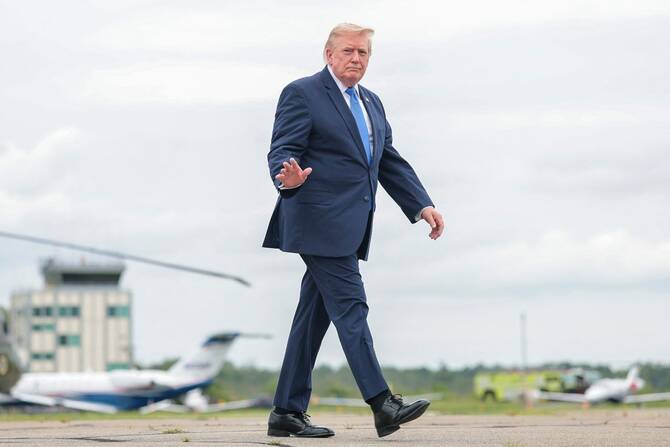
US President Donald Trump walks to board Air Force One. (AFP/File)
While Trump’s “art of the deal” might eventually produce a breakthrough, Chebaro said other pressures weigh on the president, including energy costs, the upcoming midterm elections, and unity within his own MAGA base, much of which opposes Washington’s foreign interventionism, especially in the Middle East.
“Might makes right,” Chebaro added, arguing that Iran has shown it can close Hormuz and, despite the MoU and mediators’ efforts, simply refuse to abide by any deal imposed on it.
“We are in for a very hot and uncertain summer,” he said. “Could Trump magically turn the tables around? I don’t know. Are we in a protracted war? It looks like it.”
He said the prospects for a “magic deal” with Iran are growing slimmer, and that real success lies not in another MoU or truce extension, but in resolving the underlying dispute over the Strait of Hormuz.

An Iranian woman walks past an anti-US billboard at Enghelab Square in central Tehran. (AFP)
“The core issue of the memorandum was to allow trade and energy to flow through Hormuz, which the Iranians are not letting happen,” he said.
“How can you call that a success? The flaw in this ‘art of the deal’ (was there) from minute one: when they agreed to a ceasefire, they did not agree to allow free navigation. And here we are.”