

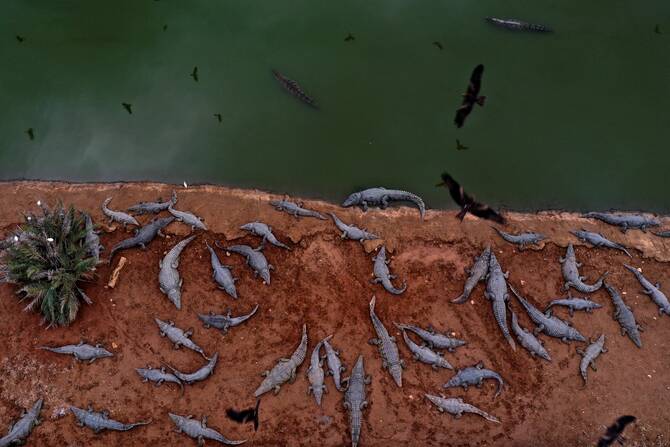

LONDON: An Israeli court on Sunday temporarily blocked plans by the national security minister to install crocodile-filled moats around Ketziot Prison, following a legal challenge centered on the reptiles’ welfare that has also reignited concerns over the treatment of Palestinian detainees.
The Jerusalem District Court issued an injunction freezing National Security Minister Itamar Ben-Gvir’s proposal to transfer crocodiles into security areas at Ketziot, a desert prison where many Palestinians are held, after the animal welfare group Let the Animals Live petitioned against the plan, The Times of Israel reported.
The group asked the court to classify the reptiles as a protected species, arguing that the government lacked legal authority to proceed.
In its petition, Let the Animals Live said Environmental Protection Minister Idit Silman ignored ministry legal experts and Nature and Parks Authority officials, who warned the transfer lacked scientific basis and could endanger both the animals and prison staff.
The legal challenge follows Silman’s mid-July decision to reclassify the Nile crocodile as a “tended wild animal,” a move that reportedly paved the way for Ben-Gvir’s proposal.
In his ruling on Sunday, Israeli Judge Avraham Rubin wrote that “the claims regarding the expected harm to the crocodiles merit investigation and justify issuing an order prohibiting the transfer, or any action related to locating or preparing crocodiles for transfer.”
He ordered that no crocodiles be moved to Ketziot until a final decision is issued and gave Silman, Ben-Gvir and the Israel Prison Service until Wednesday to respond to the petition.
However, work on the moat system continues at Ketziot Prison in Israel’s Negev desert. Ben-Gvir’s office said digging had begun and that about $7 million had been allocated for the project.

Israeli Judge Avraham Rubin gave Ben-Gvir and other officials until Wednesday to respond to the petition. (AFP file photo)
While the injunction was issued on animal welfare grounds, it has renewed scrutiny of Israel’s treatment of Palestinian detainees, with critics questioning why the court intervened to protect crocodiles rather than prisoners.
Hussein Chokr, a Beirut-based policy expert, said far-right Israeli officials “view us, the peoples of the Middle East in general, and Palestinians in particular, as a human threat that must be subdued by any means necessary, even if that means dragging us back to the medieval stories of the crocodiles of Castel Nuovo in Naples.”
He told Arab News the danger lies not only in Ben-Gvir’s ability to imagine “such colonial projects, ones that evoke the Nazi concentration camps,” but also in a court decision that intervenes to protect crocodiles rather than prisoners.
“The danger also lies in the court decision that temporarily suspended the transfer of the crocodiles, not because such an idea represents a human insult that we, as humanity, were supposed to have left behind in the dark ages, but because of a petition concerned with the rights of crocodiles as a protected species,” he said.
“But what about the Palestinians? Are they not human beings worthy of protection?”
Moazzam Begg, director of human rights group CAGE International, voiced similar concerns in comments to The Independent in late July.
“The fact that we’re even trying to rationalise using crocodiles as a legitimate security apparatus in the 21st century feels outright satirical,” he said.

About 9,500 Palestinians were held in Israeli prisons as of June, according to figures from the Palestinian Prisoners Club. (AFP file photo)
Ben-Gvir’s proposal is reportedly inspired by Alligator Alcatraz, a US immigration detention facility that closed in June after lawsuits alleged inhumane conditions and environmental damage.
Begg warned that Israel’s attempt to emulate that facility could lead to similar abuses.
“Israel regularly acts with impunity under the pretext of national security,” he said. “Adding crocodiles is just another vicious decision in the consistent mistreatment of Palestinians.”
Ketziot Prison has become a focal point of Ben-Gvir’s prison policies and wider concerns about the treatment of Palestinian detainees.
Since the Gaza war began on Oct. 7, 2023, former detainees and rights organizations have alleged torture, sexual assault, starvation and medical neglect at the facility. B’Tselem, Human Rights Watch, the UN and other organizations have documented allegations of abuse and ill-treatment in Israel’s prison system.
Critics say the crocodile proposal fits into a broader pattern of dehumanizing rhetoric toward Palestinians. Former Defense Minister Yoav Gallant reportedly referred to Palestinians as “human animals” in October 2023.
Since Oct. 7, 2023, Israeli forces have arrested more than 24,600 Palestinians across the occupied West Bank, according to the Palestinian Prisoners Society. Thousands more have reportedly been detained from Gaza.
For many in the region, the crocodile proposal crystallizes their sense of how those detainees are regarded.
“We live in a world where Palestinians are treated as creatures without rights, as beings to whom anything can be done and against whom any harm can be inflicted,” Chokr said.
“This is colonialism in its clearest form,” he added, arguing that the mindset extends beyond Palestinians. “If Israel can, it would not do this only to Palestinians. It would do it to the Lebanese, the Jordanians, the Syrians, the Egyptians, and every people of the region.
“Simply, in the eyes of such a system, we are not fully human.”


