

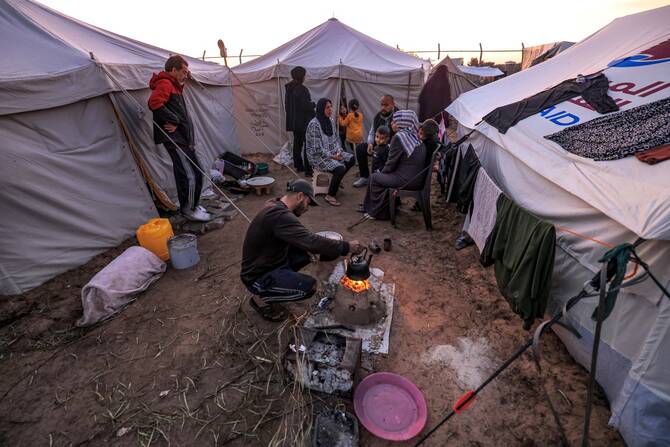

LONDON: Palestinians in the embattled Gaza Strip once flicked a lighter or pushed a button to make tea. Now, brewing a single cup can take mother of four Maysa Yousef nearly an hour as wartime shortages turn a simple flame into a luxury.
As Israel’s war in Gaza grinds on, shortages of gas, a near-total power blackout and tight restrictions on goods entering the enclave have transformed routine tasks into daily struggles.
“Before the war we only used lighters occasionally because we relied on gas stoves, which ignited easily using a button,” Yousef told Arab News.
That changed after Oct. 7, 2023, when a Hamas-led attack in Israel triggered Israel’s large-scale military campaign. At first, households still had some cooking gas, but as cylinders emptied and supplies dwindled, families were forced to improvise.
“That’s when lighters became essential,” Yousef said. “At first they were still available, so some people stocked up. I bought a few whenever shipments came in, as much as I could afford, since cash has been hard to come by.”
Even then, tasks that once took minutes now demanded patience and persistence.
“Brewing a cup of tea, which took five minutes in the past, now requires nearly an hour, using paper, cardboard or whatever I can find to burn,” Yousef said.
“Sometimes the fire goes out, and other times we have to keep blowing on it to keep it burning.”

Maysa Yousef says she has repaired her lighter at least 20 times, as the simple tool has become a prized possession. (Supplied)
The added effort has reshaped daily routines.
“My husband used to leave at 6:30 in the morning. I would wake at 5 a.m., pray and then stay up just to prepare him a cup of coffee or tea,” she said.
But even that small act became difficult as supplies dwindled.
“We were living in a state of hunger and supplies weren’t available. We would drink tea without sugar, just hot water and tea,” she said.
As scarcity deepened, prices soared. Before the war, a lighter cost about half a shekel (16 cents). Now they can cost between 100 and 200 shekels.
The shortages have also reshaped the local economy. With new demand came an unlikely trade: lighter repairs.
“People go around neighborhoods offering to fix or refill lighters, and there are spare parts now,” Yousef said. “You can even sell a lighter for parts.”
Yousef has repaired her own lighter multiple times. It remains one of her most valued possessions. “For me, it’s a treasure. I couldn’t give it to anyone because I depend on it.”
But fixing a lighter can cost about 20 shekels — a burden for families with little or no income.
The shortage is largely driven by Israeli restrictions on goods entering Gaza. During a brief ceasefire, Yousef said, small numbers of lighters entered the enclave.
“Everyone bought one or two and used them only when absolutely necessary,” she said.
The broader economic picture is bleak. Gaza’s economy has largely collapsed, with unemployment above 80 percent and the entire population of about 2.3 million living below the poverty line, according to UN figures.
Recovery remains constrained by widespread destruction, damaged infrastructure and tight limits on the movement of goods and people.
Israel has maintained varying levels of blockade on Gaza since 2005, but since October 2023, the restrictions have become nearly total, raising concerns about civilian survival.
Aid groups and media reports have highlighted the scope of restricted items. In March 2024, CNN reported that goods frequently denied entry as “dual-use” included ventilators, oxygen cylinders, anesthetics, water filtration systems, X-ray machines and crutches.

Palestinian lighter repairman Hassan Abu Latifa ignites a repaired lighter at his kiosk, amid shortages of lighters and cooking gas, in Khan Younis, in the southern Gaza Strip, July 21, 2026. (Reuters)
Amid the shortages, even small businesses have suffered. Roadside tea and coffee stalls, once common, have largely shut down because they have no way to light their fires.
People have turned to improvised methods to create flames. Some use batteries and exposed wires to generate sparks. Others rely on magnifying lenses, mirrors or leftover charcoal. Some even strike stones together.
“Still, none of these replace a lighter,” Yousef said. “Firewood is expensive and hard to find, though it’s slightly more available now.”
She has tried multiple methods herself.
“I also use cooking oil to start fires, it produces a strong flame, even though it’s costly.”
Sometimes she has spent hours trying to get a spark.
“I would strike two rocks together for two or three hours. Sometimes it worked, and sometimes it didn’t,” she said.
“Even the magnifying glass only worked in the summer. In winter it didn’t. In winter it was especially frustrating because you couldn’t light a fire. And even if you did, a gust of wind or a bit of rain would put it out.”
Recently small amounts of gas have become available again, though supplies remain scarce.
“Of course, we’re no longer like before the war,” Yousef said. “We only use gas when absolutely necessary, to prepare the main meal or make tea for breakfast. Beyond that, we don’t use it at all. It’s strictly limited.”
While restrictions on goods have eased slightly since a fragile ceasefire was announced in October, Palestinians in Gaza say renewed Israeli strikes have left the truce feeling unreal, as if there is no ceasefire at all.


