

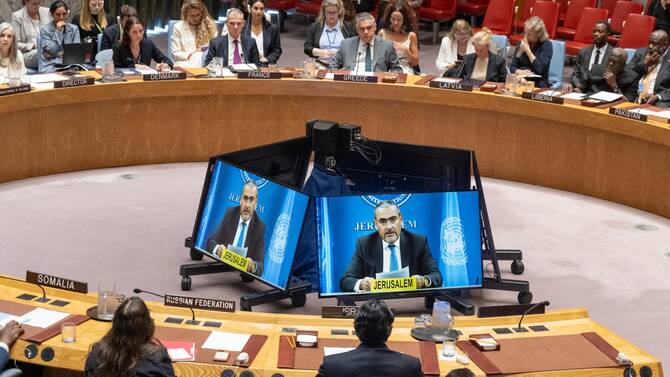

NEW YORK CITY: The rapidly deteriorating situation in the West Bank threatens to undermine the fragile progress so far on the Comprehensive Plan to End the Gaza Conflict, the UN Security Council heard on Tuesday, as speakers offered starkly differing visions of the possible paths ahead.
Ramiz Alakbarov, the UN’s deputy special coordinator for the Middle East peace process, warned the council during its regular briefing on the region that events in the West Bank were “compounding the already alarming conditions across the rest of the Occupied Palestinian Territory, with a wider escalation increasingly likely unless immediate steps are taken to reverse course.”
Alakbarov, who recently visited Gaza, said humanitarian conditions in the territory had “improved somewhat” but progress remained “far too slow,” pointing to continued displacement, overcrowding and near-daily casualties as a result of Israeli military operations.
He cited the latest Integrated Food Security Phase Classification report, published last week, which revealed improvements in food security, but cautioned that most Gazans were still entirely dependent on humanitarian aid, while the looming winter is narrowing the window to address shelter needs.
Turning to the West Bank, Alakbarov detailed a bloody week of violence, including the killings of two Palestinians, one of them a child, near Nablus on July 23, followed a day later by clashes that left four Palestinians and two Israelis dead.
“I urge Israel to take immediate and effective measures to prevent settler violence, protect Palestinian communities, and ensure that all perpetrators are held accountable,” he said, while also calling on Palestinians to “unequivocally reject violence and incitement.”
He reiterated that “all settlements are illegal under international law,” referencing in particular a $350 million allocation of funds by the Israeli finance minister, Bezalel Smotrich, for settlement housing units, which was announced on July 14.
Bahrain’s permanent representative to the UN, Jamal Alrowaiei, welcomed a recent coordination meeting between the Palestinian government and the Board of Peace, the international organization tasked with overseeing the Gaza peace plan, which took place on the sidelines of a Palestine Donor Group gathering in Brussels this month.
He said Manama “calls for removing all obstacles before the work of the Board of Peace as a transitional administrative entity,” and stressed the need for deployment of the International Stabilization Force in Gaza, along with a full Israeli withdrawal.
Bahrain’s Royal Humanitarian Foundation has signed a cooperation agreement with the Jerusalem Development Fund, making it “the first country to implement an endowment project in Jerusalem,” he added.
Alrowaiei also invoked a US-Gulf Cooperation Council ministerial statement issued in Manama in June that rejected annexation of the West Bank, and reaffirmed Bahrain’s position that lasting stability in the region will require “an independent, sovereign Palestinian state along the lines of June 4, 1967, with East Jerusalem as its capital.”
The US deputy representative, Tammy Bruce, welcomed a pledge by Morocco on July 15 that made it the first country to contribute troops to the International Stabilization Force, and highlighted nearly $1 billion in pledges from European nations for early recovery efforts under a “Team Gaza” initiative launched this month.
Bruce argued that Gaza is facing three possible futures: renewed war, continuing international indifference, or the “transformative option” offered by President Trump’s peace plan.
“Hamas has no place in Gaza,” she said, adding that nor does the UN Relief and Works Agency for Palestine Refugees.
She also linked the intransigence of Hamas directly to Tehran, saying: “Iran’s ties to Hamas are the reason Hamas will not disarm.” She extended this argument to Hezbollah in Lebanon and the Houthis in Yemen, declaring that “many conflicts are fueled by a single actor: the Islamic Republic of Iran.”
The UK charge d’affaires, Kate Foster, warned that eight months after the Security Council adopted Resolution 2803, which endorsed the US-backed peace plan for Gaza, “implementation risks stalling” and she urged all parties to fulfill their commitments in full.
She noted that 1.2 million people in Gaza still face significant food shortages, with about 90 percent of the population expected to remain dependent on aid. “Averting famine cannot be a benchmark for success,” she added.
Foster called on Israel to improve humanitarian access by opening more border crossings and streamlining the approval process for dual-use civilian goods, such as construction materials, communications equipment and certain medical supplies, that potentially could also have military applications.
She voiced concern over reports that Hamas had obstructed aid operations, including an incident at a World Food Programme distribution center this month.
Regarding recent events in the West Bank, she said Britain was “appalled by the violence” on July 24, and expressed alarm at a mass incursion by thousands of Israeli settlers and others at Al-Aqsa mosque compound on July 23, as well as an incursion on Monday by Israeli forces at a UNRWA training center near Kalandia refugee camp.
Foster also noted that 104 Israeli settlements had been approved over the past four years, representing what she described as “a deliberate attempt to erode the possibility of a two-state solution.”


