

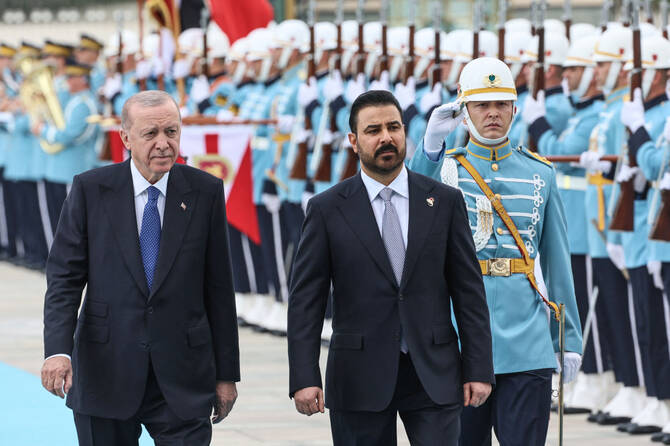

ANKARA: President Tayyip Erdogan said on Tuesday that Turkiye aimed to sign a comprehensive energy cooperation deal with neighboring Iraq as soon as possible after he held talks with Iraqi Prime Minister Ali Al-Zaidi in Ankara.
Speaking at a joint news conference after a signing ceremony that had been expected to feature a deal to keep the Kirkuk-Ceyhan crude oil pipeline open for another year, Erdogan said Turkiye’s state-owned oil and gas company TPAO would operate in the Kirkuk oilfield used by BP. The sides did not sign the deal to extend the decades-old pipeline agreement, which governs exports through the pipeline and officially expired on Monday.
After signing three accords on cooperation in various fields, Erdogan said more agreements were expected, only for his ministers to abruptly brief him on stage and for the two leaders to then proceed to their remarks without further signatures.
“The Iraq-Turkiye crude oil pipeline agreement ended yesterday. Our aim is to sign a comprehensive energy cooperation agreement that will benefit both sides as soon as possible,” Erdogan said.
In a statement on X, Turkish Energy Minister Alparslan Bayraktar said TPAO had acquired a 15 percent stake in BP Energy Company of Kirkuk Limited (BPECKL), adding that this would allow the Turkish company to operate in the field.
“It will work together with BPECKL partners to bring the approximately 3 billion barrel reserve potential into production,” Bayraktar said.
BP confirmed the deal and said it welcomed the partnership with TPAO.
Al-Zaidi, arrived in Turkiye on Tuesday for talks that are expected to include the construction of a pipeline to Turkiye aimed at reducing the exposure of Iraq’s oil exports to tensions in the Gulf region. It is Al-Zaidi’s third visit abroad since taking office.
Zaidi’s meetings with Erdogan and other officials will also focus on security, trade, energy, transportation and water management, Turkish officials said.
A statement from the Iraqi prime minister’s office said the sides will discuss “joint infrastructure projects in a way that serves the interests of the two neighboring countries.”
Al-Zaidi, who emerged as a consensus candidate in Iraq after months of deadlock over the premiership following last year’s parliamentary elections, is visiting Ankara on the heel of trips to Washington and Tehran.
Following Al-Zaidi’s talks with US President Donald Trump earlier this month, US companies signed roughly $60 billion in agreements and partnerships with the Iraqi government, including deals intended to create alternative routes for shipping oil out of the Arabian Gulf.
One project under consideration is a pipeline that would connect southern Iraq’s Basra to western Iraq’s Haditha and from there to the Ceyhan port in Turkiye and the port of Baniyas on Syria’s coast.
The visit comes as Turkiye is engaged in talks to end a decades-long conflict with the militant Kurdistan Workers’ Party, or PKK, whose fighters are largely based in northern Iraq. Last year, the PKK announced it was laying down arms and disbanding as part of the efforts and later held a symbolic ceremony in northern Iraq, where dozens of fighters burned their weapons in a cauldron.
Turkiye is now scheduled to enact legislation to help advance the peace effort, which is expected to include a limited amnesty that could allow some militants’ return to Turkiye.
The PKK has waged an armed insurgency since 1984, which has claimed tens of thousands of lives since then. It’s designated a terrorist organization by Turkiye, the United States and the European Union.


