

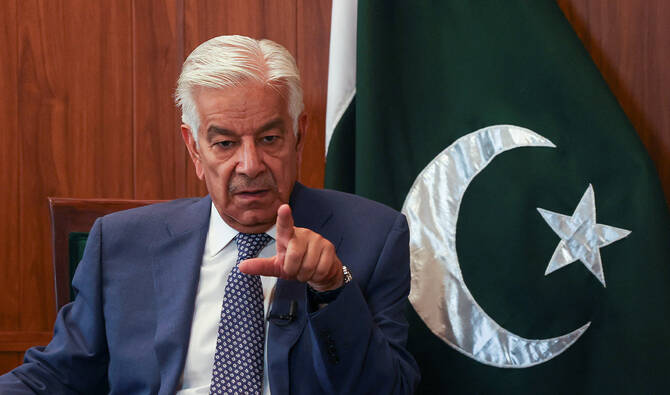

ISLAMABAD: Pakistan’s Defense Minister Khawaja Muhammad Asif criticized his Indian counterpart on Monday over his latest criticism of Islamabad on the Kashmir dispute, alleging that the comments were an attempt by New Delhi to deflect attention from its “internal turmoil.”
Asif’s response came hours after India’s Defense Minister Rajnath Singh accused Pakistan’s government of backing “terrorism” activities against India on Sunday, reiterating that New Delhi would not engage in talks with Islamabad except on Azad Kashmir, the part of the disputed Kashmir territory that is administered by Pakistan. Singh said at a public event on Sunday that Azad Kashmir is an integral part of India, warning Islamabad that any attempt to undermine India’s sovereignty would invite a decisive response from its armed forces.
Nuclear-armed neighbors India and Pakistan have fought two out of three wars over the disputed Himalayan territory of Kashmir. Both claim the region in full but administer parts of it. India and Pakistan fought briefly in May 2025 after Delhi accused Islamabad of backing a militant attack in Indian-administered Kashmir that killed over 30, mostly tourists. Pakistan denies the allegations.
“Defense minister’s rhetoric is an attempt to deflect the attention from internal turmoil and increasing unrest and discontent against Modi’s autocratic and divisive style of governance,” Asif wrote on social media platform X.
The Pakistani defense minister was referring to week-long massive protests in India, led by the country’s Cockroach Janta Party (CJP), which ended after Indian education minister Dharmendra Pradhan resigned last week.
Thousands of students and youth protesters had occupied the protest site near India’s parliament, demanding education reforms and posing one of the biggest challenges to Indian Prime Minister Narendra Modi’s government.
Asif said Singh’s comments reflect a continued attempt to distort internationally recognized legal realities related to the Kashmir dispute through “political rhetoric and coercive posturing.”
“They neither alter the status of the Indian Illegally Occupied Jammu and Kashmir nor contribute to regional peace, stability or meaningful dialogue,” he said.
He described India’s threats to carry out military action against Pakistan as an alarming rhetoric that risks lowering the threshold for interstate conflict in the region.
“Pakistan remains committed to peace and dialogue, but its resolve to safeguard its sovereignty, territorial integrity and national security is absolute and must never be tested,” Asif warned.
In a separate statement, Pakistan’s foreign office also condemned Singh’s statement. It said Singh’s comments were an attempt to divert attention from India’s continued “occupation” of Jammu and Kashmir, its sponsorship of “terrorism” and domestic instability.
“Pakistan urges the international community, in particular the United Nations, to take note India’s continued rouge behavior and to hold it accountable for its failure to uphold the relevant UN Security Council resolutions that guarantee the right to self-determination to the Kashmiris,” the foreign office said.


