

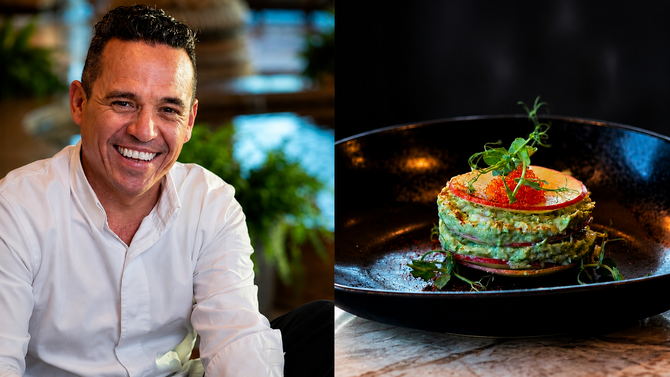

DUBAI: Mexican chef Victor Martinez’s journey has been shaped as much by circumstance as by ambition. Hurricanes, specifically, have been a “transformative force” in his life — pushing him toward career-shaping opportunities, he tells Arab News.
“I started my culinary journey at 17 (at culinary school) in Cancun, Mexico,” he says. “At that point, my only training had been the lessons I received from my father, a passionate cook who had a deep love for food and ingredients.”
A year after he started culinary school, however, Hurricane Wilma struck. He was forced to leave the city and never completed his studies. But, he explains, “I was blessed with another kind of education: the professional kitchen.”

Mexican chef Victor Martinez’s journey has been shaped as much by circumstance as by ambition. (Supplied)
In 2007, Martinez joined celebrated chef Antonio de Livier’s La Frida, rose to sous chef, stepped away, and was eventually invited back as head chef. “The restaurant that helped make me the chef I am today was bringing me back as head chef,” he says.
In 2017, he was at the airport in Mexico City waiting to board a flight to the British Virgin Islands, where he was set to join Rosewood Little Dix Bay. Once again, life had other plans. Hurricane Irma struck the islands, and Martinez was relocated to Rosewood San Miguel de Allende, the first of several Rosewood properties he would work in across Mexico, California, and the British Virgin Islands.
In 2025, he joined the opening team of Rosewood Doha. It was his first encounter with regional cuisine, and he immediately fell in love.
“The Middle East captivated me because it brings together history and modernity, tradition and ultraluxury, in a way that feels deeply alive,” he says.
In January 2026, he joined Rosewood Jeddah as executive sous chef.
When you started out, what was the most common mistake you made?
Controlling the heat. In the kitchen, fire is a transformational force — too much and you risk irreversible changes to the food; too little and you may never achieve the flavor and texture you’re after. I used to cook everything on high heat, driven by the energy of those early days. But when you learn to control the fire around you, you also learn to control the fire within you and time becomes your ally.
What’s your top tip for amateur chefs?
Practice, practice, practice — and don’t give up. Enjoy the journey. Don’t expect that following a recipe from the internet or a cookbook will immediately deliver the result you’re hoping for. Perfection in the kitchen is a process, a learning curve. Take your favorite recipes and make them over and over. You’ll discover that there are things no recipe can put into words. Respect the recipe, but perfect your technique through repetition.
What one ingredient can instantly improve any dish?
A Mexican would say cilantro, lemon, and chili. My grandmother would say food tastes good when it is made with love. I would say salt. It’s a game changer when balanced well.
When you go out to eat, do you find yourself critiquing the food?
In my early days as a chef, I was a tough customer. With time, I realized I was missing the opportunity to enjoy the moment by focusing too much on the food being served. Going out to eat isn’t just about the food; it’s about the people you’re sharing the table with, the conversation, the laughter… Food is just one part of the experience. I made a decision to enjoy the moment more.
That said, there are places — rare, but they exist — where the food is so outstanding that the conversation stops and everyone at the table gives their full attention to what’s on the plate. Those are the places I always return to.
What’s the most common mistake you find in other restaurants?
Forgetting that the most important values in hospitality are flavor and warm, efficient service. Everything else is secondary.
What’s your favorite cuisine or dish to order?
Wherever I am in the world, I make it a point to explore local food — mostly in markets. I always ask the locals; taxi drivers in particular are excellent at recommending street food specialties. They’ve tried them all. As a Mexican who has been living outside his country for a decade, eating traditional Mexican food can bring me to tears. Food is full of memories.
What’s your go-to dish if you have to cook something quickly at home?
Quesadillas! I don’t know why, but flour tortillas seem to be available everywhere in the world. They’re easy, filling, and my inner child smiles every time I eat them.
What request or behavior by customers most annoys you?
I try not to look at guest behavior that way, because hospitality is about understanding people. Hotels welcome a wide mosaic of guests from different cultures, backgrounds, preferences, and health needs, often all in the same dining room on the same evening. That diversity is one of the most beautiful parts of the job, and also one of the most challenging. For me, the goal is never to force a guest into something unfamiliar, but to create a dining experience that respects their needs while also allowing them to discover something new.
What’s your favorite dish to cook?
There is a dish from my home state of Yucatan that I love cooking because it is both very traditional and complex. It’s called Relleno Negro, and it’s built around a paste called chilmole — made from spices, dried peppers, green tomatoes, and other ingredients that are charred until they’re almost ash. Despite that, it produces one of the most beautiful and delicate flavors I’ve ever tasted: complex, layered, deep, and full of history.
What’s the most difficult dish for you to get right?
I have always admired pastry chefs. Baking probably has the highest difficulty level. Getting it right requires a mastery that only comes from years of experience and a deep knowledge of your oven. Achieving a perfect croissant, sponge cake, baguette crust, or sourdough loaf is never a matter of chance.
As a leader, what are you like?
I believe the key to success is a well-trained, motivated team that feels free to explore. I like to hear all opinions. I encourage my team to try, fail, learn, and try again — and sometimes what comes out of that creative process ends up on the menu. I’m proud of my team and we work well together. No one is left behind, because everyone has something to learn, always. If not, what are we doing here?
Chef Victor’s Dungeness crab salad

Green Goddess Dressing
Yields more than one serving
Ingredients:
25g Tarragon, leaves only
25g Dill, leaves only
25g Basil, leaves only
25g Parsley, leaves only
95g Labneh
5 cloves Garlic
2 Lemons, zested
60g Lemon juice
6g Honey
12g White balsamic vinegar
300ml Olive oil
Salt and pepper to season
Method:
Blend all ingredients together except olive oil until smooth.
With the blender running, drizzle in the olive oil in a thin, constant stream until fully integrated.
Salad
Ingredients:
75g Dungeness crab lump meat, carefully cleaned (remove all shell pieces)
¼ Jicama (Mexican turnip), sliced paper-thin on a mandoline
10g Honeycrisp apple, sliced paper-thin on a mandoline
50g Green Goddess Dressing
10g Smoked trout roe
1g Sumac
5g Shallot, finely brunoise
¼ Meyer lemon, juice and zest
2 sprigs Tarragon fronds (to garnish)
Method:
Fold the crab with the green goddess, shallot, and Meyer lemon juice and zest.
Place a round mold on the plate and spread half the crab mixture across the base.
Layer with paper-thin jicama slices.
Add a second layer of crab mixture and top with sliced apple.
Garnish with a drizzle of olive oil, a sprinkle of sumac, and dollops of trout roe.
Finish with picked tarragon fronds.


