
BEIRUT: Lebanon is looking to Tuesday’s summit between President Joseph Aoun and US President Donald Trump as a rare opening to advance its interests and test the newly signed US-brokered framework with Israel.
It will be the first meeting between a Lebanese and a US president since 2009, ending a 17-year gap in direct presidential diplomacy between Beirut and Washington — and one that carries highly significant strategic implications.
The summit is expected to revive direct presidential diplomacy between Beirut and Washington, which have long fluctuated between political patronage and stringent security conditions over the past decades.
Aoun is also expected to press Trump for US help in securing an Israeli withdrawal from Lebanese territory, strengthening the Lebanese Army and advancing implementation of the framework agreement signed last month under US sponsorship, which comes at a time when Israel occupies one-third of Lebanese territory, amid regional developments with a profound impact on the situation in Lebanon.
According to a Lebanese official who spoke to Arab News, Aoun will present Trump with a set of demands that include completing the Israeli withdrawal from all occupied Lebanese territory, extending state authority over the entire country, enabling the return of displaced residents to southern villages and launching reconstruction efforts.
“The Lebanese president is counting on the meeting for the US to pressure Israel to carry out the withdrawal,” the source said, adding that Auon will also raise Hezbollah’s weapons, the future of UNIFIL — whose mission expires at the end of this year — and urgent military assistance for the Lebanese Army.
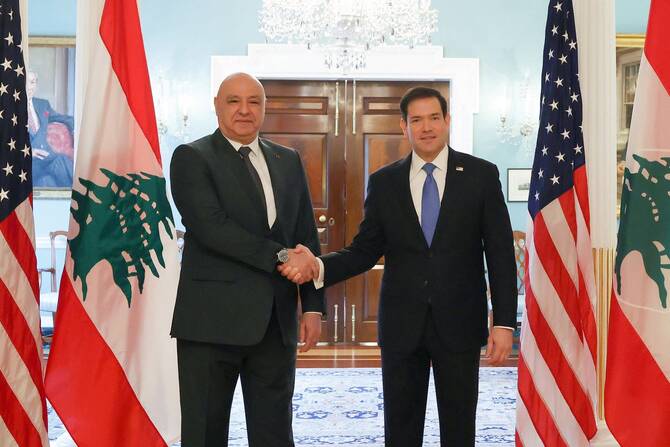
Aoun met US Secretary of State Marco Rubio in Washington on Sunday as part of the preparations for the summit, and both sides described the hour-long talks as “very positive.”

A vehicle carrying mattresses drives past a billboard on which hangs a portrait of Lebanese President Joseph Aoun and reads, “Diplomacy is the way to end wat in Lebanon” along the highway of the coastal city of Sidon as displaced families return to their home villages in southern Lebanon on June 15, 2026. (AFP/File)
According to Aoun’s media office, the president stressed the need to align the Lebanese and US positions on implementing the framework agreement, beginning with the first Israeli withdrawal from the first pilot zone.
He also urged stronger US support for the Lebanese Army and military institutions, along with economic backing and investment.
Rubio said Lebanon should not be linked to any other negotiating track and that Lebanese sovereignty could only be determined through Lebanon’s own constitutional institutions.
“Lebanon cannot be tied to any other negotiating track, and that Lebanese sovereignty can only be determined through decisions issued by Lebanon’s constitutional institutions,” Rubio stressed.
The US State Department said Rubio reaffirmed Washington’s support for the framework, praised Beirut’s efforts to restore sovereignty and economic recovery, and endorsed its push to disarm Hezbollah and dismantle its infrastructure.
The summit comes at a moment when the framework agreement signed between Lebanon and Israel under US sponsorship at the end of June is facing its first real test, amid strains in the US-Iranian understanding, as well as US-Israeli differences over regional issues.
The framework is entering its implementation phase, with Lebanon and Israel already holding follow-up talks in Rome to work out the details.

Smoke rises following Israeli controlled-explosions in the village of Kfar Tibnit as seen from Nabatieh in southern Lebanon on July 18, 2026. Israel has kept up intermittent strikes on south Lebanon, particularly in the Nabatieh area, despite the two-week-old truce. (AFP/File)
Speaking to Arab News, Lebanese Forces MP Fadi Karam described the Washington summit as “an important and fundamental milestone,” which reflects President Aoun’s approach, with Lebanon negotiating on its behalf.
“Lebanon has paid a heavy price to reach this moment and free itself from the axis that has destroyed the country for 50 years,” he said, adding that the broader regional climate leaves little room for Hezbollah or its allies to benefit from the shift.
Independent Beirut MP Ibrahim Mneimneh said the visit comes at a highly sensitive moment, with the Lebanese-Israeli track showing gradual progress despite remaining gaps.
“The crucial point on this track is that the Lebanese state recovers its own decision-making, free of Iranian influence.”
Mneimneh said the state must do more to turn the current momentum to Lebanon’s advantage and strengthen its position in negotiations with Israel.
Asked whether Hezbollah was ready to seize the moment, Mneimneh said he did “not believe Hezbollah has any intention of giving the state room to maneuver. It places Iran’s interests above Lebanon’s.”

People take a dip at a beach in the southern city of Tyre as a damaged building is visible in the background. Under a framework agreement reached on June 26, Israel will gradually withdraw from areas of southern Lebanon where it has deployed troops to fight Hezbollah. (AFP/File)
Progressive Socialist Party lawmaker Bilal Abdullah said Aoun must press firmly at the summit for an Israeli withdrawal and stronger support for the Lebanese Army. “That is where our bloc stands,” he told Arab News.
A source close to the Lebanese negotiating team told Arab News that a Lebanese-Israeli-American military meeting was held out of public view late last week, “and that the pilot zones will include areas currently held by the Israeli Army,” declining to elaborate.
As talks move from political understanding to implementation, Lt. Gen. Joseph Clearfield, commander of US Marine Forces Central Command, is expected back in Beirut on Thursday to oversee the Israeli pullout from the pilot zones and the arrangements for monitoring and coordination.
On the ground, Israel has stepped up violations over the past 72 hours, with airstrikes and large-scale detonations in southern border towns. On Monday, Israeli warplanes staged mock raids over Lebanon’s eastern and northern frontiers, including the highlands of Akkar and Hermel.
The Lebanese Army, meanwhile, continued deploying into towns outside Israeli occupation, reinforcing its presence with patrols and checkpoints while overseeing the removal of unexploded ordnance and the reopening of roads.