

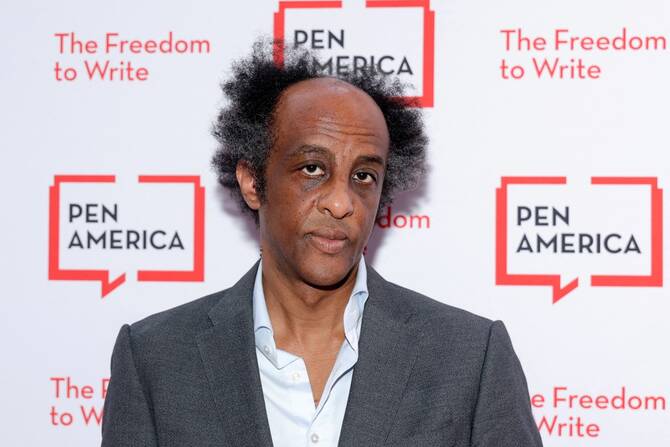

LONDON: PEN America pledged to keep defending Palestinian writers after its president resigned in protest over what he called the organization’s “unethical” and unfair treatment of Palestinians compared with Israelis and Jewish Americans.
The literary and free expression group issued its response after Dinaw Mengestu, an Ethiopian-American novelist and PEN America president, said he was stepping down because the organization had failed to uphold its commitment to defend free expression equally and had diminished the Palestinian experience.
“We’re grateful for Dinaw Mengestu’s leadership of and contributions to PEN America, and we respect that he’s made a decision he believes in,” the organization said.
It added that it “remains dedicated to defending writers under threat, including Palestinians” and that it “believes what has happened there is a genocide.”
Mengestu quit earlier in July after PEN America published a report on the emotional toll and “rising isolation and exclusion” experienced by Israeli and Jewish-American writers after the war in Gaza.
In an early section of the report, titled “A Silent Moratorium” and written by NBC News veteran Lisa Tolin, Pulitzer Prize winner Geraldine Baum and publisher executive Malka Margolies, PEN America said boycotts such as those used by pro-Palestinian activists in the Boycott, Divestment, Sanctions movement represent a threat to writers’ free expression rights.
The report, at the center of the dispute, drew on interviews with about 30 Jewish and Israeli writers, literary agents and translators who described harassment, de-platforming and professional isolation after the war in Gaza.

The former president of PEN America, Suzanne Nossel, speaks onstage during the 2023 Literary Gala at American Museum of Natural History in New York City. (AFP/File)
Mengestu, who was elected PEN America president in December after the departure of Suzanne Nossel, said the report “is not an isolated incident” and continued an approach that defended some rights while neglecting others.
In a follow-up post on Instagram, he said PEN had long characterized BDS as an “assault on the identity of Jewish students,” adding that “the Palestinian experience is diminished almost to the point of erasure.
“What PEN America fails to understand is that a boycott is a form of dialogue,” he said.
PEN America said it has previously opposed anti-BDS laws and defended writers punished for involvement with the movement.
“PEN America has long opposed cultural and academic boycotts, but we have always drawn a clear line between disagreeing with a tactic and defending the right to use it,” the organization said in an email on Friday.
Mengestu’s resignation is the latest upheaval at the organization, which has faced criticism over its response to the war in Gaza.
In 2024, PEN America canceled its annual book awards and global literary festival after a boycott by writers accusing it of anti-Palestinian bias.
When Mengestu was elected president in December after about a decade on the board, he told The New York Times it was important to “mend and rebuild” relationships with writers who felt PEN America had not done enough for Palestinian authors.
“We have worked to help relocate Palestinian writers and artists to other countries,” he said. “For those with no way of remaining in Gaza, we were able to work to help them rebuild new lives.”
In the interview, Mengestu also said the organization lacked transparency, adding that staff members had expressed “anger and frustration” at being kept in the dark about the article on Jewish writers.


