

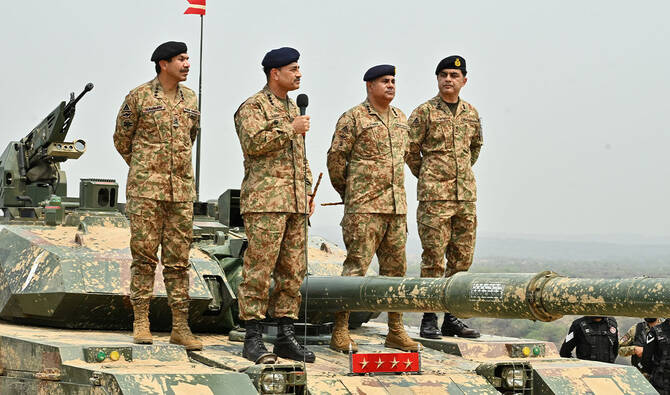

ISLAMABAD: Prime Minister Shehbaz Sharif on Sunday vowed to support Pakistan’s armed forces against internal and external threats amid surging militant attacks and Islamabad’s tensions with arch-rival India, a statement from his office said.
Sharif’s statement came as Pakistan marked 27 years since Captain Karnal Sher Khan, a Pakistan Army officer, was killed during the 1999 Kargil conflict with India. Khan is widely recognized in Pakistan for acts of valor against the Indian armed forces and was posthumously awarded the Nishan-e-Haider, Pakistan’s highest military award for bravery.
Sharif’s statement comes as Pakistan faces surging militant attacks in its Khyber Pakhtunkhwa (KP) and Balochistan provinces bordering Afghanistan. At least three security personnel were killed and 15 injured on Saturday when a vehicle-borne suicide bomber targeted a paramilitary Pakistan Coast Guards checkpost in Balochistan.
“The prime minister reaffirmed the government’s and the people of Pakistan’s unwavering resolve to stand shoulder to shoulder with the country’s armed forces against any external or internal threat facing the nation,” the Prime Minister’s Office (PMO) said in a statement.
Pakistan blames India for supporting militant outfits such as the Tehreek-e-Taliban Pakistan (TTP) and the Baloch Liberation Army (BLA) for carrying out attacks against its citizens and law enforcers. It also accuses Afghanistan of providing sanctuary to these militant outfits and others.
Both Afghanistan and India deny Pakistan’s allegations and blame it for hosting militant groups as well.
Tensions between Islamabad and New Delhi have persisted since May last year, when both countries engaged in a days-long conflict that threatened to escalate into nuclear war before the United States intervened to broker a ceasefire in May 2025.
That ceasefire has managed to hold over a year later, but tensions remain as India continues to hold a water-sharing treaty between the two nations in abeyance.
Pakistan has warned that any attempt by India to divert or block its flow of water will be considered an “act of war.”


