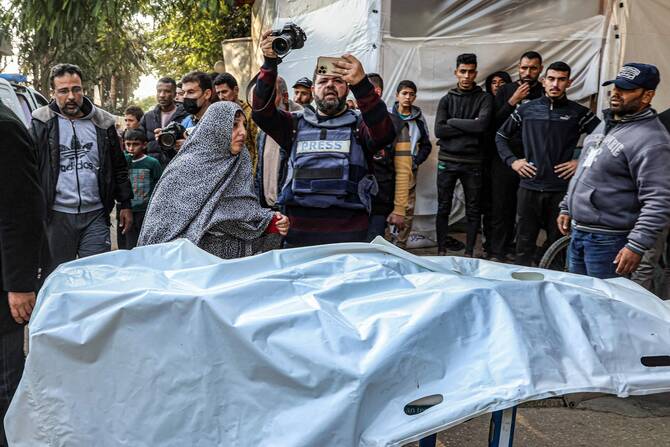

LONDON: Media rights group the Committee to Protect Journalists has voted to keep its current definition of who counts as a journalist, following a week of turmoil over fears that Palestinian and Lebanese reporters killed by Israel could be erased from its casualty database.
On June 25, CPJ announced it had removed 20 names from its database of journalists killed in Gaza and Lebanon after finding that some listed individuals had been identified as Hamas or Palestinian Islamic Jihad combatants — a decision that drew criticism and sparked speculation of an imminent change to how the organisation formally defines who can be included on the list.
Of the names removed, eight were identified as combatants, while a further 12 were delisted for unspecified reasons.
“CPJ frequently considers its definition of a journalist, including a review that took place in 2025 led by CPJ staff and the board’s policy task force,” board chair Jacob Weisberg said in a statement.
“Board members asked for a vote on a plan to look again at this definition and today voted to affirm the existing definition.”
He said it was “not true” that CPJ had planned to change its definition of a journalist to exclude slain Palestinian and Lebanese press killed in the Israel-Gaza war.
“Such unsubstantiated allegations undermine the rigorous documentation of our Middle East and North Africa program over many years, while endangering Palestinian and Lebanese journalists documenting events on the ground today,” Weisberg added.
CPJ defines journalists as people who regularly cover news or comment on public affairs through any medium to report or share fact-based information with an audience. Read our methodology: https://t.co/auYbSaIEGq
— Committee to Protect Journalists (@pressfreedom) July 1, 2026
The board’s vote followed a demand from former board member and Drop Site News publisher Nika Soon-Shiong, who had warned that reopening the definition could expose CPJ’s database to political pressure.
“Reopening the question of ‘who is a journalist’ carries profound implications for the individuals CPJ protects and for the organizations with which they are affiliated,” Soon-Shiong wrote in a letter to the board, raising concerns about the review’s scope before her departure — which CPJ said was due to the expiry of her term, although the timing drew scrutiny.
CPJ’s longstanding policy has been to include journalists working for state-backed media, as well as those affiliated with outlets linked to militant groups, provided they are not engaging in combat or inciting violence with imminent effect.
The reversal comes after a fierce backlash this week over concerns that CPJ was reconsidering its definition of a journalist, at a time when media workers face mounting and varied threats.
The controversy began when CPJ announced it was conducting a full review of its database of journalists killed since the start of Israel’s war on Gaza.
In a statement, the New York-based organisation said obituaries published by Hamas and Palestinian Islamic Jihad had identified some individuals it had previously listed as journalists as combatants.
The announcement sparked alarm within and outside the organisation, with critics of Israel’s conduct warning that the review risked legitimising Israeli efforts to portray Palestinian reporters as militants after killing them.
Palestinian writer Mohammed El-Kurd claimed CPJ was moving to exclude Palestinian and Lebanese reporters who worked for publicly funded media outlets, arguing the shift appeared to follow pressure from The Washington Free Beacon, which has repeatedly portrayed Palestinian and Lebanese journalists as militants or used their political affiliations to justify their killings by Israeli forces.
Before the 20 removals, CPJ’s preliminary tracking in Gaza, the West Bank, Lebanon, Israel, Yemen and Iran had reached 263 — making Israel the country that has killed more journalists than any on record.
CPJ’s database carries significant institutional weight, used by international media, UN bodies and diplomatic actors as an authoritative record of journalist deaths in conflict.