

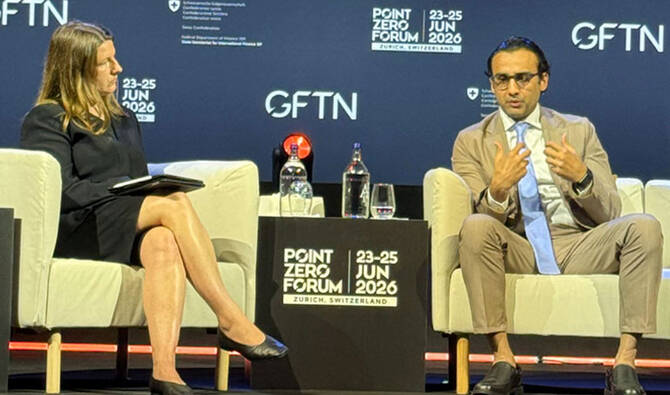

ISLAMABAD: Pakistan called for developing economies to play a greater role in shaping the future of tokenized finance and urged global policymakers at the ‘Point Zero Forum’ in Zurich to ensure emerging markets have a voice in setting standards for digital financial systems, the Pakistan Virtual Assets Regulatory Authority (PVARA) said on Saturday.
The annual Point Zero Forum, an initiative of the Global Finance and Technology Network (GFTN) to promote a policy and technology dialogue in financial services, convenes central bankers, regulators, policymakers, and industry leaders to address the latest developments in financial technology and the future of finance.
Pakistan is one of the world’s largest digital asset markets and ranks third in the world in terms of public crypto adoption, behind only India and the United States, according to China Analytics’ 2025 Global Crypto Adoption Index. The reasons for this include a young, mobile-first population, one of the world’s largest freelance economies, over $38 billion in annual remittances, and the growing use of stablecoins as a hedge against inflation.
PVARA Chairman and State Minister Bilal bin Saqib took the centerstage at the Point Zero Forum, which ran from June 23 till June 25 this year, and spoke about how the rules of the financial systems are being redefined, and that Pakistan intends to play its role in shaping these rules.
“The financial system is now being automated through software and blockchain, and software knows no borders. We have always thought of money as something that only the state can control. One flag, one border, one currency. That era is coming to an end,” he said.
“Pakistan is adopting a Pakistan First approach to digital assets,” he said. “Our position is that developing economies should play a role in setting the rules for tokenized finance, not simply inherit a framework built elsewhere.”
Saqib participated in the forum’s panel, ‘Unchaining Tokenized Money: Stablecoins, CBDCs, and the Race for Scale,’ and was joined by Dr. Mampho Modise, Deputy Governor of the Reserve Bank of South Africa.
The session examined where tokenized money has been used, what barriers are preventing it from becoming widespread, and how regulators, banks, and technology providers can create synergy between Central Bank Digital Currencies (CBDCs), stablecoins, and tokenized systems.
Saqib said in countries where millions of people are already using digital assets, the question is not whether to allow them or not, but the question is “whether we should be autonomous or leave it to others,” according to PVARA.
“Those countries that will succeed will have the courage to say one thing: It’s happened, our people are already here,” he said. “Our responsibility is not to stop economic innovation, but to better manage it.”
In addition to the main stage, Saqib participated in several high-level, invitation-only sessions that brought Pakistan into direct dialogue with central bankers and financial leaders from Singapore, Japan, the Philippines, the Gulf region, and Europe, where the world’s largest banks and prominent digital asset institutions were also present, PVARA said.
The sessions discussed the same question that faces every developing economy today: how to leverage the benefits of dollar-denominated tokenized money without having to give up fiscal sovereignty, control over payment systems, or oversight of its financial flows.


