


NEW YORK CITY: The escalating conflict in Sudan’s North Kordofan state risks triggering a humanitarian catastrophe on the scale of last year’s siege of El-Fasher.
The warning from UN officials to the Security Council on Friday came as drone strikes intensified around the city of El-Obeid, putting an estimated 500,000 civilians at immediate risk.
Late last year, Sudanese paramilitary group the Rapid Support Forces captured the city of El-Fasher after an 18-month siege, unleashing an unrelenting wave of ethnic killings, mass executions and sexual violence against civilians. A UN human rights investigation said the violence amounted to possible war crimes and crimes against humanity.
UNICEF’s deputy executive director, Hannan Sulieman, told the council that children “are paying the highest price” in the civil war between the RSF and the Sudanese Armed Forces that began in April 2023, and in which more than 5,000 youngsters have been killed or maimed.
“The children of Sudan cannot survive on expressions of concern,” she said. “They need protection. They need food, water, healthcare and education. They need humanitarian access. And above all, they need this war to end.”
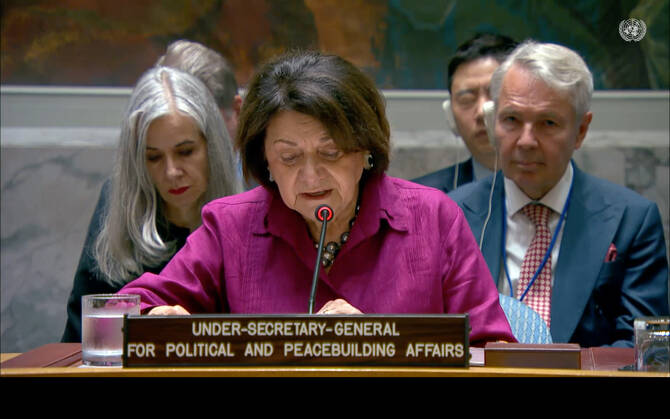
Rosemary DiCarlo, the UN’s under-secretary-general for political and peacebuilding affairs, told council members that drone attacks had increased sharply around El-Obeid over the past two weeks, even as the RSF expanded its presence around the city.
The UN’s high commissioner for human rights, Volker Turk, previously warned of an “impending human rights disaster” should the offensive continue.
DiCarlo said that a full-scale battle for the city would trigger fresh waves of displacement and “further entrench the parties’ positions in negotiations, narrowing the space for mediation.”
She added: “The window to avert a wider escalation in El-Obeid is rapidly narrowing.”
Sulieman drew a direct comparison between the current situation and last year’s battle for El-Fasher.
“We must not allow history to repeat itself,” she said, calling on the council to secure humanitarian corridors out of El-Obeid and establish child-protection services for young people separated from their families.
“Children cannot endure, and we cannot allow, another El-Fasher,” Sulieman added.

UNICEF’s deputy executive director, Hannan Sulieman, told the council that children “are paying the highest price” in the civil war between the RSF and the Sudanese Armed Forces. (Screenshot/UNTV)
In the wider conflict, DiCarlo said fighting continues on several fronts, with Kordofan remaining the epicenter, and intensified clashes around Dilling, Kadugli and Babanusa.
She said drone strikes targeting bridges and transport corridors across Darfur and Kordofan had disrupted humanitarian routes, while fighting also continues in White Nile and Blue Nile states, in places such as Kurmuk, Geissan and Bau.
DiCarlo warned that the rainy season, which has traditionally caused fighting to ease, would bring no such respite this year because of the surge in drone warfare.
To illustrate the cascading toll of attacks on infrastructure, Sulieman highlighted a strike last year on energy infrastructure in White Nile state that knocked out a major water-treatment facility,
forcing families to collect untreated water from a river. Within weeks, she said, thousands of cases of cholera were reported, children died and schools were forced to close.
“In Sudan, one attack does not end when the explosion stops,” she said. “A single strike can trigger a chain reaction that deprives children of safe water, healthcare, education and protection.”
Nearly half of school buildings in Sudan can no longer function as classrooms, Sulieman added, forcing at least 8 million children out of school. Nearly 19.5 million people face acute hunger, with several places already at or close to famine thresholds, and an estimated 825,000 children under the age of 5 are expected to suffer severe acute malnutrition this year.
DiCarlo also noted that tensions between Sudan and Ethiopia have been rising since early May over allegations of interference in each other’s internal security, as well as continued friction between Sudan and Chad following border clashes this year.
“These tensions risk becoming drivers of further escalation, drawing neighboring states more directly into the conflict,” she said.
On the diplomatic track, DiCarlo said the Quintet — a grouping that includes the African Union, the EU, the Intergovernmental Authority on Development, the League of Arab States, and the UN — convened consultations early this month in Addis Ababa with a broad range of Sudanese civilians who endorsed the need for a Sudanese-owned process of political dialogue facilitated by the Quintet.
But she cautioned that diplomatic efforts “cannot substitute for the political will required to end this war,” and urged the council to follow up on the situation in El-Obeid with stronger, unified action.


