

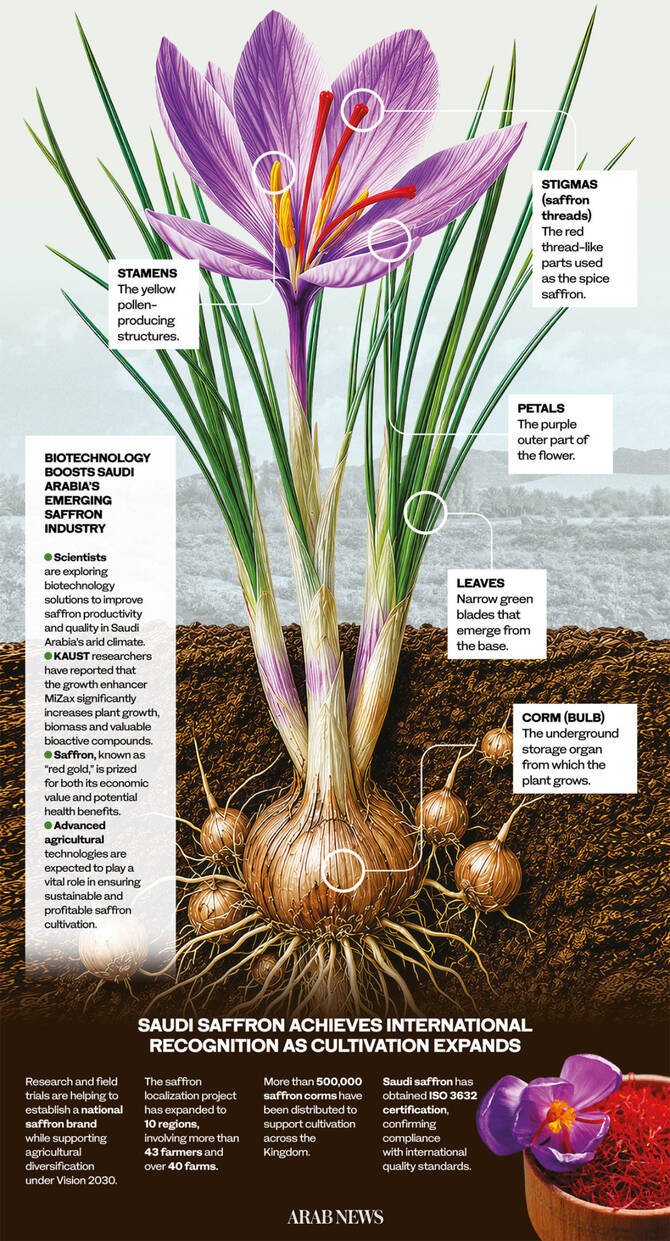

MAKKAH: As Saudi Arabia expands saffron cultivation across regions including AlUla, Tabuk and Al-Baha, scientists are exploring ways to improve the productivity and quality of one of the world’s most valuable crops.
Prof. Salim Al-Babili, associate vice president for research for plant science at KAUST, told Arab News that biotechnology could play a key role in supporting the Kingdom’s emerging saffron industry and helping growers overcome the challenges of cultivating the crop in arid environments.
Known as “red gold,” saffron is prized not only for its economic value but also for its bioactive compounds, which have attracted growing interest for their potential health benefits.
Al-Babili said: “Cultivating the delicate Crocus sativus under arid climatic conditions presents considerable biological and agronomic challenges.”
Addressing these challenges requires innovative scientific solutions.
“The application of MiZax to saffron has produced remarkable results, significantly improving plant growth, stigma biomass and the accumulation of valuable bioactive compounds. These improvements translate directly into higher yields, better quality and enhanced nutritional value.”
“Saffron production is highly labor-intensive, requiring approximately 150,000 flowers to produce just 1 kilogram of spice.”
“As Saudi saffron continues to gain international recognition, the integration of advanced biotechnology with agricultural practice will be essential for ensuring sustainable and profitable cultivation.”
Saudi saffron is gaining international recognition through research and field initiatives led by the National Center for Sustainable Agriculture Research and Development, known as Estidamah, as part of efforts to localize cultivation of the high-value crop and align production with international standards.

Saffron fields in the Al-Jouf region. (Supplied)
Khalid Al-Ruhaili, director general of Estidamah, told Arab News that the center has achieved a major milestone by securing international certification confirming compliance with ISO 3632 standards.
The certification followed successful laboratory testing at accredited international facilities, underscoring the quality of Saudi saffron and strengthening its competitiveness in global markets.
“This achievement comes as part of the saffron cultivation localization project launched by the center in 2024,” Al-Ruhaili said.
“Since its launch, the project has followed an integrated approach combining scientific research with field implementation, beginning with assessments of agricultural suitability, followed by field trials and ultimately improving product quality in accordance with international standards.”
The project has expanded across 10 regions in cooperation with more than 43 farmers. Research findings have been applied at over 40 farms covering more than 364,000 sq. meters, while more than 500,000 saffron corms have been distributed to growers.
According to Al-Ruhaili, the initiative has helped transfer knowledge from research institutions into practical agricultural applications and strengthened prospects for localizing saffron cultivation in Saudi Arabia.
To implement the project, the center adopted multiple cultivation models, including open-field farming, vertical farming and controlled-environment agriculture, enabling researchers to compare productivity and crop quality under different growing conditions.
“The diversity of cultivation methods enabled a more precise understanding of the plant’s behavior and helped identify the most suitable agricultural practices for each environment,” Al-Ruhaili said.
Trial results showed saffron is highly influenced by climatic conditions. The crop performs best at temperatures between 20 and 25 degrees Celsius during its initial growth stage and can withstand temperatures as low as minus 14 degrees Celsius.
DID YOU KNOW
• Saffron does not require high fertilizer inputs and can be grown using organic fertilizers.
• Saudi Arabia is among the world’s largest saffron importers, accounting for roughly one-third of global imports.
• Laboratory testing confirmed that saffron produced in Jouf achieved first-grade classification under international standards.
Cool weather and moderate humidity during autumn and winter improve productivity. Trials also showed that cultivation during October and November — particularly in northern and northwestern regions and some highland areas — provides ideal growing conditions and may support a longer production season than in some other saffron-producing countries.
The project also examined planting densities ranging from about 100 to 200 corms per sq. meter.
According to Al-Ruhaili, the optimal density depends on whether farmers prioritize long-term production or intensive short-term cultivation.
He said saffron is a low-water-consumption crop, requiring between 3,000 and 3,500 cubic meters of water per hectare during the growing season. In some regions, rainfall can partially meet irrigation requirements.
However, excessive irrigation remains one of the main challenges because it increases the risk of fungal diseases. The use of organic fertilizers also improves soil properties and supports sustainable production, he added.
Field trials and cultivation practices have had a direct impact on product quality. Laboratory analyses confirmed that Saudi saffron complies with ISO 3632 requirements, which assess concentrations of key compounds including crocin, responsible for color; picrocrocin, responsible for taste; and safranal, responsible for aroma.
The results enabled Saudi saffron to achieve the highest classification under the standard.
Al-Ruhaili noted that saffron is among the world’s most valuable medicinal and aromatic plants. The commercially used portion consists of the red stigmas, while the flower also contains purple petals and yellow stamens.
He added that characteristics such as color, aroma and taste are influenced by growing conditions, agricultural practices and post-harvest handling.

Saudi saffron is gaining international recognition through research and field initiatives. (Supplied)
Beyond production, the project is contributing to the development of agricultural value chains, empowering farmers and increasing crop diversification through the cultivation of high-value products.
Al-Ruhaili added that saffron also holds cultural significance in Saudi Arabia because of its use in Saudi coffee, reflecting traditions of hospitality and generosity while strengthening the presence of locally produced saffron in everyday life.
To support farmers, Estidamah has launched specialized training and capacity-building programs that include transferring international expertise, supplying saffron corms and drying equipment, and providing continuous field support to encourage adoption of best practices throughout the production process.
As the project expands, the center is working to increase cultivation in environmentally suitable regions, develop local corm production, strengthen value chains from production to marketing, and establish a national brand for Saudi saffron to boost its presence in domestic and international markets.
Nawaf Al-Duwaiban, who has led one of the successful saffron cultivation initiatives in the Al-Jouf region, told Arab News that the localization project, implemented through cooperation between King Saud University and Estidamah, represents a strategic step toward strengthening farmers’ capabilities in line with Saudi Vision 2030.
The project included the distribution of more than 60,000 saffron bulbs in Al-Jouf, alongside specialized training programs and field workshops that helped improve production efficiency and deliver promising results, he said.
In another success story, farmer Aafat Al-Khamali, who cultivates saffron in AlUla, said the project’s achievements were the result of cooperation among King Saud University, Estidamah and local farmers.
He said the partnership helped transfer scientific knowledge into practical application through training and field trials, contributing to improved product quality.
Experiences in Hail, Al-Jouf and AlUla demonstrate the success of integrating scientific research with field expertise, supporting the sustainability of saffron cultivation and advancing Saudi Arabia’s efforts to diversify agricultural income sources while building a globally competitive national brand.


