

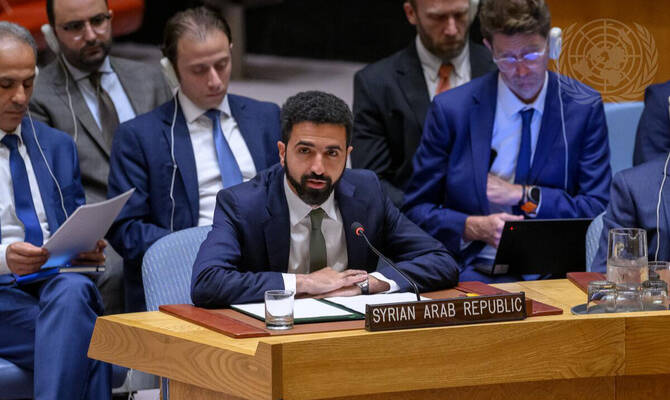

NEW YORK CITY: Syria’s permanent representative to the UN, Ibrahim Olabi, told the Security Council on Thursday that Israel’s true fear relating to Syria was never instability in the country, but the collapse of a regime that tortured and gassed its own people.
Arguing that when that collapse took place Israel lost any remaining justification for its continued military presence in southern Syria, he suggested the continuing occupation amounts to an attempt to seize land for political gain rather than to address any genuine security threat.
His comments came as the council unanimously voted in favor of a resolution renewing the mandate of the UN Disengagement Observer Force, a peacekeeping mission established in 1974, after the 1973 Arab-Israeli War, to monitor the ceasefire and demilitarized area of separation between Israeli and Syrian forces.
Olabi said residents of Qunaitra and surrounding communities in Syria near Israeli-held areas had been unable to celebrate the fall of the Assad regime on Dec. 8, 2024, the way the rest of the country had. He described foreign military incursions, interference in daily life, and abductions in areas into which Israeli forces later advanced. He said he continues to receive messages from affected families even while he is in New York.
Israel’s argument that its presence was temporary and justified by changes inside Syria “was never valid” and certainly “today it is not,” he told council members.
He highlighted the stabilization of the country post-Assad, its reconstruction efforts, and its cooperation with members of the Security Council on counterterrorism efforts and chemical weapons compliance as evidence the Israeli rationale for occupation no longer held water, even rhetorically.
In a question posed directly to the council, Olabi asked whether Israel’s continued presence suggested it had, in fact, preferred the status quo under the Assad regime.
He cited as proof that Damascus does not seek confrontation a request by the new Syrian authorities for increased funding for the Disengagement Observer Force, and more monitoring. Meanwhile Israel remains in violation of the 1974 disengagement agreement, a conclusion he said has been documented in reports submitted to the council.
The resolution, jointly drafted by Russia and the US, was adopted by all 15 council members on Thursday. Olabi welcomed its reaffirmation of the validity of the disengagement agreement, and its prohibition of any military presence in the area of separation, describing these as “binding obligations” that Israel continued to violate.
Recent Israeli statements ruling out any withdrawal from Syrian territory were especially concerning, he said, given the parallel US-brokered mediation efforts in talks between Damascus and Israel under President Donald Trump, negotiations he noted were being conducted publicly for the first time.
Olabi added that he hoped he would not to need to raise the issue at the council’s next session on Syria in six months “not because it will be ignored, we will never ignore it … but because it has been resolved and stability restored.”
Syria, he said, was fulfilling its responsibilities and it was Israel’s turn to do the same.
Israel's Ambassador to the United Nations, Danny Danon said his country supported the extension of UNDOF's mandate.
He added: “We remain committed to maintaining stability along Israel's northeastern border and ensuring the security of the residents of northern Israel.”


