
DUBAI: Just before the COVID-19 pandemic hit, Zein Izzat Sajdi was preparing to move from Amman to London to work for a PR firm in the UK capital. However, when lockdowns meant that her move was postponed, Sajdi started posting song covers on her Instagram account. They quickly became extremely popular, and gained enough confidence to begin releasing her own material, in both English and Arabic.
Today, that move into the London PR world still hasn’t happened. Instead, Sajdi is known simply as Zeyne, and her music career is flourishing, with tens of millions of streams across various platforms. In September, she will begin a European tour in support of her debut album “Awda” (Return), which dropped in October 2025. She has collaborated with artists including Palestinian singer-songwriter and rapper Saint Levant and Bayou and has received critical acclaim for her eclectic sound, which incorporates Eastern and Western influences including R&B, hip-hop, jazz, classic Arabic music, and more, all while remaining distinctively her own.
Here, Zeyne discusses her album, the importance of her Jordanian and Palestinian roots, and the experience of breaking through to a global audience.
People often say your success is not just about hits, but that your identity is the backbone of your work. What does your identity mean to you?
Being Palestinian-Jordanian shapes how I think, how I feel, how I write, how I sing. I never had to put my identity into the music — it was there from the first note. But it’s never been a banner I hold up; it’s just part of me, and part of everything I make. Over time, I stopped seeing my roots as holding me back and started seeing them as something I carry with me — a source of strength. I never went looking for global fame at the cost of where I come from, and I never will.

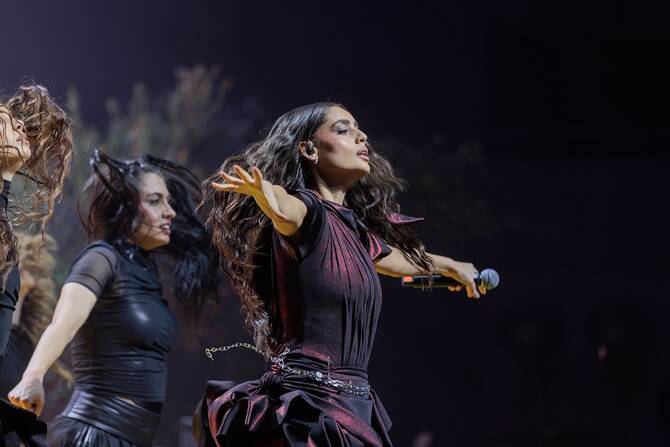
Zeyne performing at Balad Beast in Jeddah in 2025. (Instagram)
You called your album “Awda.” What ‘return’ are you referring to?
It’s less about returning to a place than about returning to a part of myself I had lost touch with. While I was working on it, I kept stopping to ask what actually mattered to me, what my real voice sounded like. So the album became a kind of reconciliation with myself, not just a record I was putting out. It’s the most personal thing I’ve ever made. And I learned something: letting yourself be emotionally exposed is not a weakness; it’s where the honesty in songwriting comes from. In the beginning I worked hard to seem strong, like I had it all together. “Awda” finally gave me room to say things out loud that I used to circle around and avoid. I no longer ask myself to pick where I belong, or to choose one side over the other. I am all of it: Jordan, Palestine, the stories I heard as a child, the songs that raised me. Pull out any single thread and I’m not the same person.
How do you think you’ve managed to incorporate your heritage into a modern sound without hollowing it out?
It comes down to honesty. My team and I are careful to treat heritage with respect, not as something we stick on from the outside. When dabke — or any traditional element — shows up in my work, it’s because it’s part of my story. We present it and produce it in a modern way, but heritage is not a decoration I add. It’s part of what the work actually is.
What have you taken from dabke, as a performer?
It’s given me a different relationship with the ground beneath me, and with the people around me. That sounds simple, but on a stage it is enormous. Dabke is about rootedness, belonging, a rhythm you keep together, something you do as a group. It changed how I understand movement, and it taught me that the body can hold memory and history in the same way that words and music do. Dabke demands real physical strength, discipline, and endurance, while also carrying a rich cultural and human significance. That’s what I love most about it; it combines physical presence and meaning at the same time, providing me with a form of expression that that goes beyond movement itself.
What legacy do you hope to leave through your music?
The feeling. Not the numbers, not the trends, not the production, but the emotion the songs carry. That’s the power of music for me: Emotions are a universal language that transcends borders and cultures, and I hope my songs remind people that what connects us as human beings is far greater than what sets us apart. If someone hears one of my songs years from now and feels a little less alone, a little closer to themselves, then my music did exactly what I wanted it to do.
You’re one of the region’s most prominent rising female voices. What does that mean to you?
It makes me happy, but I try not to load it with more than it can hold. What matters in the end is staying honest with myself and with the people listening. And if a young girl sees me and believes a little more in her own dream because of it, that’s about the most beautiful thing art can do.
Do you feel a particular responsibility to young Arab girls?
I do. I think about it the most when I’m on stage. There’s real power in a girl watching someone who looks like her — who comes from somewhere familiar — go after her dreams without giving up who she is. I want Arab girls to understand that their roots and their culture are not standing in the way of success; they’re part of what makes them stand out.
What stereotype about Arab women most frustrates you?
The one that says a woman has to choose between things that supposedly cannot go together: strong or soft, modern or rooted, local or global. An Arab woman can be all those at the same time. My entire artistic identity is built on refusing to be categorized and showing something fuller, more layered, more alive. Real strength, for example, lies in not covering up your fragility, but being able to own it. For a long time, I felt I had to look strong and composed no matter what. Then I realized that the moments when I let people see the human in me are the most honest, and the ones that land hardest. Honesty is the most direct path to building a genuine connection with people.
What did the women in your family teach you?
That strength does not need to be loud. My mother and my sister were steady, patient — the kind of people who keep going regardless. They taught me that endurance is its own strength and that love, family, and roots are not things you set down as you get older; you take them with you.
What has changed since you started to gain international recognition?
Plenty. On the practical side — the scale, the speed, the kinds of opportunities and obligations. But the thing I worked hardest to hold onto was my relationship with the music. I still believe that writing, composing, and rehearsing has to stay private. The honesty of those moments is what gives everything else its worth.

Zeyne arrives on the red carpet of the inaugural Franca Fund Gala in Qatar last year. (AFP)
How do you shut out all the noise online?
I put distance between myself and the screens whenever I feel I need to. Sometimes I step away before a writing session and give myself time to read, to move, to think. Some of the best ideas arrive when you pull back a little and let yourself listen to your own voice.
Does fame frighten you?
Not the fame itself. What frightens me is losing that private space that any person needs to stay connected to who they are. There’s an inner world I work to protect, because that’s where the ideas and the songs come from. When everything turns into content, into performance, then guarding that space matters even more.
What do people most often get wrong about you?
That I’m closed-off or old-fashioned. It’s the exact opposite. I’m wide open to other cultures and experiences, and I love to experiment. People also assume the confidence they see on stage means it’s easy for me, but behind all that there’s a lot of work, a lot of exhaustion, a lot of doubt.
Was there a price for success that no one saw?
Everyone who takes this road pays something, and the price is different for each person. For me it’s cost time — time I can’t give to the people I love, moments I have to miss for work and travel. There’s an emotional cost, too, in being public: dealing with assumptions and judgments that have nothing to do with who I really am. But it’s part of the journey.
How did you come to collaborate with Saint Levant?
Marwan (Abdelhamid, aka Saint Levant) and I became friends over Instagram. I sent him “Balak” and asked if he wanted in. He was in the US at the time, so he recorded his part from there. When he came to Jordan that summer, we shot the video. It began as a virtual collaboration and grew into a steady one; sometimes I help on his songs, sometimes he helps on mine. We play shows together now and then too. He’s like a brother to me.
You performed in front of thousands of people at Ed Sheeran’s concerts (in Bahrain and Qatar last year). What did you learn from that experience?
Performing in front of more than 65,000 people as an Arab artist, singing in my own language and staying true to my identity, was incredibly powerful. What struck me most was Ed Sheeran’s ability to connect with his audience on a personal level, no matter how large the crowd; that’s a lesson I try to bring to every performance.
How would you describe your relationship with MDLBEAST in Saudi Arabia?
I’ve been working with MDLBEAST for about two years. They released my album, and I’m deeply grateful for that opportunity. I’ve also performed at Soundstorm in Riyadh several times. Performing on that stage for an audience that’s passionate about music is truly special.
What dream of yours has not come true yet?
I still have many dreams: stages I hope to perform on, musical experiences I want to explore, and new sounds I want to discover. But what matters most to me today is creating a new artistic chapter that surprises people while remaining true to the authenticity I believe in.
What do you imagine your life will look like 10 years from now?
I imagine being calmer, more confident, and more courageous in embracing new experiences. I hope to have created work that leaves a real impact while staying connected to the roots and values that inspired me, regardless of how my artistic journey evolves.
This story is adapted from an article that first appeared in Arab News’ sister publication, the Arabic-language magazine Hia.