

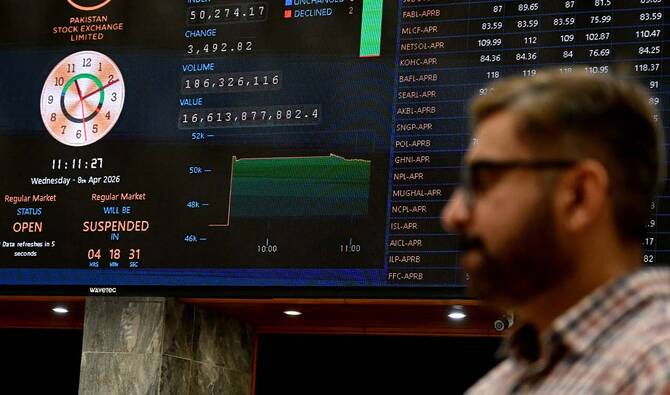

KARACHI: For 23-year-old Isra Ghous Rasool, Pakistan’s stock market offers a chance at money and something else: a break from the constant nine-to-five job hassles that most salaried people dream of escaping.
Rasool actively invests in stocks and compares them against commodities such as gold, cryptocurrency and the foreign exchange market.
And she is far from being the only Gen Z Pakistani trying her hand at stock investing.
Rasool is one of 180,148 retail investors who entered the Pakistan Stock Exchange (PSX) from August to May in the outgoing fiscal year, as per the PSX data. Investors aged 18 to 30 made up more than 41 percent of all new registrations in the period, totaling 74,629.
In 2023, Pakistan was on the brink of a sovereign default and inflation surged to a record 38 percent. Economic indicators have improved since then, and the stock market has joined the recovery. The benchmark index rose by 1.1 percent to 179,571.27 points on Wednesday. The gain lifted the index’s year-to-date advance to 43 percent or 53,944 points, according to the PSX’s data.
“Quite literally, the only reason is that it’s a way for me to get money while I’m sitting at home and not, you know, going out and doing your classic nine-to-five,” Rasool told Arab News on Wednesday, explaining why she entered the stock market.
And the PSX has provided her with dividends. Rasool said she has increased her investment portfolio sixfold to Rs100,000 [$360] this year.
When asked if she saw equities as a path to wealth creation or a hedge against surging inflation, Rasool said investing in stocks was a “good opportunity” for a young investor like herself without a stable income.
Abdul Qadir, a 23-year-old student of Bachelor of Business Administration specializing in finance and investments, said he has grown his stock portfolio by 800 percent to Rs450,000 [$1,620] in about a year.
He started with Rs50,000 [$180] by buying his first stock in Al Shaheer Corporation.
“That’s a meat company and then slowly and gradually, I invested more and more amount as soon as it started attracting me,” he told Arab News.
He invests in oil, banking and automobiles sectors, and runs a small mutual fund that manages funds almost equal to the size of his own portfolio.
Qadir charges a brokerage fee to investors whose funds he manages, while offering an average return of 8 percent, well below the 66 percent annualized dollar return Pakistan’s benchmark KSE-100 Index has been delivering over the past three years.
’SOMETHING THAT MULTIPLIES’
Aamir Mushtaq Kanju, PSX’s deputy general manager of lead product management and research, said the stock market has proven to be a powerful wealth multiplier this year.
He said the stock market has delivered an annualized return of about 66 percent in dollar terms over the past three years, the highest in the region.
“Most of the return was driven by the macroeconomic stability, which our government has done so well in terms of IMF (International Monetary Fund),” Kanju said.
Pakistan has stabilized its fragile economy with a $37 billion IMF loan program.
Kanju said Gen Z’s share in total Unique Identification Number (UIN) account openings is “quite significant,” adding that the average monthly account openings at PSX had tripled to 15,000 this year.
“Gen Z accounts for around 40 percent of the total accounts opened,” he said.
However, the PSX’s current data shows that Pakistan’s investor population versus its total population size stands at less than 0.2 percent compared to India’s six percent and Bangladesh’s 1-2 percent.
“As an agreed strategy with the SECP, our target for the next two years is to reach 2.5 million UINs from 563,000, which comes to around 1 percent of the population size,” Kanju said.
Jibran Sarfaraz, an equity analyst at Munir Khanani Securities Ltd., said investing in stocks will be a “learning process” for Gen Z.
He said investing in equities will teach younger minds how a listed company functions, what is an earning and what a profit and loss account is.
“There will be financial information in this as well as learning,” he said.
Qadir wants to increase his investment portfolio to Rs10 million [$35,971]. Rasool is adamant on staying on as an investor, saying that she believed Rothschild and Goldman Sachs “built their wealth” the same way.
Also, she feels a nine-to-five job, in this economy, cannot support her dreams.
“We need something that multiplies,” she said.


