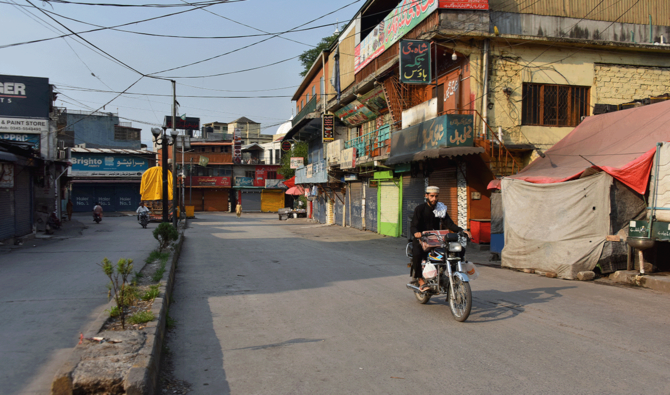

MUZAFFARABAD: A territory-wide shutdown in Azad Kashmir has brought daily life to a standstill after the region’s deadliest unrest in years left at least 24 people dead in nearly two weeks of protests.
The confrontation between local authorities and supporters of the recently banned Joint Awami Action Committee, or JAAC, poses a sensitive challenge for Islamabad, which frequently criticizes Delhi’s handling of dissent in Indian-administered Kashmir but is now facing anger in the territory under its own control.
The unrest began ahead of a June 9 strike called by the JAAC in protest against the reservation of 12 seats for refugees in the July 27 elections to the region’s 45-seat legislative assembly. The refugees live in Pakistan after being displaced from Indian-administered Kashmir.
Protests had already grown in the days before the shutdown, with government officials, speaking on condition of anonymity, saying at least 20 civilians were killed between June 6 and June 14 and dozens more wounded.
Regional police chief Liaqat Ali Malik said four officers had been killed and 97 wounded in clashes with protesters, while 515 people had been detained.
Thousands of JAAC supporters are now camped out on the outskirts of Rawalakot, about 100 km (62 miles) south of Muzaffarabad, the regional capital.
The government has responded by shutting main roads, blocking the Internet and restricting media access to much of Kashmir.
‘NOT EARNED A SINGLE RUPEE’
In Muzaffarabad’s Upper Adda commercial district, menial laborers sit idle beneath a red-brick monument, waiting for work that has not come.
“Since June 9, I have not earned a single rupee,” said day laborer Ikhlaq Ahmed, 27, from a remote village.
The usually busy Upper Adda, once filled with grocers by day and food stalls by night, is mostly silent.
Medical stores and some grocers have begun opening for limited hours, and fruit and vegetable sellers have cautiously returned, but other businesses remain closed.
Bank notices blame the government’s suspension of Internet and satellite services for the closure of ATMs and banking operations, while petrol stations are also shut due to an official order.
For workers like motorcycle taxi driver Asif Naz, the crisis is unbearable.
“Those with resources may sustain it,” he said, “but for blue-collar workers like us, it is self-slaughter.”