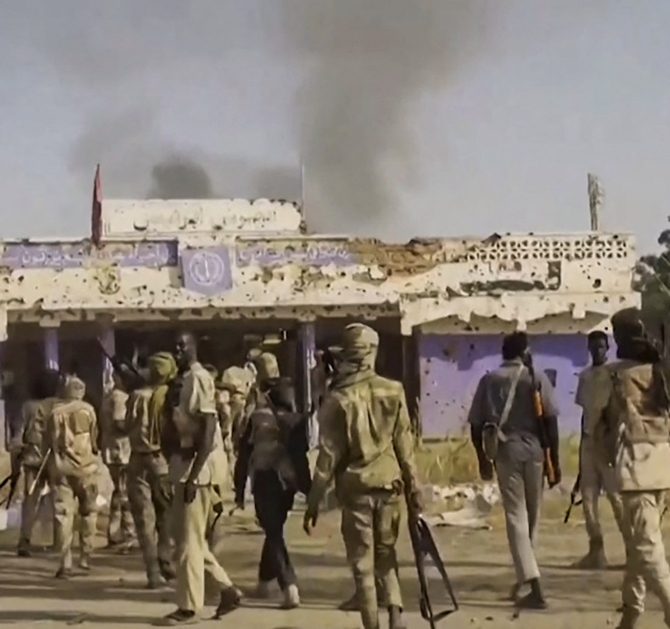

NEW YORK CITY: The UN’s secretary-general and its human rights chief on Thursday issued urgent warnings over an imminent offensive by the Rapid Support Forces against El-Obeid, the capital of Sudan’s North Kordofan state, and called on the international community to intervene before the city becomes the next scene of mass atrocities.
Secretary-General Antonio Guterres and High Commissioner for Human Rights Volker Turk each sounded the alarm over reports of a significant buildup of RSF troops around El-Obeid, amid intensified drone strikes and artillery shelling that have targeted the city over the past two weeks.
“We have seen this playbook before,” Turk said as he called for the madness to end. “We know where it led then, and cannot now allow a repeat of the preventable atrocities we documented in El-Fasher and Zamzam IDP (internally displaced persons) camp in North Darfur last year.”
An offensive risked a fresh wave of serious crimes in breach of international law against a civilian population already strangled by siege-like conditions that have persisted for more than 18 months, he added.
Guterres echoed these concerns, warning that the deployment by the RSF of substantial military reinforcements around El-Obeid might be indicative of an imminent ground offensive “potentially placing yet another major population center in Sudan at grave risk of large-scale violence.”
The Paramilitary RSF and the Sudanese Armed Forces, who jointly staged a military coup to take control of Sudan in October 2021, have been locked in a civil war since April 2003.
Seif Magango, a spokesperson for the Human Rights Office, told Arab News that the warnings about El-Obeid were triggered by information received by UN officials that highlighted the possibility of a repeat of a scenario already witnessed in Sudan, the 18-month siege of El-Fasher between April 2023 and October last year.
“The RSF besieged the city of El-Fasher for many months on end and finally started shelling and bombarding it; I think over 1,000 people were killed in a matter of days,” he said.
“The reports we received regarding El-Obeid point to the possibility that the same could happen, and that is concerning.”
Drone strikes have emerged as a central concern. Over the past two weeks, the city has been bombarded by dozens of strikes that targeted fuel stations and trucks, and killed civilians, including at least one humanitarian worker.
Magango told Arab News that while both sides in the conflict have used drones, the RSF has been the primary operator.
“We see a lot of usage of drones by the RSF to attack markets, bridges, schools — and in an indiscriminate way,” he said.
Turk called on all states with influence over the parties involved in the conflict to act immediately to deescalate the situation, and for weapons that are fueling the atrocities to stop flowing into the country.
Asked which states or regional forces the high commissioner believes carries the greatest responsibility to intervene, Magango said that Turk’s call went out to the wider international community.
“The high commissioner has called on all the international community to come together, but in particular members of the Security Council and other parties that have any influence on the RSF — without naming any — because at the end of the day this is of concern for everyone,” he said.
Asked by Arab News which countries Guterres was specifically appealing to, the secretary-general’s spokesperson, Stephane Dujarric, said: “There are a lot of external parties, not all of which, let’s be honest, have been playing a very constructive role.”
Both officials invoked the specter of El-Fasher, where the UN documented summary executions, abductions, arbitrary detentions, widespread sexual violence, and mass civilian casualties during the RSF offensive there.
Turk warned that there was a high risk of a repeat in El-Obeid, and called on the armed parties to take immediate steps to deescalate the situation.
Magango said the warring factions “have to stop it: all attacks on civilians and infrastructure, and the pain and suffering they have inflicted on the people of El-Obeid and the whole country,” as he reiterated the high commissioner’s direct message to RSF leadership: “They must immediately deescalate and not proceed with this impending offensive.”
The warnings came as the UN officials expressed frustration that Sudan — now in its fourth year of conflict and scene of the largest humanitarian crisis in the world — continues to receive inadequate international attention.
“The high commissioner has long had the concern that this has been the forgotten conflict, with attention drawn in other directions,” Magango told Arab News.
“There is a need for more attention to alleviate this suffering before it reaches another milestone, because recently we crossed a three-year milestone, a sad one.”
The conflict has triggered mass displacements, widespread conflict-related sexual violence and what Magango described as “a disaster of unequaled magnitude.”
Guterres reiterated his call for an immediate cessation of hostilities and urged both sides in the conflict to engage with international efforts, including those of his personal envoy for Sudan, to facilitate deescalation and a reach negotiated settlement.
“Far too many times in this conflict, clear warnings have failed to trigger concerted action by the international community,” Guterres said.
“We must not allow the horrors of El-Fasher to be repeated in El-Obeid.”