

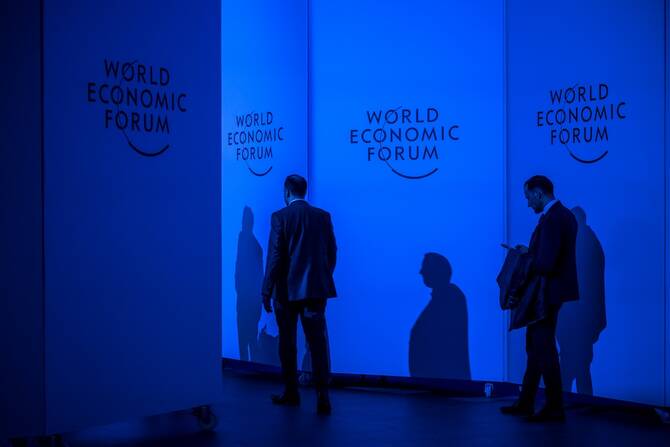

LONDON: A new report from the World Economic Forum says that “geopolitical tensions, supply disruptions and rising demand” are slowing global progress toward more secure, sustainable and affordable energy systems.
According to the 16th WEF annual Energy Transition Index, overall progress “has flatlined” and “transitional readiness has declined for the first time in over a decade.”
Overall, the Middle East and North Africa saw a decline of 0.9 percent, “as weakening policy commitment and infrastructure investment weighed on progress.”
But Saudi Arabia, says the report, is the stand-out country in the region, having improved its ranking through “stronger financial backing, accelerated renewable deployment and investments in large-scale battery storage.”
The Kingdom saw its overall ETI score rise 1.5 percent to 57.4, its ranking boosted by increases in sustainability and investment in renewables.
This, says the report, was driven by the National Renewable Energy Program, which, in line with targets outlined in Vision 2030, aims to increase the share of renewables in the energy mix for electricity production to 50 percent.
Under the program, Saudi Arabia is building dozens of solar farms and wind farms across the country.
The report cites as a “key highlight” the Kingdom’s investment in renewables, which rose from $6.6 billion in 2024 to $11.9 billion in 2025. Tenders for more than 20 gigawatts of renewable energy had been issued by 2025, “achieving world-leading low solar tariffs through competitive auctions.”
The index uses 44 indicators across 120 countries to assess both current energy system performance and readiness for the future.
European countries occupy all but two of the top 15 places in the Energy Transition Index, with the top five positions dominated by the Nordic countries. Sweden leads with a score of 75.3.
Israel, which is in 12th place with 67.5, has seen its score increase by 9.3 percent since 2017. China, on 66.9, is in 14th place, having also increased its score (by 5.8 percent since 2017).
The report, published today but based on research carried out before the current conflict with Iran, says that disruption in the Strait of Hormuz is nevertheless “exposing vulnerabilities in energy systems already strained by rising demand, infrastructure bottlenecks and concentrated clean-energy investment.”
The WEF says that the overall global decline in transitional readiness signals “a weakening of the foundations needed for future gains — one that we hope proves temporary, rather than the start of a more prolonged period of stagnation.”
Roberto Bocca, head of the WEF’s Center for Energy and Materials, says that the energy transition “is fracturing. In a more volatile geoeconomic environment, security, affordability, and resilience are central to sustaining progress.
“Closing the gap between ambition and delivery will require stronger foundations, including more diversified and resilient energy systems, faster infrastructure build-out, and capital that can reach markets where it is needed most.”
The report identifies three priorities for sustaining progress: “Embedding security and resilience into energy system design from the outset, rather than as a response to crisis; unblocking delivery by accelerating grid expansion and system integration capacity; and restoring investability through stable policy frameworks and targeted capital flows, particularly toward the emerging economies that will drive the majority of future demand growth.”
Countries that act on all three, it adds, “will be best placed to turn today’s pressures into a durable competitive advantage in a shifting global landscape.”


