


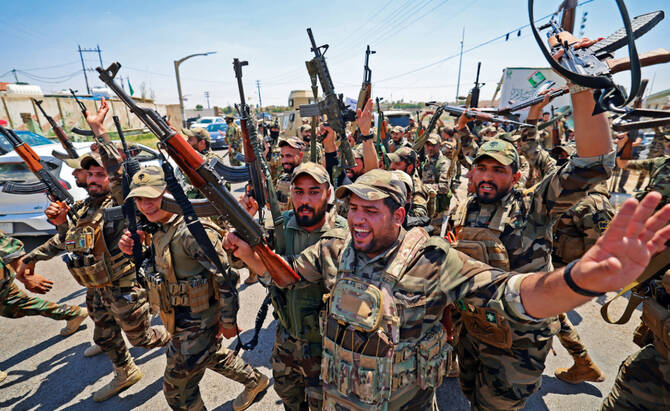

LONDON: Iraqi officials like to say that the “age of militias” is ending. On paper, the past few weeks seem to support that narrative.
Asaib Ahl Al-Haq, a hardline Iran-aligned faction, announced it would disengage from the Popular Mobilization Forces and place its weapons under state control, following a similar move by Kataib Al-Imam, and influential cleric Muqtada Al-Sadr’s Saraya Salam, or Peace Brigades.
At first glance, these decisions suggest a system long defined by fractured, overlapping — and at times opposing — chains of command might be inching toward a new security order. For many Iraqis, however, the question is not what these factions declare but how far they will go.

Tahseen Al-Humaidawi (R), commander of Saraya al-Salam, folds his forces' flag after it was taken down and replaced by the Iraqi flag during a ceremony in the city of Samarra on June 4, 2026, marking their separation from the Sadrist movement and their integration into the Iraqi security forces. (AFP)
Disarmament committees and carefully worded communiques are familiar features of Baghdad’s political theater. The real test is whether groups that have spent years building arsenals, economic influence and patronage networks are ready to surrender power.
Since taking office in May, Prime Minister Ali Al-Zaidi has placed the issue of “weapons in the hands of the state” at the center of his agenda. This message targets both a domestic audience and Washington, which has long pressed Baghdad to rein in the militias.
The announcement drew praise from Tom Barrack, Washington’s special envoy for Iraq and Syria, who called it a “significant step forward.” For Al-Zaidi, however, movement on the militia file is now a prerequisite for maintaining international relations and proving Iraq’s sovereignty.

In one of his first acts after assuming office on May 16, 2026, Iraqi Prime Minister Ali al-Zaidi urged the country's armed factions to join state institutions. (AFP)
“Among the political class, there is recognition that US pressure has made the PMF/armed groups question harder to avoid, but there is little appetite for a direct confrontation that could destabilize the new government,” Hayder Al-Shakeri, a research fellow at Chatham House, told Arab News.
The sense of urgency is rooted in the evolution of the Popular Mobilization Forces.
Formed in 2014 after Iraq’s most powerful Shiite cleric, Ayatollah Ali Al-Sistani, issued a fatwa, the all-volunteer force was intended to rescue the state after the collapse of the army in the face of Daesh, bringing preexisting armed groups and new formations under a single umbrella.

In this photo taken on November 25, 2017, an infantry fighting vehicle (IFV) flying the flag of Asa'ib Ahl al-Haq advances with the Iraqi forces through Anbar province in the western desert bordering Syria, in a bid to flush out remaining Daesh fighters in the al-Jazeera region. (AFP)
Over time, it became dominated by Iran-aligned militias such as the Badr Organization and Asaib Ahl Al-Haq, alongside Sadrist formations, Sunni tribal units and smaller Christian, Turkmen and Yazidi forces.
A 2016 law recognized the PMF as an “independent” security formation reporting directly to the prime minister, with its own commission, rank system and budget line.
The law secured salaries, status and political clout but did not erase external allegiances, autonomous command structures or economic interests.
READ MORE: How Iraq’s Al-Hashd Al-Shaabi turned into an Iranian foreign policy instrument
A decade on, the PMF is both a pillar of Iraq’s security system and, to critics, the clearest example of a “state within the state.” With more than 200,000 registered members and a budget in the billions, its brigades control territory and are deeply involved in border commerce, public contracts and running local administrations.
Against this backdrop, pressure to formalize or reshape the PMF has intensified. International partners want assurances Iraq will not be used as a launchpad for rocket and drone attacks against their forces or neighboring states.
Amid the US-Israel war with Iran, Washington has repeatedly struck militia and PMF sites inside Iraq. Earlier this year it appeared to threaten to place sanctions on Iraqi state institutions if Nouri Al-Maliki, seen as having a close relationship with Tehran, returned as prime minister.
These strikes on Iran-aligned groups on Iraqi soil underline the risks posed by powerful armed actors operating outside Baghdad’s diplomatic calculus.
While PMF fighters are widely viewed as having played a decisive role in defeating Daesh, memories of the 2019-21 crackdown on protests, when demonstrators accused armed groups of carrying out killings and disappearances, have hardened the demands for accountability and an end to impunity.

This photo taken on October 26, 2019 in Baghdad shows Hashed al-Shaabi fighters in a funeral procession for Asaib Ahl Al-Haq commander Wissam Alyawi, who was killed when protesters stormed the paramilitary group's headquarters in southeastern Missan province. (AFP)
Among the armed groups themselves, Al-Shakeri said, the mood around disarmament varies.
“Some see institutionalization as a way to secure salaries, status and protection, while more hard-line factions view any disarmament language as a threat to their identity and regional role,” he said.
Ordinary Iraqis are similarly divided.
“Many Iraqis want weapons under state control, but they are skeptical that reform will be real and they fear that a rushed process could either trigger violence or simply repackage militia power inside new state structures,” Al-Shakeri added.
It is in this tense but fluid moment that Baghdad is currently debating a structural overhaul that could include a Federal Security Ministry to house the PMF, Federal Police, Rapid Response Force and Border Guards.
“Creating an entirely new security structure may not be strictly necessary from an institutional perspective,” said Al-Shakeri, noting that frameworks for unification already exist.
“The emphasis on structure and appointments rather than disarmament reflects the fact that administrative reforms are generally easier to negotiate, while questions of weapons control and authority remain far more contentious.”
He argued that powerful armed groups will only agree to integrate if the benefits — legal status and access to state budgets — outweigh the costs.

Members of the Popular Mobilization Forces stand guard at a military base near the Iraqi-Syrian border in Al-Qaim, west of Iraq on January 23, 2026. The Iraqi government is focusing on its border security after days of fighting between Syrian government forces who have regained swaths of the Kurdish-controlled territory of northeastern Syria. (AFP)
The contours of the plan also reveal its political constraints. Discussions are advanced enough for insiders to sketch its broad shape, but no draft law has yet been published and the government has not formally presented the proposal to parliament or to the public.
For skeptics, that raises an old fear that Iraq could end up with a rebranded security architecture in which the same actors retain the same leverage, only with new titles and an even stronger claim to legitimacy.
“In general, the disarmament of militias is welcome among the public,” Lahib Higel, senior Iraq analyst and interim deputy director for MENA at the International Crisis Group, told Arab News.
“However, the rank and file want assurance that they will have future employment within the security forces, which the government has promised.”
While an umbrella ministry has not yet been confirmed, “it might become relevant for task distribution if and when a significant number of PMF groups hand over their weapons and place their members at the disposal of the commander-in-chief,” Higel said.

Supporters of Hashd al-Shaabi (Popular Mobilization Forces) attend a burning of a large printed image of the US Embassy, to mark the anniversary of the killing of Iranian military commander General Qassem Soleimani and Iraqi militia commander Abu Mahdi al-Muhandis in a US drone attack, in Baghdad, Iraq December 31, 2021. (Reuters)
So far, Saraya Al-Salam is the only faction that has dissolved its PMF brigades and started to hand over weapons, with Asaib Ahl Al-Haq and Kataib Al-Imam Ali pledging to follow suit and other factions signaling their openness to the initiative.
However, the renewed push could face immediate obstacles, as some powerful hard-line factions have already announced that they will not disarm until all US troops leave the country.
“For those that have invested in electoral politics it is primarily a way to secure political continuation, as the US is demanding that political parties with armed groups be denied cabinet positions,” said Higel.
“For those that are committed to the resistance axis, it is unlikely that they will surrender their weapons, at least not in the short term.”
Opinion
This section contains relevant reference points, placed in (Opinion field)
For Al-Zaidi, navigating this terrain is a test of political skill as much as authority. Unlike some of his predecessors as prime minister, he benefits from a rare alignment of domestic and external pressures but leads a government rooted in a coalition tied to the very factions he must restrain.
“Al-Zaidi is helped by the fact that US demands are pressuring the whole ruling Shiite coalition, the Coordination Framework,” Higel said.
“The crucial next step is whether Asaib Ahl Al-Haq and Kataib Al-Imam Ali will follow through on their promise and do what Sadr did. In that case, a significant number can integrate into other security forces.”
The calculations are also tied to the US presence in Iraq. Earlier this year, Iraqi and US officials said the remaining American forces were scheduled to leave by September 2026 under an agreed drawdown plan, but the current confrontation between Washington and Tehran could yet delay that timetable.

This photo taken on January 27, 2024 in Baghdad shows US Major General Joel "J.B." Vowell leaving after a meeting with top-ranking officials of the Iraqi armed forces and of the US-led coalition during the talks on the future of American and other foreign troops in the country. (AFP/File photo)
On Wednesday, government spokesperson Haider Al-Aboudi said Baghdad has set the end of September as a deadline for disarmament, adding another layer of pressure and uncertainty.
For major Iran-aligned groups, that same uncertainty reinforces the claim that their “resistance” role continues to justify retaining an independent military capability, even if it is nominally linked to the state.
Signaling deeper US engagement, and probably more strain on disarmament, Al-Zaidi said on Monday that he intends to visit Washington soon.
“The main obstacle this time is that not everyone within the armed factions is on the same page,” said Al-Shakeri, who noted that some groups were likely to view the process as an existential threat.
“This divergence makes consensus difficult and increases the risk of internal tensions. Al-Zaidi may have slightly more room because US pressure, regional escalation and economic vulnerability have made the status quo more costly. But that room is still narrow.”
He warned that “if he pushes too hard, he risks confrontation with armed actors and their political allies. If he accepts a partial integration plan without weapons control, independent oversight and limits on economic power, the result could be the opposite of reform.”

An aerial photograph shows members of the Popular Mobilization Forces deployed along the border with Syria in the Tarfawi area of northwestern Iraq on January 22, 2026. (AFP)
The dilemma is not unique to Iraq. From Hezbollah in Lebanon to the Houthis in Yemen, regional governments have struggled to “integrate” armed movements that remain beholden to external patrons.
The lesson here is that formalization alone is not a solution. Without enforceable chains of command and state control of heavy weapons, integration might simply harden the grip of these groups.
That is what makes the current opening both fragile and significant. For the first time, some of Iraq’s most influential factions are publicly endorsing the idea of submitting their weapons to the state, at the same moment the government is exploring a redesign of the security architecture.
If that combination produces nothing more than new paperwork and rebranded units, Iraq will remain trapped in the hybrid security order that has defined the post-Daesh era.
If, however, it leads to a genuine dismantling of the “state within the state,” it could mark the beginning of a new chapter.


