

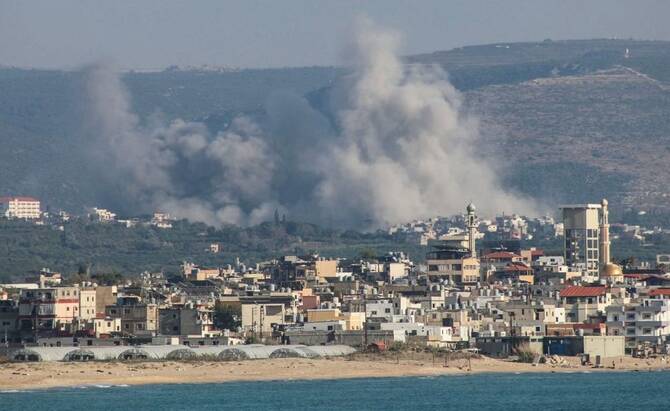

BEIRUT: Lebanese-Israeli negotiations risk stalling as Israel appears focused on consolidating its military gains in southern Lebanon rather than pursuing a diplomatic settlement, a person familiar with the talks told Arab News.
The diplomatic source told journalists that continued Israeli advances, particularly around Nabatieh, could undermine efforts to secure a ceasefire and cast doubt on whether a new round of negotiations would take place in Washington.
“Our situation in Lebanon is dangerous if we cannot put an end to the ongoing Israeli incursion,” the person told a closed media briefing.
“The Israelis have a strong appetite for Nabatieh and under these circumstances it is impossible to compel them to commit even to sparing Beirut’s southern suburbs from strikes.”
The remarks come as Lebanon and Israel struggle to preserve a negotiation process launched under US auspices in Washington amid escalating military operations on the ground.
The source warned that a fifth round of talks might never materialize.
“What is happening in southern Lebanon is a complete catastrophe,” he said, adding that more than 1.5 million people had been displaced since the start of the current fighting, up from about 110,000 during the previous conflict.
The source described the Israeli side as unenthusiastic about the negotiations, both in substance and format, despite continued American efforts to keep the process alive.
“The Israeli side does not want to negotiate and is not interested in it,” he said, adding that the American role nevertheless remained important because it underscored that Lebanon was negotiating on its own behalf rather than through any external intermediary.
Signs of Israeli reluctance were already visible during the fourth round of political negotiations held at the US State Department earlier this month, the source said.
“The Israeli delegation entered the building as if under duress.”
He attributed that attitude partly to Israel’s internal political turmoil and the calculations surrounding upcoming elections.
“The Americans certainly have ways of exerting influence but Israel’s alternative to negotiations may be what we are seeing on the ground.”
Despite US pressure, the source said that Israel had rejected every proposal advanced by the Lebanese delegation, while Washington’s leverage remained constrained by the strategic alliance between the two countries.
The fourth round of negotiations produced the joint Lebanon-Israel statement, which generated controversy inside Lebanon and was rejected by Hezbollah and its ally, Parliament Speaker Nabih Berri, both of whom opposed aspects of the process.
But the source argued that the declaration represented a diplomatic achievement for Lebanon because it included provisions for a comprehensive ceasefire, the creation of pilot zones allowing the Lebanese army to return to sensitive areas occupied by Israel, the return of displaced civilians and the start of reconstruction efforts under Lebanese state authority.
“The importance of the declaration is that it obligates Israel to ceasefire. Unfortunately, it faltered with the escalation of hostilities,” he said.
The source said that one of the most contentious moments in the negotiations came when Israel proposed maintaining military control over a mountain ridge stretching from Tell Al-Bayada on the Mediterranean coast deep into Jabal Amel.
The area extends as far as 10 km inside Lebanese territory and has been extensively bulldozed. Israel views the ridge as strategically important because it believes Hezbollah’s anti-tank weapons cannot effectively target Israeli communities beyond it.
The Israeli delegation proposed retaining control of these elevated positions while assigning the Lebanese army responsibility for disarming Hezbollah in the rear areas.
The proposal triggered a sharp confrontation between the two sides.
“The Lebanese delegation nearly walked out,” the source said, accusing Israel of attempting to impose as a fait accompli what it calls the “yellow zone” seized during the war.
Lebanon responded by proposing pilot zones in Bint Jbeil, which lies within the perimeter of the Israeli-controlled area. After Israel rejected that idea, Lebanese negotiators suggested implementing the arrangement around Beaufort Castle instead.
The source said that Lebanese officials feared that Israeli control of Beaufort Castle could pave the way for a broader advance toward Nabatieh.
“Today it appears those fears were justified,” he said, citing the recent escalation around the city.
The source also criticized what he described as attempts by Hezbollah and the Amal Movement to establish a parallel negotiating track separate from that pursued by the Lebanese state.
“What the Lebanese negotiating delegation did was a response to a national desire to end a senseless war whose cost has become unbearable,” he said.
Asked about US President Donald Trump’s claim that he had spoken with Hezbollah, the source dismissed the suggestion but said Trump had contacted Lebanese Ambassador to Washington Nada Mouawad seeking a Hezbollah contact.
“She replied that she did not know and that’s the end of it.”
The source said that tensions also surfaced during the most recent negotiating session when Lebanese delegates accused Israel’s hardline position of strengthening Iran’s influence in the region.
US Secretary of State Marco Rubio subsequently contacted Israeli Prime Minister Benjamin Netanyahu and language condemning Iranian attacks in the region was ultimately included in the Washington statement following Lebanese objections, the source said.
Lebanon’s strongest asset remained its insistence on negotiating independently and avoiding the parallel power structures that shaped previous eras of Syrian influence over the country, he said.
“Lebanon’s strength lies in its independent position.”
Drawing a comparison with the 1991 Madrid Conference, the source said that although Lebanon was represented by senior diplomats at the time, it had little ability to influence the outcome.
“The lesson is that representation alone is not enough unless Lebanon is able to defend its own interests.”


