

 Why the local golden palm remains the true soul of Saudi cinema
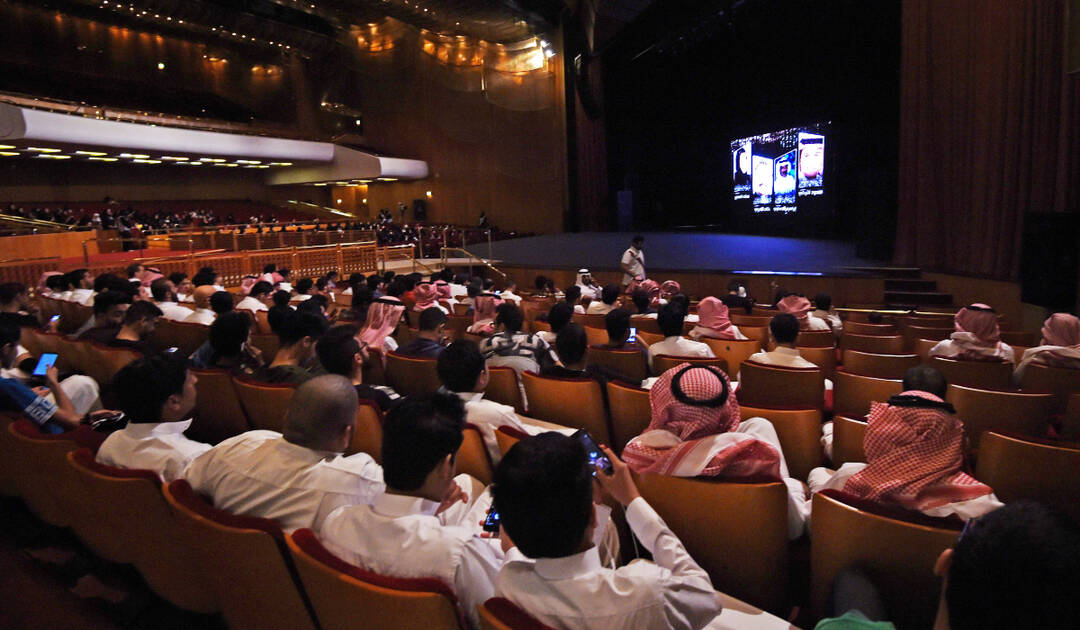

The 12th Saudi Film Festival will take place on June 26 for a period of seven days at the King Abdulaziz International Cultural Center in Dhahran. The number does not reflect the festival’s actual age, which is 18 years; it began in 2008 in Dammam.
As the first film festival in Saudi history, it was launched by poet Ahmed Al-Mulla and his group, self-funded. In those days, cinema was not welcomed, as evidenced by the fact that the festival was suspended for seven years after its first edition, only to return in 2015.
Throughout its history, the festival has screened 1,060 films and film projects, compared to the Red Sea International Film Festival in Jeddah, which has completed five editions since its launch in 2021. There is a 13-year gap between the first and second festivals, and they differ in the types of entries they prioritize.
The Saudi Film Festival focuses on local works, and the first film screened there was titled “An Innocent Dream,” directed by Bashir Al-Mahnaashi. In its inaugural edition, the film “Leftovers,” directed by Musa Al-Shaaban, won the Golden Palm Award for Feature Films, and the film “500 km,” directed by Abdullah Al-Ayaf, the current head of the Film Commission, won the Golden Palm Award for Documentary Films.
At the Red Sea Film Festival, however, the focus is more on foreign films. The first film screened at its inaugural edition was an Italian musical titled “Cyrano,” and the Georgian film “Brighton IV” won the Golden Prize for Best Feature Film, while the Silver Prize, awarded by the jury, went to the Iranian film “On the Road.” Only one award went to a Saudi film, won by director Hamza Jamjoum for his psychological thriller “Tear.”
I did not understand the choice of the word “Al-Yusr,” with all due respect to those who selected it. It refers to the black oyster found on the Red Sea coast in Jeddah, and the award’s sculpture represents it; it is unique and appealing. However, the word “Al-Yusr” does not carry a cultural or geographical dimension, unlike the Palm of the Film Festival.
The Saudi Film Festival did not attract a large audience during its first edition, which was limited to industry professionals due to social and cultural sensitivities. This lack of attendance persisted in its second edition in 2015, and it was not until 2016 that audiences began to flock to the festival.
It was the festival that established the first standards for judging, criticism and the local film industry. It is considered unique in its commitment to building a foundation for cinematic documentation and scholarly research through the translation and publication of annual film books, most notably the “Saudi Encyclopedia of Cinema,” whereas the Red Sea Film Festival focuses on the red carpet and finished productions.
To elaborate on the above, the difficult beginnings of the Saudi Film Festival resemble the situation faced by filmmakers with Thomas Edison, who was not merely the inventor of the light bulb but also the head of a monopolistic syndicate that hounded filmmakers and filed lawsuits against them, numbering as many as 215.
He was the indirect cause of the birth of Hollywood in 1910, which was then a remote village in Los Angeles near the border with Mexico. It was there that filmmakers sought refuge and found a gateway into Mexican territory in case they were pursued.
The Edison syndicate was classified as an illegal monopoly and was officially dissolved under the Sherman Antitrust Act in 1915. However, the festival’s financial difficulties were resolved, and between 2020 and 2025, it received government support estimated at about SR9.5 million ($2.5 million).
A study published by the University of Texas in 2022, following a visual analysis of 50 Saudi and Gulf films, confirmed that the scorching summer sun — specifically during the months of June and July — has given Gulf cinema, and Saudi cinema in particular, a unique visual identity resembling magical realism in Latin American cinema.
This comparison is apt, and its impact is evident in Saudi box office sales, with revenues reaching SR921 million in 2025 and 2026, according to the Journal of Urban Studies in April 2026. Saudi films alone recorded net revenue of SR122.6 million, with the latter representing commercial box office revenue from no more than 11 domestic films.
What is striking about the 2025 Saudi Film Festival is that its selection committees have become much stricter in their choices; they rejected 76 percent of all submitted works and accepted only 68 films out of 284. This indicates a high level of professionalism in the screening process and marks the end of an era in which courtesy took precedence over quality.
In the worlds of marketing and economics, there is a rule that scarcity creates value. If global distributors, along with popular and widely used digital streaming platforms, learn that the festival has filtered entries to this extent, the market and reputational value of every film on its lists will automatically increase. A nomination will become a certificate of quality, making it easier for a director to secure a multi-million-dollar distribution deal, just as is the case at major international festivals. We look forward to the surprises the Saudi Film Festival has in store this year.
• Dr. Bader bin Saud is a columnist for Al-Riyadh newspaper, a researcher in media and knowledge management, a university professor and expert in crowd management and strategic planning, and the former deputy commander of the Special Forces for Hajj and Umrah in Saudi Arabia. X: @BaderbinSaud


