

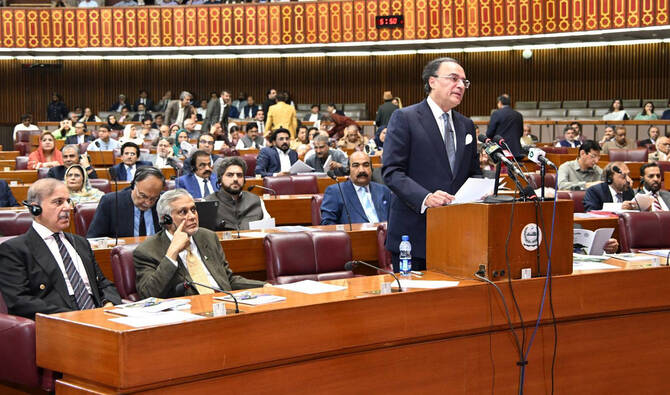

ISLAMABAD: Pakistan has postponed the presentation of its federal budget to June 12 as consultations with coalition partners continue, Federal Minister for Parliamentary Affairs Tariq Fazal Chaudhry told Arab News on Tuesday, marking the second delay in the rollout of the country’s annual fiscal plan.
The budget was originally scheduled to be presented in parliament on June 5 before being moved to June 10 and then postponed again. The delay comes as Prime Minister Shehbaz Sharif’s government seeks to build consensus on a budget expected to be shaped by revenue targets and fiscal reforms linked to Pakistan’s $7 billion International Monetary Fund (IMF) program.
“Yes, the budget will be presented on June 12 instead of June 10 as our consultation with government coalition partners continue,” Chaudhry told Arab News.
Earlier, the minister said summaries had been sent to President Asif Ali Zardari to summon sessions of both houses of parliament.
“The proposal is to summon the National Assembly session on June 10 at 5pm. The summary to summon the Senate session on June 10 at 4 p.m. has been sent. It is likely that the budget will be presented on June 12,” Chaudhry wrote on X.
Political leaders involved in budget consultations point to disagreements over taxation, public welfare spending and the distribution of resources between the federal government and Pakistan’s four provinces.
A senior leader of the Pakistan Peoples Party (PPP), a key ally in Sharif’s ruling coalition, said the party wanted a “people-friendly” budget and opposed any move that could reduce provincial funding under the National Finance Commission (NFC) award.
The NFC is the constitutional mechanism through which the federal government distributes tax revenues among Pakistan’s provinces. The formula is politically sensitive because provincial governments rely heavily on these transfers to fund services such as education, health care and infrastructure.
“The party wants people friendly budget without effecting the provincial funding under the National Finance Commission while the government wants provinces to share more revenue with the federation which has to pay back Pakistan’s international loans and defense budget from its resources,” the PPP leader told Arab News on condition of anonymity as he was not authorized by his party leadership to disclose the nature of talks to the media.
When asked by Arab News about the reasons behind the delay in presenting the budget and any differences among coalition partners, Chaudhry declined to comment.
The issue surfaced publicly on Monday during a meeting between President Zardari and Prime Minister Sharif as coalition partners intensified consultations ahead of the budget announcement.
“The president stressed on prioritizing public welfare, rights of provinces and economic stability in the federal budget,” Zardari’s office said after the meeting.
“The president directed that every effort should be made to harmonize growth rate and public welfare schemes in the upcoming budget.”
The meeting came a day after a PPP delegation reportedly expressed reservations about proposed tax measures during a pre-budget meeting with Deputy Prime Minister Ishaq Dar.
The debate is taking place as Pakistan seeks to maintain fiscal discipline under its IMF program while also responding to demands for tax relief and increased social spending. According to officials, the IMF has asked Pakistan to introduce at least Rs430 billion ($1.5 billion) in additional fiscal measures in the upcoming budget, alongside a nearly matching contribution from the provinces.
The concerns are not limited to coalition partners.
Khyber Pakhtunkhwa, which is governed by the opposition Pakistan Tehreek-e-Insaf (PTI) party of jailed former prime minister Imran Khan, has also objected to proposals it says would effectively reduce the provinces’ share of resources.
Relations between the federal government and the PTI-led provincial administration have remained strained for years over fiscal transfers, governance issues and broader political disputes following Khan’s removal from office in 2022.
Muzzammil Aslam, adviser on finance to the Khyber Pakhtunkhwa chief minister, said disagreements over the NFC award were at the center of the dispute between Islamabad and the provinces.
“It is primarily the differences between center and provinces specially KP over budget allocation under NFC Award,” Aslam told Arab News.
The federal government, he said, had informed provinces that their allocations under the NFC framework would effectively be capped, with any increase above current levels expected to be returned to the center.
“The provinces have lodged their protest as this demand from the center would push their budgets into deficit,” Aslam said.
Describing the proposed fiscal plan as an “unfriendly and status quo” budget, Aslam said federal and provincial governments had so far failed to agree on a formula for distributing resources under the NFC award in the next fiscal year.
Aslam also said PTI had linked its position on the issue to access to Khan, whom party leaders say they have been unable to consult freely on major political and economic decisions while he remains imprisoned.
“We kept a condition to meet Khan first to give our consent on this issue,” Aslam said.


