


NEW YORK CITY: The United Nations Population Fund, the UN’s sexual and reproductive health agency, has warned that women and girls in Lebanon are facing a worsening humanitarian emergency as Israeli attacks on healthcare facilities continue despite a ceasefire agreement.
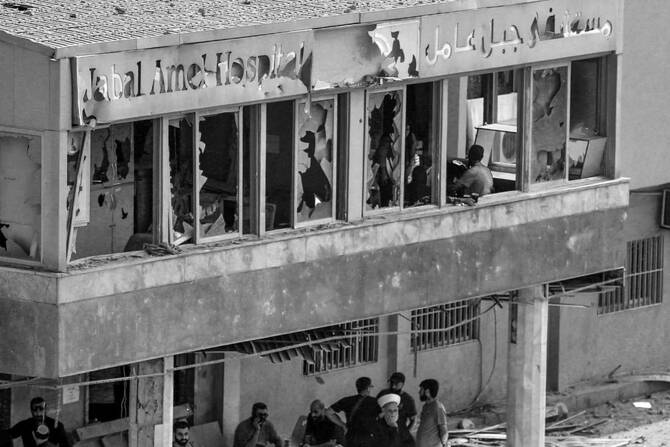
It came a day after an Israeli airstrike on Monday severely damaged a hospital in the southern city of Tyre and left dozens of people injured.
Anandita Philipose, the agency’s representative in Lebanon, on Tuesday described a time of “deep fear, uncertainty and escalation” across the country.
“Despite the ceasefire that’s in place, the hostilities have not stopped,” she said. “People across Lebanon, particularly women and girls, are facing appalling levels of violence, displacement and human loss.”
The Israeli strike on Monday hit Jabal Amel Hospital in Tyre. At least 86 people, including healthcare workers, were injured in the attack, which caused significant damage to the emergency department and intensive care unit, according to the World Health Organization, who said the hospital was one of only a handful still functioning in southern Lebanon.
Healthcare services in Tyre District have been particularly hard hit in recent days. On May 31, Hiram Hospital was also damaged by an Israeli attack. The Lebanese Italian Hospital, the third and only other remaining hospital in Tyre is still operational but said to be overwhelmed by the growing number of casualties.
The WHO said that six hospitals affected by the conflict between Israel and Hezbollah have not yet resumed maternity or delivery services, and currently provide only emergency room care.
Philipose said that over the past weekend alone, Israeli airstrikes also damaged a Population Fund-supported primary healthcare center and safe space for women and girls in southern Lebanon.
It was “one of the very few facilities that have continued to be operational and provide lifesaving support in that region,” she added. “In another airstrike on southern Lebanon, there was damage to a public hospital that has maternal health services. It’s one of three hospitals that provide these kind of services in southern Lebanon.
“Again, when maternity wards and hospitals are damaged and destroyed, it is pregnant women who cannot get life-saving services.”
According to the Population Fund, there are 13,500 pregnant women among the displaced persons across Lebanon; 1,500 are expected to give birth within the next 30 days.
“That means, while we are sitting here today, 15 women may have gone into labor in situations of displacement across the country in a very difficult situation,” Philipose said.
An estimated 1,500 pregnant women also remain trapped in southern Lebanon without access to skilled maternity care or safe delivery spaces, she added.
Lebanon is facing health and protection crises, Philipose warned, that are becoming increasingly protracted despite the ceasefire agreement and a World Health Assembly resolution, adopted on May 21, that calls for the protection of healthcare in Lebanon.
The WHO said 190 attacks on healthcare facilities have been verified since the latest escalation of violence in the country began on March 2, in which 128 healthcare workers have been killed and 332 injured. In the past week alone there have been 11 assaults on healthcare facilities and personnel.
“These attacks shatter the continuum of care, and they also create fear among people,” Philipose said.
“We are deeply worried that women and girls will not seek out lifesaving services because they know that healthcare is under attack.”
The WHO said about 130,000 people currently live in shelters after fleeing fighting, and displacement is increasing following recent Israeli evacuation orders. The health agency is monitoring disease outbreaks in these shelters and host communities, and reports an increasing trend of acute watery diarrhea.
Women and girls face particularly severe protection risks at displacement sites, Philipose said. The Population Fund and its partners recently conducted safety audits in shelters and found overcrowding, lack of privacy, lack of gender segregation, poor lighting and unsafe sanitation facilities.
Female-headed households, adolescent girls, pregnant and lactating women, and people with disabilities were identified as among the groups at greatest risk.
“Women and girls are bearing the brunt of this crisis,” Philipose said. She warned that funding shortfalls put at risk the continuation of relief efforts, and “our ability to sustain this life-saving work is under severe threat.”
She pointed out that The Population Fund’s initial flash appeal for the period from March to May 2026 was only 30 percent funded.
“Without this immediate and sustained funding, thousands of pregnant women will lose access to skilled birth attendance and … our mobile medical clinics will be forced to stop serving remote areas,” she said.
“Scaling down our operations means cutting off more than 75,000 women from critical gender-based violence protection, case management, and safe spaces at the exact moment that they need them the most.
“My call to the international community is clear,” she added as she outlined the three priorities the Population Fund is asking of the international community, the first of which echoes the UN “secretary-general’s call for a permanent end to hostilities, as well as respect for international humanitarian law.
“The second is sustained funding for the humanitarian response, particularly critical and underfunded areas such as maternal and reproductive health, as well as prevention of and response to gender-based violence.
“And third is preserving the health, safety and dignity of the women and girls in Lebanon. Women and girls are not an afterthought; they must remain at the very heart of our collective humanitarian response.”
In comments to Arab News, Philipose emphasized that the Lebanese government remains in charge of coordinating the humanitarian response while UN agencies help support national efforts and relay concerns from affected communities.
“We work primarily with two line ministries: the Ministry of Social Affairs, that is the one that starts with coordinating the overall response, as well as the Ministry of Public Health, that oversees the health response. We also play that very important license role between the government of Lebanon and our communities on the ground.
“So, the government is leading the response, it’s coordinating the response. Our role as the UN is ensuring that what we’re hearing from the ground also informs the government response.
“We’re also convening partners around health and protection, so that we’re making sure that at the same table we have government, women-led organizations, and (nongovernmental organization) partners all speaking together.
“This is very important for a continued and sustained national ownership and community-driven response to the humanitarian crisis.”
The latest escalation in the conflict between Israel and Hezbollah has taken a devastating toll on Lebanon. According to UN figures, more than 3,400 people have been killed and nearly 10,400 injured, most of them civilians, since fighting intensified on March 2.


