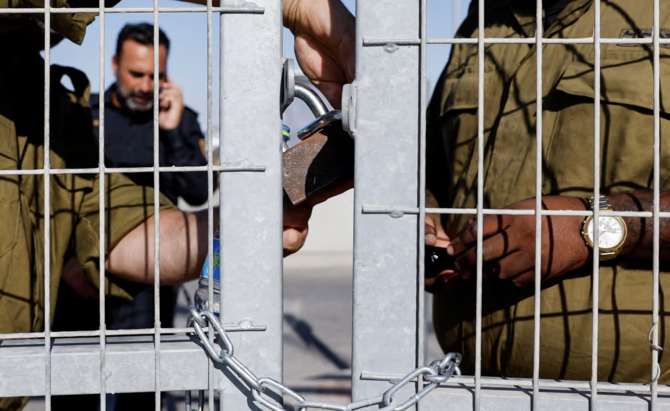

NEW YORK: A newly released UN report has accused Israeli military, prison, and security personnel of committing widespread sexual violence against Palestinian detainees, including rape, gang rape, torture targeting genitals, forced nudity, and threats of sexual assault.
Presenting the Secretary-General’s 17th annual report on conflict-related sexual violence on Friday, Pramila Patten, the UN Special Representative on Sexual Violence in Conflict, said Israeli forces were listed in the document based on what the UN described as credible evidence of persistent patterns of rape and other forms of sexual abuse against Palestinians in detention and during military operations.
Patten said the allegations involved the Israel Defense Forces, along with the Israel Prison Service, including the Keter initial response force, and the police counter-terrorism unit Yamam. She added that Israeli authorities had already been warned in the previous year’s report over concerns about abuse and restrictions preventing UN investigators from accessing detainees and detention facilities.
“Since last year’s notice, both the patterns of sexual violence and the denial of access have persisted,” Patten said.
According to the report, the UN verified 31 cases involving Palestinians from Gaza and the West Bank. The victims included 14 men, seven women, nine boys, and one girl.
Patten said the violations occurred “primarily in detention settings, but also at checkpoints and during military operations.”
Because of severe restrictions on access, many cases could only be verified after detainees were released, she said.
Of the 31 verified cases, 13 occurred in 2025, while 18 dated back to 2023 and 2024, but were only verified later due to access limitations.
Patten described the verified abuses in graphic detail.
“These violations consisted of rape, including rape with objects, gang rape, attempted rape, physical violence to the genitals, instances of targeted shooting of the genitals, touching of breasts and genitals, strip and cavity searches conducted without apparent security justification, forced nudity, and threats of rape and gang rape,” she said.
Rape and gang rape were reportedly perpetrated against nine victims, while four victims suffered repeated rape on multiple occasions.
Patten said the abuses occurred across 12 sites, including military camps, Israeli prison service facilities, and one police station.
She said that detainees were explicitly threatened by Israeli personnel not to report abuses to the media or human rights organizations.
“These violations occurred in a climate of total impunity,” she said.
Patten devoted a substantial portion of her briefing to reporters in New York to describing exchanges between the UN and Israeli authorities over the past year.
She said Secretary-General Antonio Guterres formally communicated preventive measures to Israel in a letter dated Aug. 11, 2025, stressing that implementation of those measures, along with ending abuses and allowing UN access, would be considered in any future listing decision.
According to Patten, Israel’s permanent representative rejected both the notice of potential listing and the contents of the report in a reply sent the following day.
Patten said she later wrote to the Israeli mission on Nov. 24, 2025, offering technical assistance to help implement preventive measures.
“I did not receive a response to my letter,” she said.
She said that there was some engagement regarding a possible second visit to Israel and the Palestinian territories, including Gaza, but no meaningful cooperation followed.
After Israel received the draft country section of the report in March 2026, the government submitted a response rejecting any “patterns of sexual violence against Palestinians.”
Patten said Israel instead provided documentation outlining existing laws, detention procedures, personnel training, and internal regulations governing the military, prison service, police, and security agencies.
However, she said the submission did not include evidence of “fully fledged investigation, prosecution, or conviction for sexual violence cases.”
Patten specifically referenced the controversial Sde Teiman detention facility case, which had drawn international attention after allegations of severe abuse against Palestinian detainees.
“With regard to the emblematic Sde Teiman case, not only was sexual violence not in the indictment, but the charges were even dropped altogether by the military advocate general,” she said.
Patten recalled that the case had sparked demonstrations by some Israeli ministers and supporters protesting the arrest of soldiers accused in the incident.
“These demonstrations included attacks on the Sde Teiman camp and on those investigating the case,” she said.
Patten also criticized Israel’s continued refusal to grant UN human rights monitors access to detention facilities.
“The government of Israel maintains that it will not provide access on account of what it alleges to be institutional bias in UN bodies and mechanisms,” she said.
She added that Israel had confirmed the International Committee of the Red Cross had also been denied access to detention facilities since Oct. 7, 2023, citing security concerns.
Beyond Israel, Patten also warned that rape, torture, and sexual violence in war zones reached “extreme brutality” levels in 2025, as the UN documented nearly 10,000 verified cases across 21 conflict-affected countries.
Patten said the international debate surrounding the report had become overly focused on which actors were formally listed in the annex, obscuring the suffering of victims around the world.
“I woke up with a WhatsApp message from a survivor whom I had met in Port Sudan,” Patten told journalists at UN headquarters. She described the survivor as a 25-year-old international relations graduate who had been dragged from a bus and gang-raped by four RSF soldiers in Sudan.
“The report is not just about two countries,” Patten said, referring to Israel and Russia. “My focus, and the focus of the report, is on women, girls, men, and boys whose bodies, minds, and futures have been shattered by unacceptable violence.”
The report covers conflicts ranging from Sudan and South Sudan to the Democratic Republic of Congo, Haiti, Myanmar, Syria, Ukraine, Libya, Yemen, Israel, and the Palestinian territories.
According to the report, the UN documented 9,788 verified cases of conflict-related sexual violence in 2025, more than double the number recorded the previous year.
Patten emphasized that the figure reflected only verified cases and represented “an indication of a much broader pattern of violations that remain largely unseen and underreported.”
Victims ranged in age from one to 70. Women and girls remained the overwhelming majority of victims, though the report also documented widespread sexual violence against men and boys, particularly in detention settings.
The report described rape, gang rape, sexual slavery, forced marriage, abduction, trafficking, genital mutilation, forced nudity, cavity searches, and torture involving sexual violence.
Patten said many victims were killed after rape, while others died by suicide.
Patten said non-state armed groups remained the principal perpetrators in countries including Somalia, South Sudan, Sudan, and Syria.
The UN also documented sexual violence used as torture and interrogation methods against detainees in Libya, Myanmar, Israel and the Palestinian territories, Ukraine, Russia, and Yemen.
Patten concluded her remarks with an appeal for international attention to remain focused on victims rather than geopolitical controversy.
“These violations are neither isolated nor confined to a handful of contexts,” she said.
“They are global in scale, devastating in impact, and demand a response centered not on political posturing, selective outrage, or preconceived narratives, but on the rights, needs, and dignity of victims and survivors.”
She urged journalists not to lose sight of civilians living “in the shadow of war” from Sudan to Haiti to Myanmar.
“Their plight, their rights, should remain at the center of this conversation,” she said.