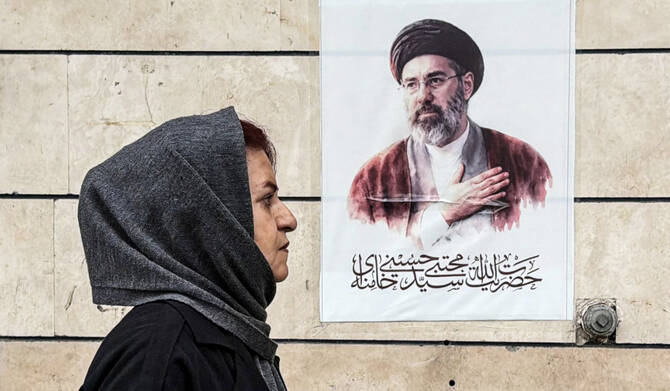
TEHRAN: An Iranian Health Ministry official said on Monday the injuries suffered by supreme leader Mojtaba Khamenei in US-Israeli strikes in late February were only “superficial,” offering a rare account of the day he was wounded.
The 56-year-old has not appeared publicly since he was named as Iran’s supreme leader on March 8, issuing only written statements, fueling speculation about his health.
In March, US Defense Secretary Pete Hegseth claimed Mojtaba was “believed to be alive, wounded, and disfigured.”
Mojtaba succeeded his father, Ali Khamenei, who was killed in US-Israeli strikes on Feb. 28 that triggered retaliatory Iranian attacks across the region.
On Monday, Health Ministry spokesman Hossein Kermanpour described the day Mojtaba was wounded and his arrival at a hospital, which he did not identify.
He said Mojtaba arrived at the hospital around 1 p.m. Tehran time on Feb. 28 and “entered the operating room along with several other wounded individuals.”
“Apart from superficial injuries to the face, head, and legs, which caused neither amputation nor any particular medical problem, nothing major had happened,” Kermanpour told ILNA news agency.
“From my perspective as a physician, these were not considered serious injuries and required no special procedures apart from one or two stitches.”
He added that Mojtaba, who was fasting until nightfall during the holy month of Ramadan, “refused to break his fast and kept fasting until iftar, which itself showed his good health.”
Kermanpour said he was discharged from the hospital at around 2:00 am on March 1, but did not say where he was moved.
On May 7, Iran’s President Masoud Pezeshkian said he had met the leader and that their meeting lasted two and a half hours.
Three days later, Iranian state TV said the head of Iran’s military central command, Ali Abdollahi, met with the supreme leader, who gave “new directives and guidance for the continuation of operations to confront the enemy.”
Iran warned Monday that, while some progress had been made, it was not yet close to striking a deal with the US to end the Middle East war.
Foreign Ministry spokesman Esmaeil Baqaei told a weekly news briefing: "It is correct to say that we have reached a conclusion on a large portion of the issues under discussion.
"But to say that this means the signing of an agreement is imminent -- no one can make such a claim."
Baqaei stressed that Iran would continue to manage maritime traffic through the Strait of Hormuz by charging service fees -- arguing that this did not amount to Tehran "seeking to collect tolls."
Ali Vaez, director of the Iran Project at independent monitor the International Crisis Group, said Tehran would need hundreds of billions of dollars to repair its shattered economy.