

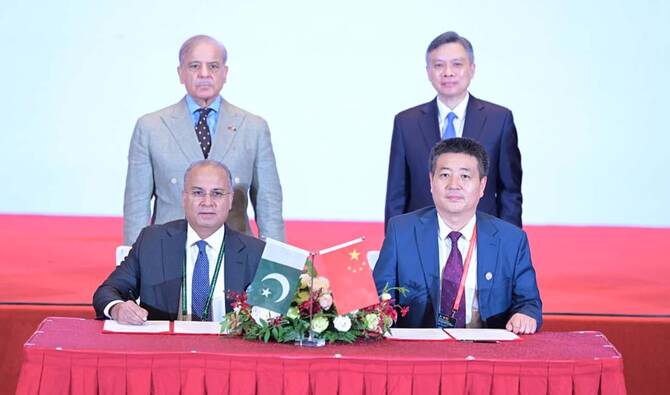

ISLAMABAD: Pakistani and Chinese companies have signed cooperation agreements and memorandums of understanding worth $1.22 billion during Prime Minister Shehbaz Sharif’s ongoing visit to China, Pakistan’s information ministry said on Monday, as Islamabad pushes to attract fresh Chinese investment into manufacturing, energy and technology sectors.
The deals come as Pakistan seeks to revive foreign investment and stabilize its economy under a $7 billion International Monetary Fund (IMF) bailout program. Islamabad is also trying to broaden economic cooperation with Beijing beyond large infrastructure and power projects under the China-Pakistan Economic Corridor (CPEC), a multibillion-dollar Chinese investment initiative launched in 2015 that built roads, ports and energy facilities across Pakistan.
Pakistan and China are now increasingly focusing on what Pakistani officials describe as the next phase of cooperation, centered on industrial development, manufacturing, agriculture, technology transfer and export-oriented investment.
“Prime Minister Muhammad Shehbaz Sharif and Governor Zhejiang Province Mr. Liu Jie witnessed the signing of MoUs and Agreements of cooperation between Pakistani and Chinese companies worth USD 1.22 billion at the Pakistan China Business Conference held in Hangzhou,” the information ministry said after the deals were signed at the Pakistan-China Business Conference in the eastern Chinese city of Hangzhou.
Sharif arrived in China on Saturday on a four-day visit aimed at expanding economic and technological cooperation as the two countries mark 75 years of diplomatic relations.
During meetings with executives of major Chinese firms on Sunday, Sharif invited companies to expand investment in Pakistan’s renewable energy, electric vehicle and smart mobility sectors, according to his office.
The discussions focused on renewable energy systems, energy storage, electric vehicle charging infrastructure, pharmaceutical manufacturing and solar-linked technologies.
China is Pakistan’s largest bilateral investor and has pledged more than $65 billion in infrastructure, transport and energy projects under CPEC, part of Beijing’s Belt and Road Initiative aimed at expanding global trade and connectivity.
Pakistan has increasingly pitched itself as a regional trade and manufacturing hub linking China, Central Asia, the Middle East and the Arabian Sea, while also offering Chinese firms lower-cost industrial opportunities.
Speaking at the investment conference in Hangzhou, Sharif said Pakistan hoped to increase agricultural trade with China by $10 billion over the next five to seven years.
“And this is not a big task, it can be done. It is possible. But we need your support,” the prime minister said.
Sharif also said Pakistan had sent 1,000 agricultural graduates to China last year for advanced training in food security and modern farming techniques.
The Beijing leg of Sharif’s visit is expected to focus on industrial cooperation, regional security and broader strategic coordination between the two countries.


