

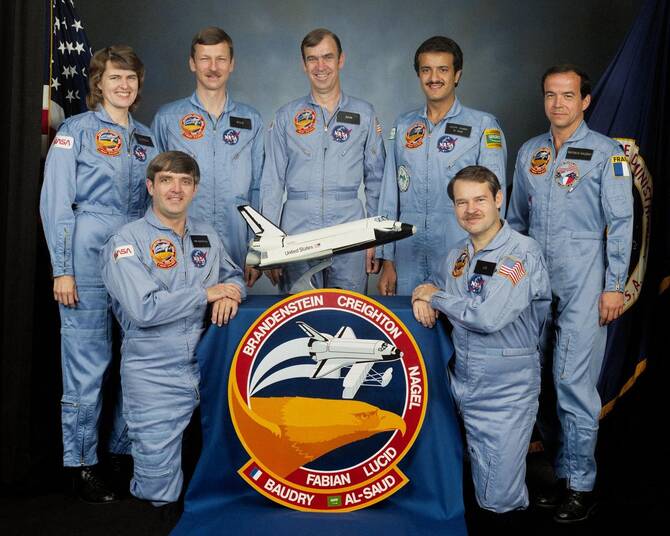

RIYADH: Former NASA astronaut John Fabian, who flew alongside Prince Sultan bin Salman on the landmark STS-51-G mission in 1985, has died at the age of 87.
Fabian was part of the seven-member crew aboard Space Shuttle Discovery during the mission that carried Prince Sultan into orbit, the first time an Arab, Muslim and Saudi citizen had traveled to space.
Launched on June 17, 1985, the mission lasted for seven days and deployed several communications satellites, including Arabsat-1B for the Arab Satellite Communications Organization.
Prince Sultan bin Salman, special adviser to King Salman and chairman of the board of trustees of the nonprofit Heritage Foundation, described Fabian as a close friend and a key figure during the mission.
“He was a scientist. He was a first-class mission mate, who earned the respect of all of us.” Prince Sultan told Arab News.
“He was the person assigned to support us, myself and Patrick Baudry, as a payload specialist,” he added, referring to French astronaut Baudry, who was also part of the mission crew.

Fabian (L) was part of the seven-member crew aboard Space Shuttle Discovery during the mission that carried Prince Sultan into orbit. (Supplied)
Prince Sultan said Fabian remained active and engaged in scientific work throughout his life.
“With his passing, it is an era for the generation of American scientists,” he said.
“He was working until the last of his life, and we had a friendship that will last forever.”
Prince Sultan said that he had spoken with Fabian’s wife, Donna, to offer his condolences.
“I spoke to Donna, and I gave her and the family my condolences,” he said.
“It is a personal loss of a friend who loved our country and has always been honorable and intelligent. I learned a lot from him.”
The relationship between Fabian and Saudi Arabia continued after the mission, with the astronaut visiting the Kingdom often.
“John visited Saudi Arabia on several occasions, the first of which was in 1986 after the space mission,” Prince Sultan said.
During those visits, Fabian and fellow crew members met Saudi leaders and were honored by the Kingdom.
Fabian received the King Abdulaziz Medal, in addition to several international distinctions.

Fabian and fellow crew members met Saudi leaders and were honored by the Kingdom. (Supplied)
Born in Goose Creek, Texas, in 1939, Fabian earned a degree in mechanical engineering, a master’s degree in aerospace engineering, and a doctorate in aeronautics and astronautics before joining the US Air Force.
He later joined NASA’s astronaut program in 1978, where he later worked extensively on satellite deployment and retrieval operations during the early years of the space shuttle program.
Fabian first traveled to space aboard STS-7 in 1983 before returning on STS-51-G two years later. Over the two missions, he spent more than 316 hours in space.
He was associated with one of the Kingdom’s defining scientific milestones that introduced a generation to the possibilities of space exploration and carried the first Saudi astronaut into orbit.
Fabian is the second member of the STS-51-G crew to die after fellow astronaut Steven Nagel, who died in 2014.
Nagel spent 32 years with NASA before retiring in 2011. He also participated in the Saudi International Space and Aeronautics Technology Conference and the 25th Planetary Congress of the Association of Space Explorers in Riyadh, held under the patronage of the late King Abdullah.


