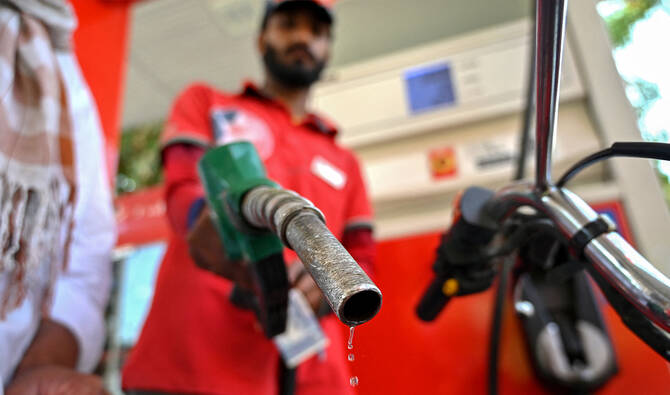

ISLAMABAD: Pakistan has recorded the world’s second-highest surge in domestic fuel prices since the start of the Iran war, data shows, with petrol and diesel soaring 56 percent.
According to global fuel price tracking data shared by the country’s energy ministry, Pakistan’s fuel price surge is second only to Myanmar’s 90 percent increase, and far exceeds hikes in the United States, Britain and several regional countries.
Last Friday, Pakistan raised petrol and diesel prices by around Rs15 ($0.05), citing sharp volatility in international energy markets. Before disruptions in the Strait of Hormuz, petrol sold for Rs266.17 ($0.95) and diesel for Rs280.86 ($1.00) per liter in Pakistan. The current price of petrol is Rs414.78 ($1.49), while that of high-speed diesel is Rs414.58 ($1.49) per liter.
Energy Minister Ali Pervaiz Malik said on Monday the government had little room to avoid the politically unpopular moves tied to commitments under a $7 billion International Monetary Fund (IMF) program, which were agreed to during budget negotiations before the outbreak of war.
“When this budget was made, there was no war at that time. Eighty rupees per liter [levy on petrol] was settled with the IMF that we would collect,” Malik told a senate committee on Monday, adding the government had initially kept zero petroleum levy on diesel because of its widespread use in agriculture and public transport and shifted the burden onto petrol instead.
“For this reason, 80 and 80, meaning 160 rupees had gone onto petrol, which, when the Prime Minister took up with the IMF, they gave an 80-rupee relaxation [on petrol levy] for one month,” he said, adding that the temporary concession later expired and the agreed levy structure was restored to avoid jeopardizing IMF approval for a more than $1 billion loan tranche last week.
“Even today, subsidies of several hundred billion rupees will still go to motorcyclists and those people, the weak classes, whom we can protect directly, through e-wallets.”
Pakistan has announced several fuel price increases since the start of the United States-Israeli war on Iran on Feb. 28, which has disrupted global energy and cargo supplies through the Strait of Hormuz.
In late April, the government announced a subsidy of Rs100 ($0.36) per liter for motorcyclists, capped at 20 liters per month, to cushion the impact of surging fuel costs. It also announced up to Rs70,000 ($252) subsidy per month for freight trucks, Rs80,000 ($288) for larger transport vehicles and Rs100,000 ($360) per month for public passenger buses.
The government attempted to balance the IMF conditions with targeted support measures for lower-income groups as it sought to avert a broader balance-of-payments crisis, according to the minister.
Malik also defended the role of private oil marketing companies (OMCs), arguing that ensuring uninterrupted fuel availability during periods of extreme price volatility required allowing firms enough liquidity to continue importing expensive cargoes.
“This is how you end up with dead stock,” Malik said, explaining why authorities avoided stricter controls during the market surge.
“The companies importing oil had to be ensured that they would not run dry. They needed to be provided with enough liquidity so they could continue purchasing the product.”
He warned that forcing companies to absorb losses without compensation could risk fuel shortages.
“If you take on the responsibility that the government will cover people’s profits and losses, then yes, you can regulate them completely,” he said.
Nevertheless, he said, the authorities were closely monitoring inventories and pricing practices through regulators and law enforcement agencies.
“Pakistan does not have a strategic reserve,” Malik said. “If at any point these companies pull back, then the consequences of that should also be kept in mind.”
Official data from the Ministry of Energy showed Pakistan had increased fuel inventories despite the regional disruption.
As of May 7, crude oil stocks had risen to 515 kilotons from 436 kilotons on March 1, while petrol inventories climbed to 662 kilotons, equivalent to roughly 30 days of cover. High-speed diesel stocks rose to 597 kilotons, or 27 days of cover.
Malik signaled the government could move toward broader deregulation of petroleum pricing after the crisis subsides, bringing Pakistan closer to international market-based systems.