

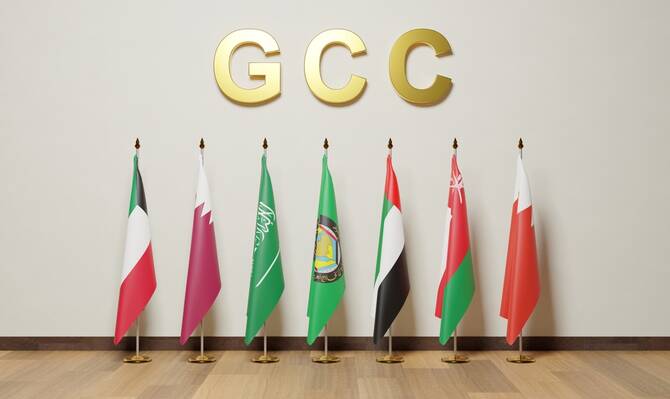

JEDDAH: Gulf Cooperation Council economies have strengthened their collective standing in the 2026 Index of Economic Freedom, outperforming the global average as reforms continue to reshape regulatory frameworks, market openness and investment conditions across the region.
According to data released by the GCC Statistical Center, the six-member bloc posted an average score of 66.9, exceeding the global average of 59.9 and highlighting the region’s relatively higher level of economic openness.
“All GCC countries recorded a slight improvement and relative stability in the index value between 2025 and 2026, with limited variation among member states,” the GCC-Stat report said.
It added: “Oman and Saudi Arabia recorded the strongest improvements this year, rising 19 places and four places respectively.”
The UAE remained the highest-ranked GCC economy, holding 23rd place globally in 2026 with a score of 71.9, supported by what the report described as strong institutional frameworks, regulatory predictability and a business-friendly operating environment.
Oman emerged as the most notable mover in the latest rankings, climbing from 58th place in 2025 to 39th this year, with a score of 68.5. The improvement signals accelerating reform momentum under Oman Vision 2040, particularly in regulatory efficiency, economic openness, and efforts to broaden the productive base of the economy.
Recording an overall score of 65.4, Saudi Arabia also advanced in the global ranking, rising four places to 59th globally to reflect continued progress under Vision 2030 reforms, with gains driven by improving investment conditions and the expansion of non-oil sectors as part of the Kingdom’s diversification strategy.
At the same time, Bahrain and Kuwait each slipped two places to rank 57th and 90th, respectively, while Qatar recorded the sharpest decline among GCC states, falling four places to 31st, highlighting uneven performance dynamics within the bloc despite overall regional stability.
Within this framework, the GCC’s overall performance signals a gradual but sustained shift toward more open and competitive economic structures, even as individual countries move at different speeds in implementing reform agendas.
Other Arab economies showed more varied performance, with Jordan, Morocco and Egypt ranking 94th, 83rd and 146th, respectively.
With an overall score of 84.4, the index placed Singapore at the top globally, followed by Switzerland with 83.7 and Ireland with 83.3. Australia, Taiwan and Luxembourg ranked next, with scores of 80.1, 79.8 and 79.7 , respectively.
The index, published annually by The Heritage Foundation in partnership with The Wall Street Journal, evaluates 184 economies based on factors including rule of law, government size, regulatory efficiency, and market openness.
Economic Freedom Index scores are grouped into ranges that indicate how open or restricted an economy is. Scores between 80 and 100 are classified as “free” economies, reflecting strong property rights, limited government intervention, and highly open markets.
A range of 70 to 79.9 is considered “mostly free,” where market-friendly policies are dominant, but some regulatory constraints remain.
Economies scoring 60 to 69.9 are labeled “moderately free,” indicating a balance between market forces and government involvement, often with structural inefficiencies.
Scores between 50 and 59.9 are “mostly unfree,” where heavier regulation and weaker institutional frameworks limit economic flexibility, while those below 50 are classified as “repressed,” reflecting significant state control and limited market openness.


