

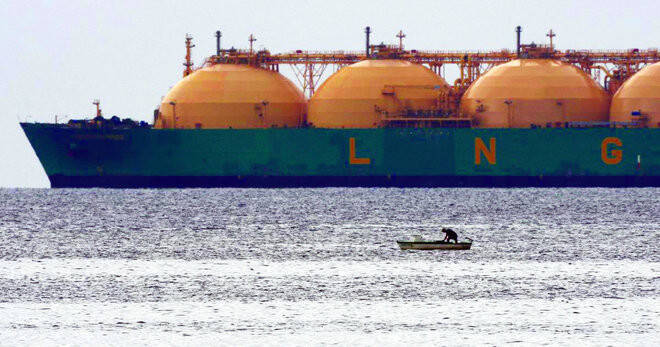

KARACHI: Pakistan needs four liquefied natural gas (LNG) cargoes each weighing 100 million cubic feet per day (mmcfd) to ease prevailing power outages, a government official said on Friday, amid widespread energy supply disruptions due to the Middle East war.
The South Asian country of over 240 million people requires at least 400 mmcfd of LNG per month, according to officials.
The nation has faced up to seven hours of power outages daily following the United States-Israeli war on Iran that has disrupted energy supplies through the Strait of Hormuz.
“The country is short of 400 mmcfd LNG,” an energy ministry official told Arab News on condition of anonymity. “Pakistan’s immediate need is four LNG cargoes.”
Pakistan produced 8,939 gigawatt-hour (GWh) in March, up 6 percent year-on-year because of seasonal uptick in demand ahead of summer months, according to Karachi-based market research firm JS Global Capital Ltd.
The South Asian nation generated 24 percent electricity from hydel, 31 percent from coal, one percent from furnace oil, 22 percent from nuclear plants and 17 percent from gas, including 6 percent imported LNG in March. In July 25-March 26, power generation rose three percent to 93,133 GWh.
Power Minister Awais Leghari this week said Pakistan was facing electricity shortage of about 3,400 megawatts (MW) because of which the country was facing six to seven hours of load-shedding, with central Punjab and northwestern Khyber Pakhtunkhwa (KP) provinces being the worst-hit.
But the government said on Friday it has reduced the duration of power outages to 2.5 hours by increasing hydropower generation by 128 percent to 4,100 MW in the country.
Pakistan’s Petroleum Minister Ali Pervaiz Malik and Sui Southern Gas Company (SSGC) Chairman Asif Inam were not available for a comment on the supply shortages.
“The power division has sent us demand for 5 cargos in April while we are supplying only one that too from local fields,” the energy ministry official said.
This week, the state-owned Oil & Gas Development Company Limited (OGDCL) started production from Baragzai X-01 well, the largest-ever oil and gas discovery from KP province, to cut reliance on imported fuel.
In March, when the Middle East conflict was raging, Pakistan could import only $70.2 million worth of LNG, 69 percent down from $226 million last year, according to the Pakistan Bureau of Statistics (PBS) data. The country has five LNG-based power plants of which four are in Punjab province and one in Karachi.
“No, there is no visibility yet. Qatar has declared force majeure and conveyed to us in black and white that there will be no cargo by May 10,” the official said when asked if imports from Doha could resume anytime soon.
“If the situation gets better, then maybe some cargo can come,” the official said, adding that the government could buy spot cargoes at prices as high as $60 million per shipment.
Since the South Asian nation’s energy mix includes 24 percent hydropower that is generated when the dams release irrigation water. However, ongoing wheat harvesting season and excessive rains have lessened demand for irrigation water from provinces.
“The previous night, hydropower generation was 1,800 megawatts, which rose to 4,100 megawatts last night due to the increased water release,” Power Division spokesperson Zafar Yab Khan said on Friday, adding this has reduced power outages in the country between 2.5 and 3 hours.
“With the early availability of LNG and increased hydropower generation, the temporary issue of load management will be resolved.”
But Muhammad Waqas Ghani, head of research at JS Global Capital, warned the power crisis could intensify if lingered.
“Pakistan’s power shortfall is a situation that is likely to intensify with the onset of peak summer demand,” Ghani told Arab News.
Spot buying of LNG could bridge current supply crisis in the short run, according to the analyst. But they would be pricier given the war-related supply shocks and could weigh negatively on Pakistan’s balance of payment position.
Pakistan has been trying to keep its external account in check with the help of International Monetary Fund’s $7 billion loan by boosting exports and keeping imports subdued.
“It is still a better option than switching to furnace oil in the short term, as furnace oil would carry higher generation costs,” the economist added.
Pakistan’s former finance adviser Khaqan Hassan Najeeb said the current power outages were not demand-driven but reflected a shortfall in effective, dispatchable supply: gas constraints, hydel seasonality, transmission bottlenecks, and reduced thermal availability.
“Lasting relief requires structural reform, fixing fragmented governance, weak planning, inefficient power distribution and generation companies, distortionary tariffs, and building a functioning electricity market,” he told Arab News.


