BEIRUT: The Israeli military renewed an order for people to leave a swathe of southern Lebanon as it pressed the war against Iran-backed Hezbollah on Wednesday, a day after landmark talks with a Lebanese government envoy in Washington.
Lebanon's health ministry said the Israeli strikes killed at least four paramedics, AFP reported.
"The Israeli enemy targeted paramedic teams in the town of Mayfadoun, Nabatiyeh District, three consecutive times," the ministry said.
"This resulted in the martyrdom of three paramedics and the injury of six others, while one paramedic remains missing."
More than five weeks into a conflict that began when Hezbollah opened fire in support of Tehran, the group condemned the talks with Israel as “a national sin” that would widen divisions in a deeply polarized Lebanon.
Tuesday’s meeting, hosted by US Secretary of State Marco Rubio, took place at a critical juncture in the wider crisis in the Middle East, a week into a fragile ceasefire between the United States, Israel and Iran.
The Israeli and Lebanese envoys said the talks were positive, though ahead of the meeting, Israel had ruled out any discussion of Lebanon’s demand for a ceasefire. Israel has said the aim of the talks is to disarm Hezbollah and achieve peace.
Israel’s offensive in Lebanon has killed more than 2,000 people and forced 1.2 million from their homes since March 2, according to Lebanese authorities.
Lebanon complains to UN
The Israeli military, which has previously ordered residents to leave the south, on Wednesday reiterated instructions for them to move north of the Zahrani River, saying in a post on X that it was operating with “great force” in the area.
Israel last ordered residents to move north of the Zahrani River on April 8. Israel has said it aims to maintain control of a swathe of the south up to the Litani River, which runs south of the Zahrani, once the war ends.
The Israeli military said it had struck over 200 Hezbollah infrastructure sites in southern Lebanon over the past 24 hours.
Hezbollah fired 40 rockets into Israel on Wednesday morning, an Israeli government spokesperson said.
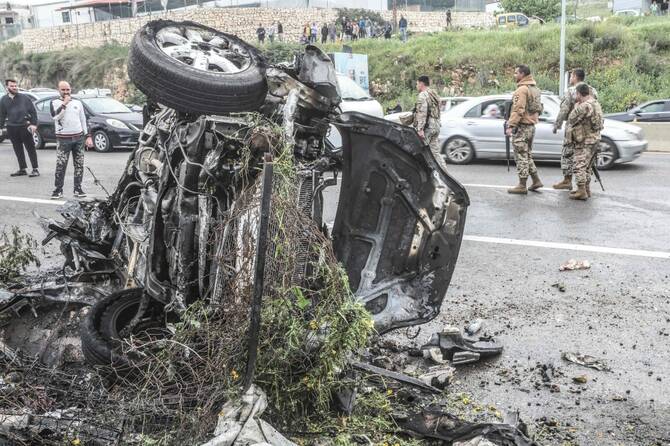
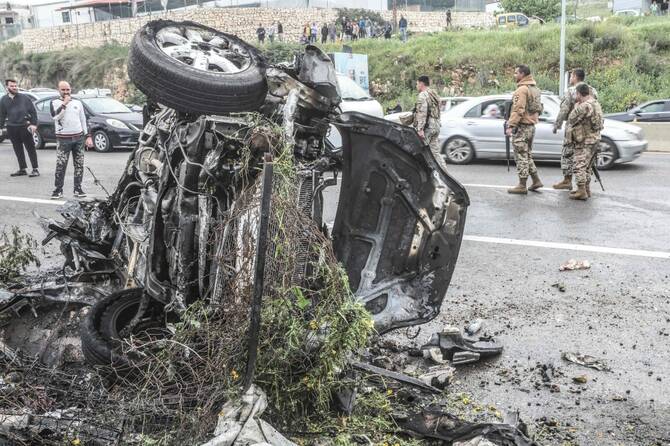
Lebanon’s state-run National News Agency said the two Israeli strikes hit two vehicles, one in the seafront town of Saadiyat and another on a coastal highway in neighboring Jiyeh, around 20 kilometers south of Beirut and outside Hezbollah’s traditional strongholds, AFP reported.
NNA also reported several other strikes across southern Lebanon.
Trump has urged Israel to scale back attacks in Lebanon, apparently to avoid undermining the ceasefire with Iran. Israel has not carried out airstrikes on the Beirut area since April 8, when it launched its heaviest attacks yet.
In a complaint to the United Nations, Lebanon’s Foreign Ministry said the death toll from the April 8 attacks stood at 303, including 30 children and 71 women. Israel has said the strikes killed more than 250 Hezbollah militants.
UN experts on Wednesday condemned the strikes.
Fighting in recent days has focused on the border town of Bint Jbeil. Israel said on Monday it had launched a ground assault against militants holed up there.
Hezbollah lawmaker Hassan Fadlallah, speaking in a televised news conference, said fighters had chosen “steadfastness and martyrdom so the enemy is not permitted to control Bint Jbeil.”
'A wrong path'
Tuesday’s meeting between Lebanon’s Washington ambassador and her Israeli counterpart was the first such direct contact in decades between the two governments, which have remained in a state of war since Israel was established in 1948.
Fadlallah said the meeting did not reflect Lebanon’s national identity or “the choices of its people.”
“Does the government not realize the danger of what it has undertaken? And does it understand that it has entered a wrong path that leads only to increasing the rift among the Lebanese?” Fadlallah said.
Fadlallah said Hezbollah wanted a comprehensive ceasefire, rather than a return to near-daily Israeli strikes and assassinations as seen after it agreed to a previous ceasefire with Israel in November 2024.
The Lebanese government has been seeking to disarm Hezbollah peacefully since that war. Any move by Lebanon to disarm it by force risks igniting conflict in a country shattered by civil war from 1975 to 1990.