

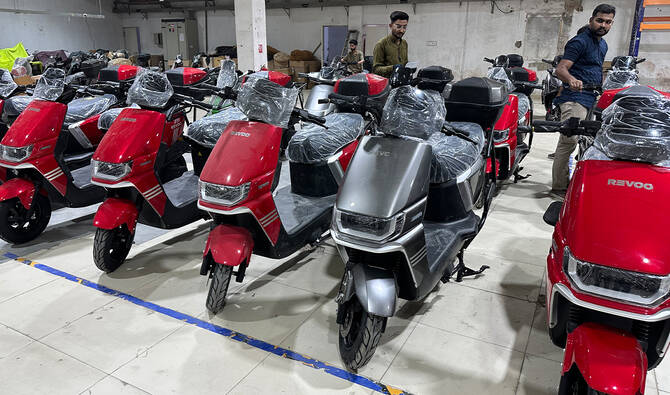

KARACHI: Muhammad Farooque dismounted from his motorbike and stepped into a brightly lit showroom off Akbar Road in Pakistan’s largest city, Karachi, where a row of sleek electric bikes stood silently in contrast to the rumble of petrol engines outside.
The 35-year-old bank cashier ran his fingers along the battery casing and digital display of one of the vehicles, weighing whether the unfamiliar technology could offer relief from Pakistan’s spiraling fuel costs.
Pakistan sharply raised fuel prices in two phases in March and early April as the Middle East conflict involving Iran, the US and Israel sent global oil prices soaring and disrupted shipments through the Strait of Hormuz, lifting petrol by 42.7 percent to Rs458.41 ($1.65) per liter and diesel by 54.9 percent to Rs520.35 ($1.87), one of the steepest increases in recent years.
On April 10, Prime Minister Shehbaz Sharif announced a partial rollback of the hikes, cutting petrol by Rs12 ($0.043) per liter and diesel by Rs135 ($0.49) per liter, with the new prices taking effect from April 11, even though fuel costs remained well above pre-war levels.
“Petrol is becoming increasingly expensive, and we don’t even know if it will remain available in the future. Supplies could become limited,” Farooque told Arab News at a dealership offering Yadea, one of the world’s top-selling Chinese electric two-wheeler brands.
“Electric is the future. Charging facilities are available in nearby areas, so commuting will be easier. That’s why we are shifting,” he said, adding his 125cc and 150cc Japanese motorbikes eat up more than 30 percent of his monthly income.
Pakistan, a country of more than 240 million people, relies heavily on motorcycles for daily transport, particularly in major cities where public transport options are limited. Two- and three-wheelers account for the vast majority of personal mobility, making fuel price changes immediately felt across households.
Motorcycle demand has surged in recent years. In fiscal year 2025, about 1.52 million units were sold, up from 1.15 million a year earlier, according to the Pakistan Automobile Manufacturers Association. The trend has continued into the current fiscal year, with sales rising 31 percent to 1.26 million units in the July-February period.
Industry players say the shift toward electric alternatives may persist even if geopolitical tensions ease and fuel prices stabilize, as consumers adapt to sustained cost pressures.
Electric scooters, meanwhile, are emerging as a potential buffer against inflation, which economists warn could rise from 7.3 percent in March to as high as 14 percent by June.
“The minimum fixed amount I spend on fuel is Rs20,000 ($72) at current prices. If I can save that and spend as much as Rs6,000 ($22) on electricity instead, it works well for me,” Farooque said.
Across the city, others are already making the switch.
Burhan Abbas, 37, rode away from a Revoo Pakistan showroom on a newly purchased electric scooter.
“Earlier, I used to ride a petrol bike, but fuel is no longer affordable. It has become too expensive, which is why I switched to an e-bike,” said Abbas, who manages a spare parts business for a foreign automobile firm in Karachi.
“It has many benefits, it’s easy to ride, there’s no petrol issue, and the savings are significant.”
Abbas estimates the switch will cut his fuel expenses by more than half.
“My monthly petrol expense was around Rs7,000 ($25). Now, with charging, it is about Rs1,000 to Rs2,000 ($7.2), so I save roughly Rs5,000 ($18),” he said.
SUPPLY STRUGGLES
Rising demand has begun to strain supply chains, with delivery times for electric bikes stretching to nearly a week from just a day previously.
“For the last three to four days, we have run out of stock. Electric scooters are simply not available,” said Muhammad Sabir Shaikh, a dealer for Yadea Pakistan.
“The models customers are asking for will only arrive after 15 to 20 days.”
Shaikh said Pakistan assembled about 100,000 electric motorbikes in 2025, a figure expected to rise sharply.
“Given the current situation, production could reach up to 300,000 units this year,” he said, adding that scaling up would require investment in local manufacturing of batteries and other components.
Around 65 companies in Pakistan have entered the electric two-wheeler market in recent years, including Yadea, Metro, Ramza and Revoo, reflecting growing competition in the sector.
“We have reached around 5,000 units (since Pakistan first increased petrol by Rs55 on March 6),” said Moiz Ahmed, a regional manager at Revoo Pakistan, which has a monthly production capacity of more than 8,000 motorbikes.
“Our goal now is to expand further and retain more customers so that more people transition to EVs.”
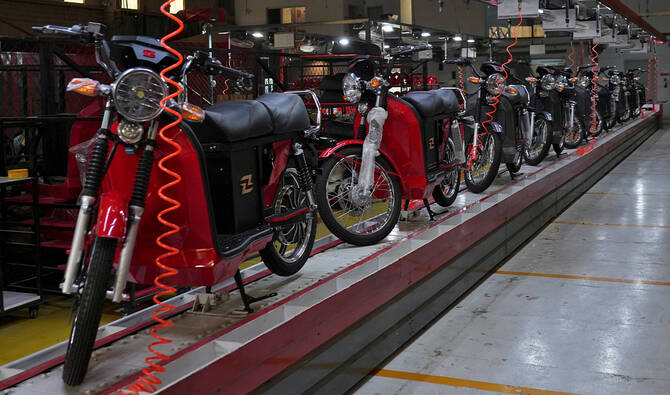
Ahmed said production lines were being expanded to meet demand, with electric motorcycle sales expected to exceed 50,000 units in the coming months.
WAR-DRIVEN SHIFT
Analysts say the current surge in demand could mark a turning point.
“EVs have been around for some time now, and a growing number of companies are entering the market,” said Abdul Azeem, head of research at Al-Habib Capital Markets.
“The next big market will be EVs, given the current situation. Even after the conflict subsides, we expect the EV market to expand rapidly.”
Pakistan has set a target to convert 30 percent of its vehicles to electric by 2030 as part of efforts to reduce carbon emissions and fuel imports.
“If we look at the conversion, it is already underway. Going forward, we can expect around 20-30 percent conversion, particularly in the two-wheeler segment,” Azeem said.
“Adoption will likely be faster in bikes than in cars.”


