


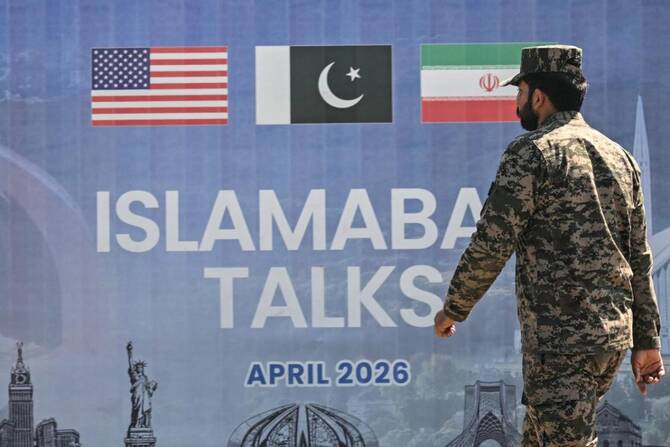

ISLAMABAD: Diplomats worked through back channels Tuesday to arrange a new round of talks between the United States and Iran after Washington enacted its blockade of Iranian ports, while Tehran threatened to retaliate by striking targets across the war-weary region.
US President Donald Trump said a second round of talks could happen “over the next two days,” telling the New York Post the negotiations could be held again in the capital of Pakistan.
United Nations Secretary-General Antonio Guterres concurred, saying it’s “highly probable” that talks will restart. He cited a meeting he had with Pakistan’s deputy prime minister, Ishaq Dar.
Meanwhile in Washington, the first direct talks in decades between the Israeli and Lebanese ambassadors to the US concluded on a productive note, according to the US State Department.
Opinion
This section contains relevant reference points, placed in (Opinion field)
An initial round of talks aimed at permanently ending the US-Iran conflict failed to produce an agreement last weekend. The White House said Iran’s nuclear ambitions were a central sticking point.
A US official said Tuesday that fresh talks with Iran were still under discussion and that nothing has been scheduled. The official spoke on condition of anonymity because they were not authorized to discuss sensitive negotiations.
Though the ceasefire appeared to hold, the showdown over the Strait of Hormuz risked reigniting hostilities and deepening the regional war’s economic fallout.
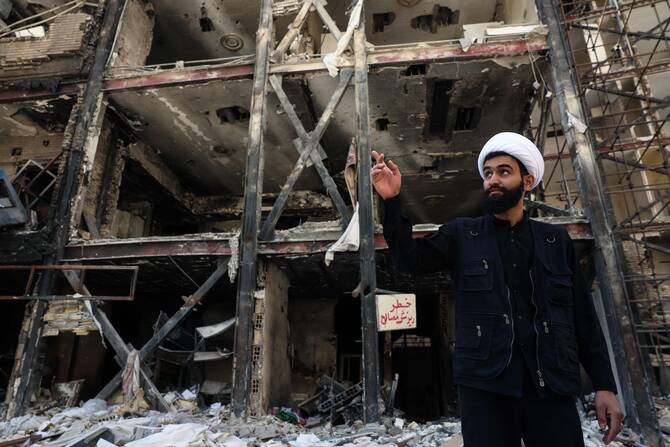
The war, now in its seventh week, has jolted markets and rattled the global economy as shipping has been cut off and airstrikes have torn through military and civilian infrastructure across the region.
The fighting has killed at least 3,000 people in Iran, more than 2,100 in Lebanon, 23 in Israel and more than a dozen in Gulf Arab states. Thirteen US service members have also been killed.
Tankers turned around after blockade took effect
The blockade is intended to pressure Iran, which has exported millions of barrels of oil, mostly to Asia, since the war began. Much of it has likely been carried by so-called dark transits that evade sanctions and oversight, providing cash flow that’s been vital to keeping Iran running.
Both the nature of enforcement and the extent to which ships will comply remained unclear Tuesday during the first full day of the blockade. Tankers approaching the strait Monday turned around shortly after it took effect, though one reversed course again and transited the waterway.
US Central Command said no ships made it past the blockade in the first 24 hours, while six merchant vessels complied with direction from US forces to turn around and re-enter an Iranian port on the Gulf of Oman.
US Treasury Secretary Scott Bessent said Chinese tankers will not be allowed passage through the strait. “So they’re not going to be able to get their oil,” he told reporters Tuesday on the sidelines of IMF-World Bank meetings.
In rare public criticism seemingly directed at Trump, Chinese President Xi Jinping said nations should “oppose the world’s retrogression to the law of the jungle.” Speaking during a reception for the Spanish prime minister, Xi said nations should work to “jointly safeguard genuine multilateralism.”
Since the start of the war, Iran has curtailed maritime traffic, with most commercial vessels avoiding the waterway.
Iran’s effective closure of the strait, through which a fifth of global oil transits in peacetime, has sent oil prices skyrocketing, pushing up the cost of gasoline, food and other basic goods far beyond the Middle East.
Trump has said that Iran’s control of the strait amounted to blackmail and extortion, and has threatened to destroy any Iranian military vessels that challenge the US blockade. Iran has threatened to retaliate against Arabian Gulf ports if attacked.
French President Emmanuel Macron and British Prime Minister Keir Starmer will co-chair a conference Friday for nations willing to deploy warships to escort oil tankers and container ships through the strait. The deployment will happen “when security conditions allow,” Macron’s office said Tuesday.


